

When someone asks, "How much do arborists charge?" they're not looking for a ballpark guess—they want a real number. Here in the Atlanta metro, costs can swing from $200 for a straightforward pruning job to over $2,000 for a tricky tree removal. It's best to think of it like any other specialized home repair; you're paying for certified expertise, strict safety protocols, and some seriously heavy machinery.
Your Quick Guide to Arborist Costs in Atlanta
To give you a snapshot of what to budget for, we put together a simple table. It breaks down the average price ranges for the most common tree services we handle in areas like Cumming, Johns Creek, and Roswell. This gives you a realistic financial starting point before we dig into all the little details that can shape your final quote.
Knowing these numbers helps you understand exactly what you're paying for.
Atlanta Arborist Services at a Glance: Average Costs
Here's a look at the estimated costs for common arborist services right here in the Metro Atlanta area. These figures should give you a solid baseline for projects in Cumming, Johns Creek, and Roswell.
| Service Type | Typical Price Range (Atlanta Metro) | Best For |
|---|---|---|
| Tree Pruning & Trimming | $200 – $700 | Improving tree health, shape, and safety by removing dead or overgrown branches. |
| Small Tree Removal | $250 – $600 | Removing trees under 30 feet tall that are dead, diseased, or poorly located. |
| Medium Tree Removal | $600 – $1,500 | Taking down trees between 30 and 60 feet, often requiring more equipment and labor. |
| Large/Hazardous Tree Removal | $1,500 – $3,000+ | Complex removal of trees over 60 feet, especially those near structures or power lines. |
| Stump Grinding | $100 – $400 | Grinding down the leftover stump below the soil line after a tree is removed. |
| Emergency Tree Service | $250/hour (minimums apply) | Addressing immediate hazards from storm-damaged or fallen trees, often after hours. |
| Tree Cabling & Bracing | $200 – $800 | Installing support systems to stabilize weak branches or multi-stemmed trees. |
Keep in mind, these are just averages. The true cost for your project will depend on the specifics we're about to cover.
Understanding National Averages and Local Realities
Before we get into Atlanta-specific pricing, it’s useful to see how our local market stacks up against national trends. Across the country, the cost for tree trimming and pruning falls into some pretty predictable buckets.
Most guides you'll find online report per-tree pruning averages between $200 and $700. Simpler jobs on small trees can be as low as $100, while massive or complex projects can easily top $1,500.
That big range comes down to factors we'll get into soon, like tree size, how easy it is to get to, and its overall health. On top of that, many certified arborists bill by the hour for consultations or highly specialized work. Looking at various 2025 tree service cost guides, you'll see that a certified arborist’s rate is typically $100–$250 per hour, usually with a one-hour minimum.
This national data gives us a solid baseline. In a competitive and dense urban forest like ours here in Metro Atlanta—from Milton all the way to Marietta—our local prices line up well with these figures. It just reflects the high demand for skilled, insured professionals who know what they're doing.
What to Expect in Forsyth, Cobb, and Gwinnett Counties
For homeowners in the northern suburbs, those numbers translate directly to everyday projects. For example, a routine pruning of a medium-sized oak in an Alpharetta front yard will probably land in the lower-to-middle part of that $200-$700 range. On the flip side, dealing with a hazardous, storm-damaged pine leaning toward a house in East Cobb is a whole different story. That job requires more equipment and involves more risk, which naturally pushes the cost toward the higher end.
So, what are you actually paying for? Here’s a quick summary of what those price points cover:
- Expertise: An ISA Certified Arborist’s deep knowledge of tree biology and safety.
- Equipment: The use of bucket trucks, powerful wood chippers, and all the necessary safety gear.
- Insurance: This is a big one. It includes critical liability and worker's compensation coverage to protect you and your property.
- Labor: A skilled crew trained to work safely and efficiently around your home and landscape.
This initial overview should help you start to understand the different line items you'll see on a professional arborist's estimate.
Breaking Down Costs for Common Tree Services
Not all tree work is created equal, and the price tag definitely reflects that. To really get a handle on what an arborist might charge, you have to look at the specific service you need. Every job calls for a different mix of skill, equipment, and time, and all of those factors get baked into your final quote.
It's a lot like hiring a contractor for your home. Painting a small bedroom is a world away from a full kitchen remodel in terms of cost and complexity. The same idea applies to tree care. A simple trim is one thing; a complex removal of a massive, ancient oak is another beast entirely.
Tree Pruning and Trimming Costs
Pruning is probably the most common request we get, but even this service isn't one-size-fits-all. The goal of the prune is what really drives the price. Are you just hoping to get a little more sunlight on your lawn, or do you need to create critical clearance over your roof?
Here are a couple of common pruning types and how their costs can differ:
- Crown Thinning: This is where we selectively remove smaller branches throughout the tree's canopy. The idea is to reduce the density, which lets more sunlight filter down and improves air circulation—it’s like giving your tree a haircut so it can breathe better and stay healthy.
- Crown Raising: This one is all about clearance. An arborist will carefully remove the lowest branches of a tree to create space over a sidewalk, driveway, or your house. This is a frequent request in neighborhoods like those in East Cobb, where beautiful, mature trees start to hang a little too low over living spaces.
Because crown raising often involves cutting larger, heavier branches and demands absolute precision to avoid property damage, it almost always costs more than a standard crown thinning job.
This infographic gives a great visual breakdown of typical cost ranges, from simple hourly work to the most complex removals.
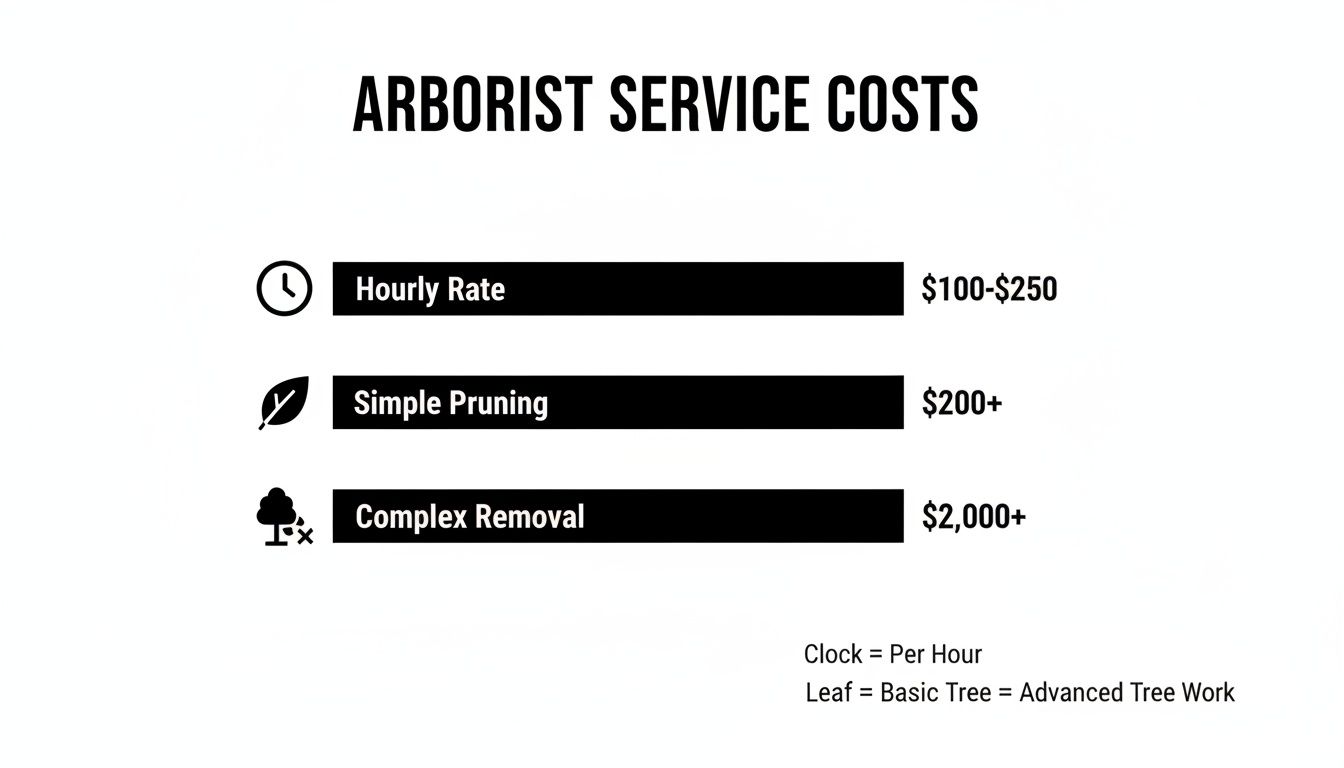
As you can see, the job's complexity is the number one driver of cost. Specialized, high-risk work will always command the highest prices.
Tree Removal Pricing Tiers
When a tree has to come down, its size is the single biggest factor that determines the cost. A 30-foot Leyland cypress standing in an open front yard in Johns Creek is a pretty straightforward job. The crew can get equipment in easily, fell the tree in a controlled way, and clean up without a fuss.
Now, imagine an 80-foot Southern red oak leaning precariously over a home in Roswell. That job is in a completely different league. It demands a highly skilled team, probably a crane, and a meticulous, piece-by-piece disassembly of the tree to guarantee no damage to the property. The risk, equipment, and time involved are exponentially greater, and the price will absolutely reflect that. Industry data shows that while routine trimming often falls between $75 and $900 per tree, a full tree removal can range anywhere from $200 to over $5,000 based on these exact factors. You can dive deeper into the specifics of arborist cost breakdowns from Angi.
The Cost of Stump Grinding
After a tree is removed, you’re left with the stump. Just leaving it there can be an ugly tripping hazard. Stump grinding is the go-to solution, and its cost is usually figured in one of two ways:
- Per Stump: If you just have one or two stumps, most arborists will charge a flat fee for each one, often with a minimum service charge.
- Hourly Rate: If you have a bunch of stumps to clear, like on a lot in Forsyth County, it might be cheaper for the arborist to just charge an hourly rate for the grinder and operator.
The stump's diameter and the type of wood also play a role—a dense hardwood stump takes a lot longer to chew through than a soft pine.
Key Takeaway: A quote for tree removal doesn't automatically include stump grinding. Always ask your arborist if this service is bundled in or if it will be a separate line item on the estimate. This simple question can save you from a surprise bill later.
Emergency Tree Service Premiums
Storms are just a fact of life here in the Atlanta area, and they often leave a trail of destruction. When a tree comes down on your house or blocks your driveway in the middle of the night, you need help right now. That's where emergency tree services come in.
This kind of urgent work always comes at a premium, and for good reason:
- After-Hours Labor: Crews are being called out away from their families, often late at night or on weekends, which means higher wages.
- Increased Risk: Working in the middle of a storm with unstable trees, downed power lines, and debris is far more dangerous than a scheduled job on a calm, sunny day.
- Urgency and Demand: After a big storm blows through, the demand for qualified arborists goes through the roof. The ability to respond immediately is a specialized service, and it's priced accordingly.
While it costs more, paying a professional for emergency service is the only safe way to secure your property and stop further damage. Trying to tackle a massive, storm-damaged tree yourself is incredibly hazardous. Please don't do it.
The Key Factors That Influence Your Final Bill
Ever wonder why your neighbor in Milton paid a certain price for tree removal, but your quote for a similar-looking tree was completely different? The answer is simple: no two tree jobs are ever the same. When an arborist looks at your tree, they aren't just seeing wood and leaves; they're running a full risk and logistics analysis in their head.
It’s a bit like a surgeon's fee. A routine procedure is one price. But a high-risk operation on a patient with complications? That requires specialized tools and a bigger team, and the cost reflects that. We arborists follow the same logic, and once you understand the variables, you'll know exactly what drives your final bill.

Tree Size and Height
This is the big one. A taller, wider tree means more time, more labor, and more equipment to safely bring it down or prune it. A crew might spend the better part of a day carefully dismantling a 70-foot oak piece by piece. On the other hand, a 25-foot decorative pear tree might be done in just a couple of hours.
The sheer volume of wood and brush is also a huge factor. Bigger trees create a mountain of debris, which adds to the time and cost for cleanup and hauling.
Species and Health
Believe it or not, the type of tree matters. A towering, multi-trunk water oak is a far more complex and dangerous puzzle to solve than a straight, single-trunk pine of the same height. Hardwoods like oak are dense and heavy, making every single cut more demanding on both the crew and the chainsaws.
Just as important is the tree's health. A healthy, stable tree is predictable. A dead or rotting tree? That’s a major liability. The wood can be brittle and snap unexpectedly, raising the risk for our climbers and ground crew. That extra danger has to be factored into the price.
Site Accessibility and Location
Where the tree stands on your property can have a massive impact on the quote. In fact, this single factor can sometimes double the cost of an otherwise identical job.
Just think about these common challenges we see in the Atlanta suburbs:
- Front Yard vs. Backyard: A tree in the front yard with wide-open street access is a cakewalk. But a tree in a fenced-in Marietta backyard might mean the crew has to haul every piece of equipment in and every branch out by hand. That’s a ton of extra labor.
- Terrain: Is the tree on a flat lawn or a steep, slippery hill? Working on uneven ground is slower, harder, and more hazardous, which naturally adds to the cost.
- Equipment Access: Can we drive a bucket truck right up to the tree? If not, the job relies entirely on skilled climbers to get up into the canopy, which is a more time-consuming and physically demanding process.
An arborist has to get their team and tools to the tree safely. If we have to navigate narrow gates, sheds, or delicate landscaping, all that extra time and effort will be reflected in your estimate.
Proximity to Structures and Hazards
This is where the risk factor really skyrockets. A tree standing alone in an open field is a simple removal. But a tree with massive limbs hanging directly over your roof, a swimming pool, or—worst of all—power lines is a high-stakes operation.
Every cut has to be meticulously planned. We use specialized rigging techniques to carefully lower heavy limbs to the ground without causing a scratch. This precision work requires a highly experienced crew and adds significant time to the project. The higher the risk of property damage, the more you should expect to pay for the expertise needed to prevent it.
The concept of various factors influencing a service's price isn't unique to arboriculture. To see how complex pricing models work in other industries, you can find valuable insights by exploring an analysis of how much search engine optimisation costs.
Cleanup and Permit Requirements
Finally, the little details in the scope of work affect the total. Does the quote include cutting the wood into firewood, hauling away every twig, and raking the yard clean? Or is cleanup on you? Make sure this is clearly spelled out.
Also, keep in mind that some cities in Cobb or Gwinnett County require permits for removing larger trees. This usually just adds a small administrative fee to the overall cost, but it's something to be aware of.
Putting It All Together: Real-World Pricing Scenarios in Metro Atlanta
Let's move past the averages and look at how these numbers play out on actual job sites. An abstract price list is one thing, but seeing how factors like tree access, risk level, and specific tasks come together on a real project tells the whole story.
These scenarios are pulled from the kind of work we do every single week in neighborhoods all over the Atlanta suburbs. Each one breaks down the problem, our solution, and the estimated cost, giving you a clear window into how a professional quote gets built. This should help you picture a similar job on your own property and understand how the final price takes shape.
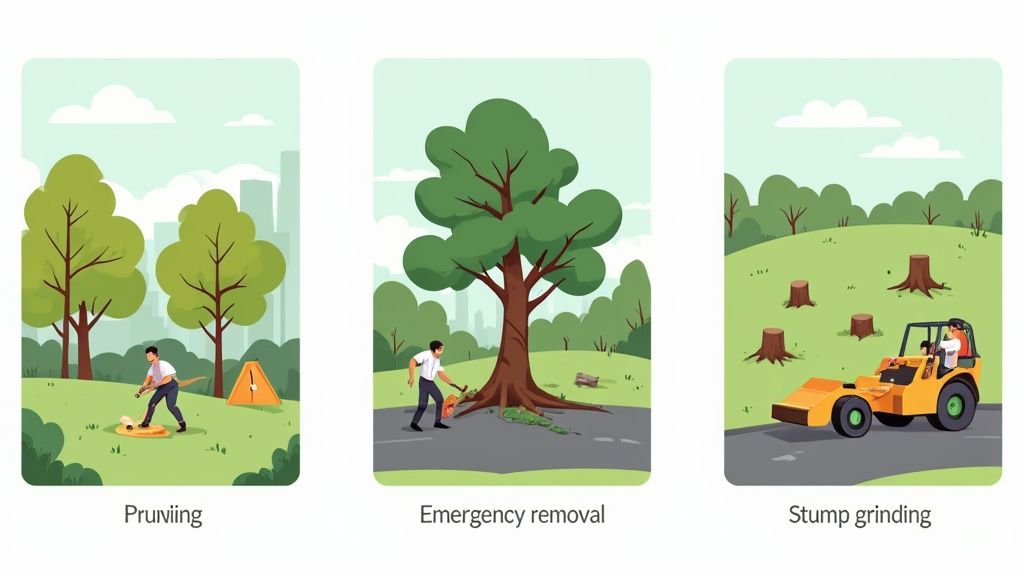
Scenario 1: Pruning Two Overgrown Bradford Pears in Roswell
A homeowner out in Roswell has a couple of mature Bradford pear trees that have gotten a little out of hand. They’re casting too much shade on the lawn and the lower branches are hanging right over the patio, making it hard to enjoy the space. The goal is to thin them out and lift the canopies.
- The Job: Prune two medium-sized (about 40-foot) Bradford pears.
- Key Factors: The good news is the trees are healthy. Even better, the backyard has a wide gate, so we can get our bucket truck in with no problem. Since no major limbs are hanging directly over the house, it's a low-risk job.
- The Process: Our crew rolls in the bucket truck for efficient access to the canopies. They’ll perform a crown thinning to let more sunlight through and a crown raising to create about 12 feet of clearance over the patio area. All the branches get chipped right on-site, and we finish with a thorough rake and clean-up.
- Estimated Cost: $550 – $750. Because the access is so easy and the risk is minimal, a two-tree job like this stays on the lower end of the pricing scale.
Scenario 2: Emergency Removal of a Storm-Damaged Pine in Cumming
A nasty thunderstorm just rolled through, and a homeowner in Cumming has a big problem. A large pine tree in their front yard split right down the middle. A huge section is now leaning precariously over their driveway, trapping their cars and blocking the way to their home. They called us late in the evening, needing help fast.
- The Job: Emergency removal of a dangerous, storm-damaged pine tree (around 60 feet tall).
- Key Factors: This is a textbook emergency. The immediate danger and the after-hours call automatically classify it as urgent. That tree is unstable, which means we have to use extreme caution and technical rigging to keep it from coming down unpredictably.
- The Process: We dispatch a specialized crew immediately. They use a system of ropes and rigging to secure the leaning section before carefully dismantling it in small, manageable pieces. Once the immediate threat is gone, the rest of the tree is brought down safely. The priority is making the area safe, so the major debris cleanup is scheduled for the next day.
- Estimated Cost: $1,800 – $2,500. The higher price tag here is a direct result of the emergency dispatch fee, the significantly higher risk of working on an unstable tree, and the advanced technical skills needed to do it safely. To learn more about how hazards affect the bottom line, check out our guide to the cost of tree removal in Atlanta.
Scenario 3: Clearing Stumps for a New Lawn in Alpharetta
A family just bought a new property in Alpharetta and they're excited to put in a beautiful lawn. The only problem? The lot is littered with six old stumps left behind by the previous owner. They range in size from a small 10-inch stump to a massive 30-inch oak stump.
- The Job: Grind six stumps of various sizes to get the yard ready for new landscaping.
- Key Factors: The cost here is driven almost entirely by the number and size of the stumps. The lot is wide open and flat, which gives our stump grinding machine perfect access. No obstacles.
- The Process: Our operator brings in a powerful stump grinder and goes to work on each one, chewing them down to about 6-8 inches below grade. This is deep enough to lay topsoil and sod right over the top. The leftover wood chips are raked into clean piles, perfect for the homeowner to use as mulch in their new flower beds.
Cost Breakdown:
- Small stumps (3): ~$125 each
- Medium stump (1): ~$175
- Large oak stump (1): ~$250
- Very large stump (1): ~$325
Total Estimated Cost: $1,000 – $1,200. You almost always get better value by bundling multiple stumps into a single visit rather than tackling them one by one. This price reflects that volume-based approach.
How to Get Accurate Quotes and Avoid Hidden Fees
Navigating the world of tree service quotes can feel a bit like the Wild West, but getting a clear, accurate estimate is the most important step you'll take. This is your game plan for hiring a pro with total confidence, so you know exactly what you're paying for before any work starts.
Let's start with the golden rule: never, ever accept a verbal quote. It’s just not worth the risk.
Your best move is to get at least two to three written, itemized estimates from different companies. This is the only way to compare apples to apples, not just the final number. A suspiciously low bid might look great on paper, but it often means they're cutting corners on critical things like insurance or proper cleanup—which can end up costing you a fortune down the road.
What Every Professional Quote Must Include
A legitimate quote is more than just a price scribbled on a notepad. It’s a professional document that protects both you and the arborist, acting as a mini-contract that lays out every single detail of the job.
Here’s a simple checklist of non-negotiables your quote should have:
- Proof of Insurance: You need to see certificates for both general liability and worker’s compensation. This is what shields you from financial disaster if an accident damages your home or, worse, injures a crew member on your property.
- ISA Certification Details: A professional will proudly display their ISA (International Society of Arboriculture) certification credentials. It’s your assurance that you’re dealing with a genuine tree care expert, not just someone who owns a chainsaw.
- A Clear Scope of Work: The estimate must break down exactly what they're going to do. Will they haul away every branch and log? Is stump grinding part of the deal? Are they cutting the wood into firewood for you? Any ambiguity here is a huge red flag.
- A Firm Total Cost: The final price should be clearly stated and locked in. Be wary of estimates that use vague hourly rates without a cap, as those costs can easily balloon out of control.
A detailed, transparent quote is the hallmark of a professional operation. If a company gets cagey about putting everything in writing, that’s your signal to walk away. It usually means they aren't confident in their process or aren't being upfront about their pricing.
Choosing the right arborist is a lot like hiring any skilled professional. It's about vetting them properly to ensure you get maximum value and avoid headaches. You can learn more about these strategic hiring practices for service providers in this handy guide.
Red Flags to Watch Out For
Knowing what a good quote looks like is half the battle. Knowing what to run from is the other half. Keep an eye out for these common tactics from less-than-reputable outfits.
Be cautious of anyone who:
- Offers "Door-to-Door" Specials: Reputable arborists are almost always busy with scheduled work; they don't go door-to-door looking for jobs. This is a classic tactic used by storm chasers to prey on worried homeowners.
- Pressures You for a Fast Decision: A real pro will respect your need to review their estimate and compare it with others. High-pressure sales pitches are a clear sign that something’s off.
- Provides a Vague or Incomplete Quote: If the estimate just says "tree work" with a price, it's not a real quote. That vague language leaves the door wide open for surprise charges and arguments later.
Getting a proper quote is your first step toward a safe and successful tree care project. We make this process easy by providing clear, detailed free tree service estimates for homeowners all across the Metro Atlanta area. This gives you the power to compare bids intelligently and understand why a slightly higher price from a fully insured, certified arborist is really an investment in your safety and peace of mind.
Why Investing in a Certified Arborist Actually Saves You Money
It's easy to look at the estimate from a professional arborist and think it's just another expense. But when we're talking about the massive, living assets on your property, paying for real expertise is one of the smartest financial decisions you can make. This isn't just about trimming a few branches; it’s about protecting your home and preventing incredibly costly problems down the road.
Think of it like this: a cheap, uninsured "tree guy" might save you a few hundred dollars today, but they could easily cost you thousands tomorrow. One wrong cut can invite diseases that slowly kill a beautiful, mature oak. A lack of proper safety gear and rigging can send a heavy limb crashing through your roof. A certified professional knows the science—the tree biology, the proper cutting angles, the safety protocols—to sidestep these disasters entirely.
The Value of a Certification
The residential tree care industry is a serious business. With the global market projected to hit $21.34 billion by 2032 and North America leading the charge, the demand for truly skilled labor is huge. That demand, coupled with the sky-high costs of insurance and specialized equipment, is why expert services come at a premium. You can get a better sense of how market scale influences arborist pricing from recent industry analysis.
Ultimately, that higher upfront cost is your best defense against risk.
An ISA Certified Arborist brings a depth of knowledge that goes far beyond what a basic tree trimmer can offer. They're trained to spot the subtle signs of disease, hidden structural weaknesses, or early pest infestations that most people would miss. Catching these problems early is the key to preventing them from becoming full-blown, expensive emergencies.
When you hire a true expert, you're paying to have the job done right the first time, protecting your property's value and structural integrity. The peace of mind that comes from knowing the work is backed by professional credentials and comprehensive insurance is worth every penny.
To see what this level of expertise can mean for your property, learn more about our team of certified arborists in the Atlanta area.
Your Top Questions About Arborist Costs, Answered
Even with all the numbers laid out, you probably still have a few questions rattling around. That’s completely normal. To help clear things up, here are the straight-up answers to the most common questions we hear from homeowners around Atlanta.
Is It Cheaper to Remove a Tree in the Winter?
It can be, yes. Once winter rolls in, the demand for tree work usually takes a bit of a dip. This can sometimes mean you’ll find more competitive pricing or at least have an easier time getting on the schedule.
Think about it: once a big oak or maple drops its leaves, the entire branch structure is laid bare. This makes it much easier for our arborists to see what they’re doing, plan their cuts efficiently, and speed up the cleanup process since there's far less leafy debris to chip and haul. As a bonus, frozen ground can act like a natural shield, protecting your lawn from the weight of our equipment.
Does Homeowners Insurance Cover Tree Removal?
This is a big one, and the answer is almost always, "it depends." Most standard insurance policies will step in to cover tree removal costs only if a healthy tree is knocked over by a covered event—like a lightning strike or a major windstorm—and it lands on a structure like your house, garage, or fence.
What they typically won't cover is the removal of a tree that was already dead, dying, or clearly a hazard before it fell. Taking down a risky tree is considered proactive maintenance, which falls on you as the homeowner. Your best bet is to always pull out your policy and check the fine print.
Keep This in Mind: If a storm blows a tree down in your yard but it doesn't hit anything, insurance generally won't pay for the cleanup. Their job is to cover the cost of repairs to your property, not just tidying up the lawn.
What Is the Difference Between an Arborist and a Tree Trimmer?
While the terms are often used interchangeably, the level of expertise is worlds apart. A "tree trimmer" or "tree cutter" usually focuses on one thing: cutting branches. Their training might not go much further than knowing how to safely fire up a chainsaw.
An ISA Certified Arborist, on the other hand, is a true tree health professional—think of us as tree doctors. We've had to pass a rigorous exam covering everything from tree biology and soil science to disease diagnosis and advanced safety protocols. We don't just cut; we diagnose problems, prescribe treatments, and perform complex pruning or removals with a deep understanding of how our work will affect the tree's health for years to come.
Can I Get a Discount for Multiple Trees?
Absolutely. In fact, bundling several tree projects into one job is one of the smartest ways to save money. It’s a huge efficiency win for our crew.
When we can tackle everything in a single visit, we only have to go through the process of mobilizing our heavy equipment, setting up safety zones, and handling the paperwork once. That saves us a significant amount of time and fuel, and we’re always happy to pass those savings on to you with a lower per-tree price.
Ready to get a clear, expert opinion on your tree care needs? The ISA Certified Arborists at Richmond Tree Experts GA provide detailed, no-obligation estimates across Cumming, Johns Creek, Milton, Alpharetta, and the entire North Atlanta area. Contact us today to ensure your trees are in the best hands.
Not sure what your tree needs? Richmond Tree Experts has worked on Marietta and Metro Atlanta trees since 1985, and every job is looked at by an ISA Certified Arborist before it is priced. Start with an ISA Certified Arborist evaluation, or see everything we do: tree removal, stump grinding and arborist services across Cobb, Fulton, Cherokee, Gwinnett and DeKalb counties (service areas).
Call (770) 974-3964, 7am to 11pm every day, or request an estimate online.

