

Thinking about adding a new tree to your property? It's a fantastic investment in your home's future, but the first question that usually pops up is a practical one: "What's this going to cost me?"
In the Atlanta area, the price tag for planting a tree can range from $300 to $800 if you bring in the pros. If you're more of a hands-on type and decide to do it yourself, you're looking at a much lower out-of-pocket cost, usually between $50 and $150. That mostly covers the tree itself and any soil goodies you might need.
Your Quick Guide to Tree Planting Costs in Atlanta
Deciding to plant a tree is exciting. It adds curb appeal, provides shade, and can even boost your property value. But understanding the cost is the first step in getting your project off the ground, and it really boils down to one key choice: grabbing a shovel yourself or calling in a certified expert.
For homeowners across North Georgia—whether you're in Cumming, Johns Creek, Milton, or Roswell—this decision is about more than just the initial price. It's a classic trade-off between your time, your back, and the long-term health of your new tree. Hiring a professional service with an ISA Certified Arborist on staff ensures the job is done right from the very beginning. They know exactly how to handle Georgia's stubborn clay soil and plant the tree at the perfect depth, giving it the best possible shot at a long, healthy life.
DIY vs. Professional: A Quick Comparison
Going the DIY route is, without a doubt, the most budget-friendly option upfront. Your main costs are the tree from a local nursery and maybe a few bags of soil conditioner or mulch. But don't forget what else it requires: your time, the right tools, and a bit of know-how. One wrong move—planting too deep, for example—can be a fatal mistake for a young tree.
On the other hand, hiring a professional service like Richmond Tree Experts is an all-inclusive investment in your tree's future. That higher price tag covers a lot more than just the tree and the labor. You're paying for an arborist's expertise, their specialized equipment, delivery, and most importantly, the peace of mind that comes from knowing the job is done to professional standards. Many pros even offer a guarantee on the tree's survival, which protects your investment.
This chart gives you a simple side-by-side look at the cost ranges for each approach.
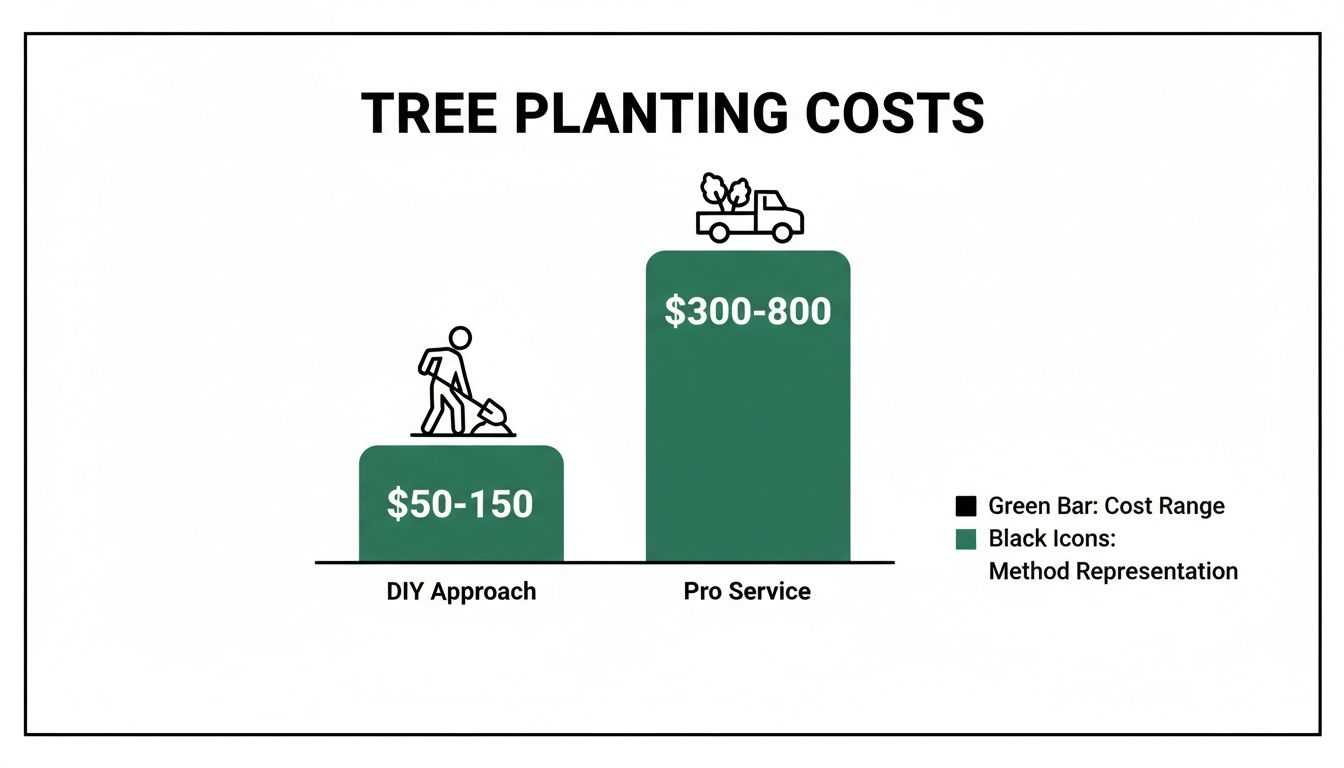
As you can see, the professional route costs more initially, but it's a solid strategy for safeguarding the health and longevity of your new tree. If you need a hand picking the perfect species for your yard, our guide on the common types of trees in our area is a great place to start.
To help you see the breakdown even more clearly, here's a quick look at what goes into each estimate.
Estimated Tree Planting Costs in Atlanta at a Glance
This table offers a quick summary of potential costs for planting a single tree in the greater Atlanta area. It breaks down the difference between tackling the job yourself and hiring a certified arborist to handle it for you.
| Cost Factor | DIY Approach (Estimated) | Professional Service (Estimated) | Notes |
|---|---|---|---|
| Small Tree (Under 6 ft) | $25 – $75 | $300 – $500 | Professional service includes sourcing, delivery, labor, and expertise. |
| Medium Tree (6-12 ft) | $75 – $200 | $500 – $800+ | Larger trees require more labor and specialized equipment for transport/planting. |
| Soil & Mulch | $20 – $50 | Included | Professionals typically include high-quality soil amendments and mulch in their price. |
| Tools & Equipment | $0 – $100+ | Included | DIY cost depends on what tools you already own (shovel, wheelbarrow, etc.). |
| Labor & Expertise | Your Time | Included | Professional cost covers arborist expertise, ensuring correct planting depth and location. |
| Delivery Fee | Varies (or self-haul) | Included | Transporting larger trees can be a significant hidden cost for DIYers. |
| Guarantee/Warranty | None | Often Included | Many professional services offer a warranty on the tree's survival for a set period. |
Keep in mind that these are general estimates. The final cost will always depend on the specific tree you choose, the accessibility of your property, and any extra prep work needed to give your new tree the best start.
Breaking Down Professional Tree Planting Costs
When you get a quote from a professional tree service, you’re looking at a lot more than just the price of a sapling and a few hours of digging. It’s easy to get sticker shock if you don't know what's involved, but understanding the breakdown clears things up and shows you the real value in hiring an expert.
Think of it like any other project around the house. You're not just paying for lumber and nails; you're investing in the skill, specialized tools, and know-how that ensures the job gets done right. The total cost is really a bundle of services designed to give your new tree the best possible shot at a long, healthy life, especially here in North Georgia's unique soil and climate.
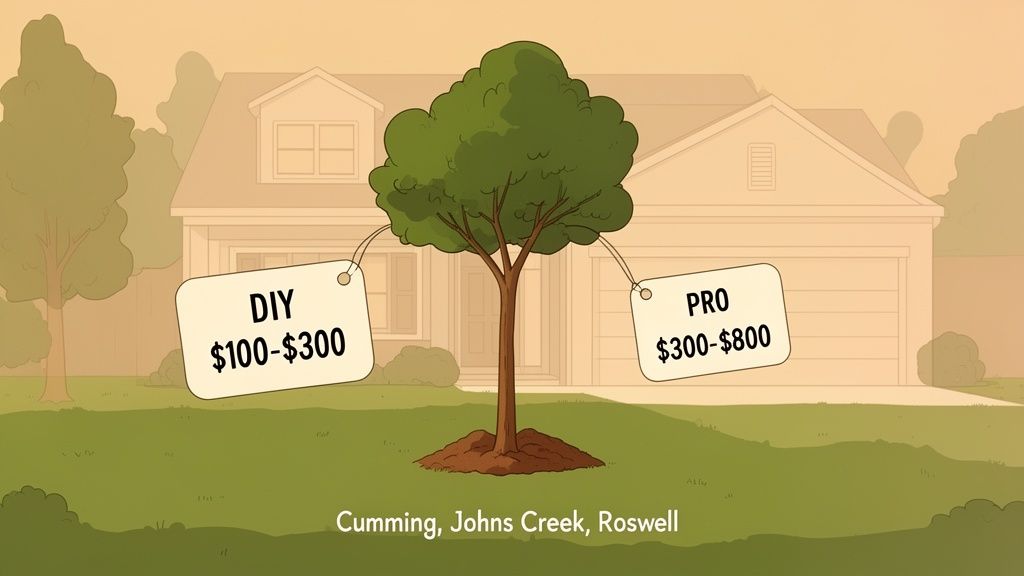
The Price of the Tree Itself
The biggest variable in your quote will almost always be the tree you choose. This boils down to two main things: its size and its species.
-
Tree Size: Nurseries sell trees by their container size, which is measured in gallons. A smaller, younger 15-gallon tree might run you $150 to $250. If you want a more mature 30-gallon tree that makes a bigger impact right away, you can expect to pay anywhere from $300 to $500 or more. Bigger trees took more time and resources to grow, and they’re a lot heavier to move and plant.
-
Tree Species: Common, fast-growing shade trees like a classic Oak or Maple are usually on the more affordable side. But if you’ve got your heart set on something special like a prized Japanese Maple or another unique ornamental variety, the price tag will reflect its rarity and slower growth rate.
Labor Fees and Arborist Expertise
This is where you get what you pay for. When you hire a company with ISA Certified Arborists on staff, you're tapping into a deep well of knowledge. That expertise is often the difference between a tree that thrives for decades and one that struggles and dies within the first year.
Across the Atlanta metro, from Forsyth to Gwinnett County, labor costs typically fall between $75 and $150 per hour for each crew member. This fee covers more than just the hard work of digging. It covers the critical thinking an arborist does on-site—like making sure the tree is planted at the perfect depth (a classic DIY mistake) and positioning it so its future roots and branches won't tangle with utility lines or your home's foundation.
An arborist’s expertise is a down payment on your tree’s future. They are trained to see the long-term picture, from root development in Georgia’s clay soil to the tree's mature canopy size, ensuring your investment grows for decades.
Equipment and Delivery Charges
Getting a tree, especially a larger one, from the nursery to your yard and into the ground safely takes some serious gear. This part of your quote covers a few key things:
- Transportation: A delivery charge to safely haul the tree to your property, whether you're in East Cobb or Cherokee County.
- Specialized Machinery: The use of equipment like mini-skid steers or tree dollies to move a heavy root ball without damaging the delicate roots.
- Tools: All the professional-grade shovels, augers, and soil testing kits needed to create the perfect home for your new tree.
These operational costs are all wrapped into the final price to make sure the job is done right. And when you're thinking about professional tree planting, it's helpful to remember the bigger picture of what experts bring to your yard. You can explore the Benefits Of Professional Landscaping Services For Homeowners to see how this kind of investment boosts your entire property's value and appeal.
Additional Services That Influence Your Total Cost
When you start asking, "how much to plant a tree," you'll quickly find the answer goes way beyond just the tree itself and the labor to dig a hole. The final price tag often includes a few crucial add-on services that are designed to give your new tree the absolute best shot at a long, healthy life.
These aren't just upsells. Think of them as a strategic investment. You wouldn't build a house on a shaky, unprepared foundation, right? The same logic applies here. If the spot you’ve picked isn't properly prepped, you’re limiting the tree's potential right from day one.
Preparing the Perfect Planting Site
Before any new tree goes into the ground, we have to clear out any obstacles. In established yards across Roswell and Marietta, this usually means dealing with the leftovers from an old tree or previous landscaping. Getting the site ready isn't optional—it's essential for a healthy root system.
Here are the most common site prep tasks we handle:
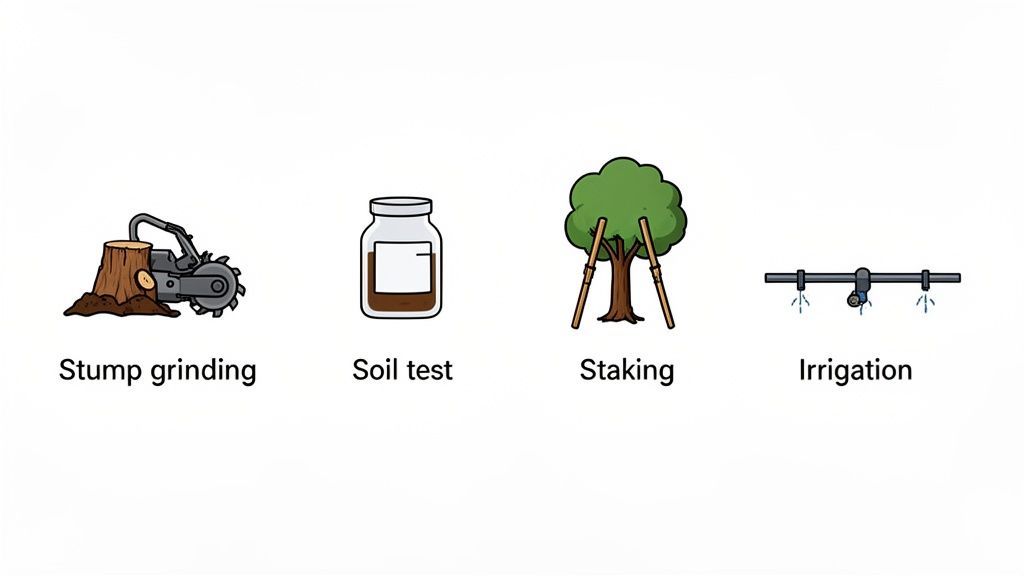
- Stump Grinding: If you're replacing a tree, the old stump has to go. We grind it down well below the soil surface, which gets rid of the old root system and prevents fungus or rot that could infect your new tree. This typically costs between $100 and $400, depending on how big and stubborn the stump is.
- Root System Removal: Even after the stump is gone, a tangled web of old roots can stick around, hogging water and nutrients. Our crew will clear out these major roots to give your new tree a clean slate to work with.
- Land Clearing: For bigger jobs or new lots, you might need more intensive work. Before planting, it's worth looking into professional site preparation and land clearing services to make sure the ground is truly ready for new life.
Giving Your Soil a Boost
Let's talk about Georgia's famous red clay. It’s dense, heavy, and can be a real workout for new roots trying to push through. While it’s part of our landscape, it often lacks the perfect mix of nutrients and drainage that a young tree needs to really take off. That's where soil testing and amendments come in.
An arborist might suggest a soil test to see exactly what you're working with. Based on those results, we can mix in organic compost or specific conditioners to loosen up the clay, improve drainage, and add vital nutrients. This service might add $50 to $150 to the job, but it dramatically boosts the tree's odds of not just surviving, but thriving.
Investing in soil amendments is like giving your tree a fully-stocked pantry. It directly tackles the unique challenges of our local soil and sets the stage for decades of strong, healthy growth.
Support and Hydration for the First Year
Once the site is clear and the soil is just right, the final touches help keep the tree stable and watered during its critical first year. These steps are especially important for larger trees or for those planted in the wide-open, windy areas you find in Forsyth or Cherokee County.
- Staking: A big tree with a full canopy can catch a lot of wind, making it lean or even snap. Professional staking ($75 – $200) uses special materials that support the trunk without choking it or damaging the bark, giving the roots time to anchor themselves securely.
- Initial Irrigation Setup: Those first few months are all about water. We can install a simple drip line or a tree watering bag ($50 – $150) to deliver water slowly and directly to the root ball. This encourages deep root growth and stops water from just running off the surface.
While these extras add to the initial cost, they are proactive measures that protect your investment for the long haul. To make it more manageable, we find many homeowners are interested in payment plans. You can learn more about the different options available on our page about tree service financing to see how it might fit your budget.
The True Cost of DIY vs. Professional Value
When you're figuring out how much to plant a tree, the price tag you see at the nursery is just the opening line of the story. It's tempting to think you'll save a bundle by going the DIY route, but the true cost often shows up months, or even years, down the road. The real comparison isn’t about the initial cash you spend; it’s about long-term value and sidestepping expensive mistakes.
A weekend trip to a local nursery, a new shovel, and a few bags of soil might only set you back $100 to $200. But that number doesn't tell the whole story. What about the hidden costs that creep in? Did you need to rent an auger to get through that tough Georgia clay? Buy a wheelbarrow? And what about the very real risk of hitting a buried utility line? A single slip-up there can lead to repairs costing thousands, wiping out any savings in an instant.
The Ultimate Cost of a Failed DIY Project
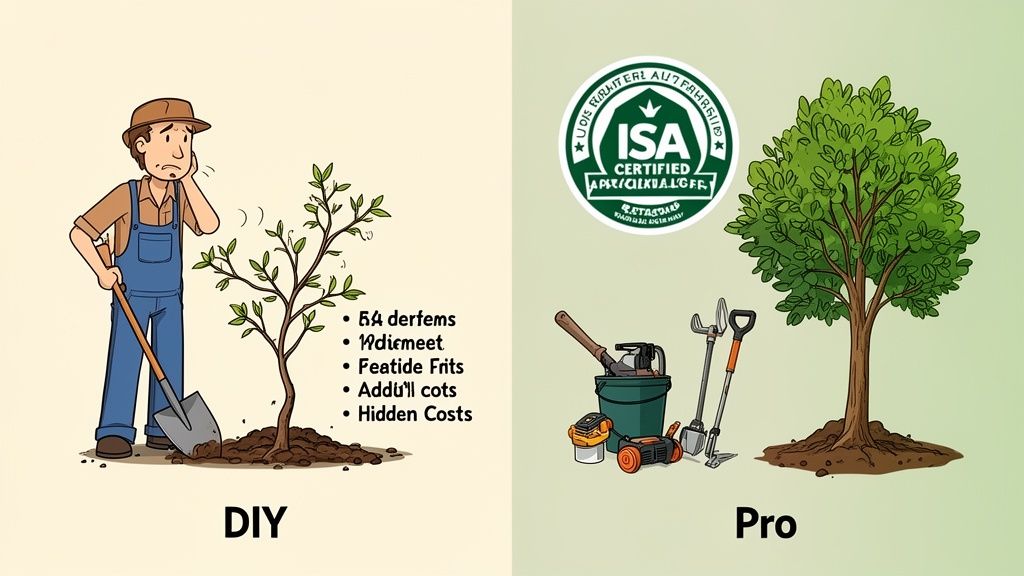
Honestly, the biggest hidden cost of DIY tree planting is total failure. A tree planted too deep, with its roots still balled up and compacted, or stuck in the wrong spot is a tree that's set up to struggle from day one. After a year or two of watching it languish, you’re left with a dead or dying tree that now has to be removed—which means calling in a professional and paying for another service.
Suddenly, that initial $150 you spent has become a complete loss. You're right back where you started, needing to buy another tree, but this time you're out both time and money. It’s a frustrating cycle we see all too often, turning a simple project into a costly headache.
The fee for professional tree planting isn't just paying for labor. Think of it as an insurance policy on your tree's survival, backed by the expertise of an ISA Certified Arborist who lives and breathes the science of horticulture.
Hiring a professional service changes the "cost" into an "investment" in success. An arborist's know-how goes way beyond just digging a hole. They make sure every single detail is handled correctly.
- Correct Planting Depth: We know that planting a tree even a few inches too deep can suffocate the roots. It's one of the most common—and fatal—DIY mistakes.
- Proper Root Ball Handling: A pro will carefully score and loosen the root ball. This simple step prevents girdling roots that can literally strangle the tree as it grows.
- Expert Species Selection: We can confirm if the tree you love will actually thrive in your specific spot in Alpharetta or Milton, taking into account sun exposure, soil type, and drainage.
Investing in Long-Term Survival and Value
At the end of the day, asking “how much to plant a tree” is only half the equation; the other half is what it costs to keep that tree alive and thriving. A tree’s chance of survival hinges almost entirely on correct installation and proper after-care. For an Atlanta-area homeowner, hiring a certified arborist is often the difference between a tree that dies in five years and one that adds property value and shade for the next 50. You can learn more about the factors that impact a tree's lifespan by reading the full research on global tree population dynamics.
When you invest in professional planting, you're paying for the peace of mind that comes with a healthy, beautiful tree that will enhance your property for decades. That lasting value, combined with avoiding the cost of removal and replacement, makes professional service the smarter financial choice every time.
How to Hire the Right Tree Planting Service in Atlanta
Picking the right professionals to plant your tree is just as critical as choosing the tree itself. When you bring in a great team, you aren't just paying for a one-time service; you're making a long-term investment in your property. That decision gives your new tree the expert start it needs to really thrive in our Atlanta landscape for decades.
Finding a trustworthy partner just takes a little homework. It's a pretty straightforward process, actually. A few key checks will help you tell the difference between a genuinely knowledgeable crew and one with less experience, protecting you from headaches and making sure you get the best value for your money.
Your Step-by-Step Hiring Checklist
To feel confident in your decision, just follow this simple checklist. These steps will point you toward a qualified and reliable tree planting service, whether you're in Alpharetta, Marietta, or anywhere in between.
-
Verify ISA Certification: This is the gold standard in our industry. An ISA (International Society of Arboriculture) Certified Arborist has proven their knowledge of tree biology, proper planting techniques, and long-term care. Don't be shy about it—ask for their certification number and look it up on the ISA website. It’s the quickest way to confirm you’re dealing with a real pro.
-
Confirm Insurance and Licensing: This one is non-negotiable. A reputable company will have no problem showing you proof of both general liability insurance and workers' compensation. This protects you completely from any financial responsibility if property damage or an on-site injury were to happen.
-
Ask for Local References: See if they can give you a list of recent clients right in your area, like Milton or Johns Creek. Hearing directly from a past customer is the best way to get real insight into their professionalism, how they stick to a schedule, and the quality of their work.
Understanding the Fine Print
Once you've narrowed it down, the details in their proposal and guarantee really matter. A transparent company will always provide clear, written documents that spell out every part of the job.
A detailed, itemized quote is a sure sign of a professional and transparent business. It should clearly break down the cost of the tree, labor, site prep, and any additional services so you know exactly what you’re paying for.
Before you sign on the dotted line, make sure you:
- Request an Itemized Quote: Steer clear of vague, lump-sum estimates. A proper quote breaks down all the costs—the price of the tree, labor fees, delivery, soil amendments, and any extras like staking. This helps you compare apples to apples with other bids and truly understand how much to plant a tree will cost.
- Discuss the Guarantee: What’s the plan if the tree doesn't make it through its first year? Ask about their policy on tree replacement. A solid guarantee is a great sign that the company stands behind its work and your investment.
By taking these simple steps, you can hire a tree planting service with total confidence. For a deeper dive into what sets an expert apart, learn more about the benefits of hiring a certified arborist in Atlanta, GA. That level of expertise is what lays the foundation for a healthy, beautiful tree that will grace your property for years to come.
Answering Your Top Tree Planting Questions
Even after you've mapped out a plan, it's completely normal to have a few last-minute questions before you dig in. Getting a handle on the timing, local rules, and what to expect after planting can make a huge difference. Here are the straight-up answers to the questions we hear most often from folks around the Atlanta area.
When Is the Best Time of Year to Plant Trees in Georgia?
If you want to give your new tree the best possible start, aim to plant it during its dormant season. For us here in Georgia, that sweet spot runs from fall through early spring, typically October to March.
Planting when it's cool outside lets the root system settle in and get established without the immediate stress of our brutal summer heat. This simple step dramatically reduces transplant shock and means you won't have to water it constantly. You can still plant in the spring, but the window is much smaller, and that tree is going to need a lot more attention to make it through its first summer.
Do I Need a Permit to Plant a Tree in the Atlanta Area?
For the most part, if you're planting a tree in your own yard in places like Cobb, Gwinnett, or Forsyth County, you won't need a permit. It's usually a straightforward process.
However, things can get a bit more specific depending on the city. Towns like Roswell or Alpharetta might have rules, especially if you're planting near a public sidewalk or street. Also, if you live in a neighborhood with an HOA, you'll definitely want to check their guidelines first. A professional arborist service knows the local ordinances inside and out and will let you know if any special permissions are needed, making sure everything is done by the book.
How Much Water Does a Newly Planted Tree Need?
Think of it this way: a new tree is thirsty. It needs consistent, deep watering to grow a strong root system that will anchor it for life. A great rule of thumb is to give it about 10 gallons of water per week for every inch of its trunk diameter. The key is to apply that water slowly right at the base, letting it soak deep into the soil instead of just running off the surface.
A soaker hose or a tree watering bag is your best friend here. For the first two years, which are the most critical, you'll want to check the soil moisture every few days and water more or less depending on how much rain we've had and how hot it's been.
What Are Some of the Best Trees to Plant in Atlanta?
Atlanta’s climate is a fantastic place for a huge variety of beautiful, tough trees. The real secret is matching the right tree to your property and what you want to achieve. An ISA Certified Arborist can take one look at your yard's sunlight and soil and recommend the perfect match.
Here are a few local favorites that do incredibly well in our region:
- For serious shade: You can't go wrong with native powerhouses like the White Oak, Shumard Oak, or the fast-growing Tulip Poplar.
- For stunning flowers: If you're looking for seasonal color, consider the classic Dogwood, a vibrant Crape Myrtle, or an iconic Southern Magnolia.
- For year-round privacy: When you need a green screen, 'Green Giant' Arborvitae and Cryptomeria are popular, fast-growing evergreens that absolutely thrive in North Georgia.
Ready to add a new tree to your landscape with the help of certified experts? The team at Richmond Tree Experts GA is here to guide you through every step, from picking the right tree to professional planting, making sure your investment thrives for decades. Contact us today for a free consultation!
Need a tree taken down safely? Richmond Tree Experts has worked on Marietta and Metro Atlanta trees since 1985, and every job is looked at by an ISA Certified Arborist before it is priced. Start with tree removal, or see everything we do: tree removal, stump grinding and arborist services across Cobb, Fulton, Cherokee, Gwinnett and DeKalb counties (service areas).
Call (770) 974-3964, 7am to 11pm every day, or request an estimate online.

