

A typical residential tree removal cost in North Atlanta lands around $200 to $2,000, with many jobs averaging near $750 per tree. If the tree is small and accessible, the price can sit near the low end. If it's tall, tight to a house, or storm-damaged, the number climbs fast.
A leaning oak after a storm in Marietta is the kind of call that changes a homeowner's week. The tree looked fine yesterday, then overnight it's resting toward the roofline, the driveway is blocked, and the first question is no longer “Can it wait?” but “What's this going to cost, and who's responsible if it fails?” That's the right question, because tree removal pricing is not a simple height fee. It's a risk-and-production estimate shaped by the tree, the site, the access, the cleanup, and sometimes the city.
What Most Atlanta Homeowners Actually Pay
A homeowner in Marietta, Roswell, or Kennesaw usually wants one answer first, not a lecture. The practical answer is that most residential tree removal jobs fall inside the $200 to $2,000 normal range, and the published average sits near $750 per tree (Angi tree removal cost guide). That number is useful only if you understand what kind of job it represents.
A straight, accessible tree in an open yard often stays toward the lower end. A storm-hit oak leaning over a roof in Cobb County is a different animal entirely. Once a crew has to rig limbs down, protect a structure, manage debris, and work around utilities or fences, the quote stops looking like a basic felling job and starts looking like a controlled removal project.
Practical rule: if a contractor gives you a number without asking about access, utilities, stump work, or debris, you probably don't have a complete estimate yet.
For North Atlanta homeowners, that's why one neighbor may hear a modest price and another gets a much larger figure for what sounds like the same service. The difference usually isn't the tree species alone. It's the production problem around the tree.
What to read the number as
- Lower-end quotes usually mean good access, manageable height, and no special rigging.
- Middle-range quotes usually mean the crew needs more time, more control, or more cleanup.
- Upper-range quotes usually mean sectional dismantling, crane work, hazard exposure, or difficult disposal.
The first screen is simple. If the tree is small, away from structures, and reachable by equipment, you're probably not near the top of the range. If it's tall, damaged, or sitting over a roof, your quote should reflect that reality.
How Tree Size Sets the Baseline
Tree height gives you the starting band, but it doesn't finish the job. Published residential benchmarks place trees up to 30 feet at roughly $150 to $450, trees 30 to 60 feet at $450 to $1,200, trees 60 to 80 feet at $800 to $1,500, and trees over 80 feet at about $1,000 to $2,000 (Jobber tree removal pricing guide). That's the frame I use when I size up a call in Atlanta.
Why taller trees don't rise in a straight line
A taller tree doesn't just add height. It adds trunk mass, limb mass, rigging loads, cutting time, and crew exposure. It also increases how far each section has to be lowered, which takes more planning and more hands on the ground. That's why a tree can move from “routine” to “technical” very quickly.
A 30-foot ornamental tree is often a straightforward project. A 70-foot hardwood over a roof may need sectional dismantling and careful lowering. Those are not comparable jobs, even if both are called tree removal. The size band tells you where the estimate starts, not where it ends.
| Tree Height | Typical Cost Range |
|---|---|
| Under 30 feet | $150 to $450 |
| 30 to 60 feet | $450 to $1,200 |
| 60 to 80 feet | $800 to $1,500 |
| Over 80 feet | $1,000 to $2,000 |
A tree that looks “not that big” from the street can still price like a larger job if the trunk is massive or the crown is buried near a roofline.
In practice, height is the first filter. Once the tree is measured, the quote moves quickly to site conditions, because that's where the cost lives.
Seven Site Factors That Move the Number
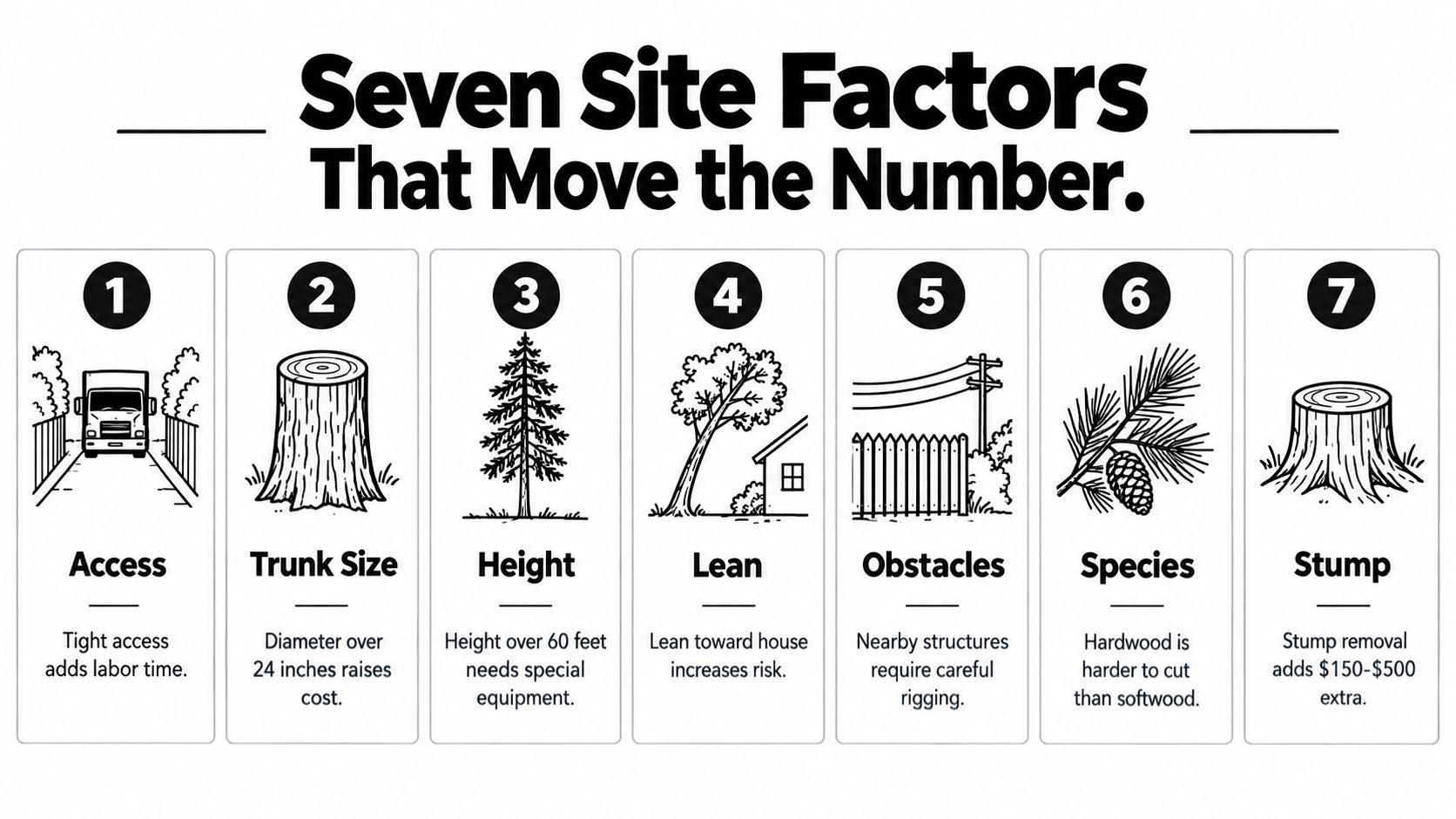
The same tree can price very differently depending on where it stands and how it has to come out. That's why residential tree removal cost works better as a risk-and-production estimate than as a height-only chart.
The seven variables that matter most
- Access. Tight side yards, narrow gates, and soft ground slow equipment and hand carry-out.
- Trunk diameter. Larger trunks mean more wood to cut, section, and haul.
- Height. Taller trees usually need more control and more time.
- Lean. A tree leaning toward a house, pool, or driveway increases the control required.
- Obstacles. Fences, roofs, wires, sheds, and hardscape all change how the removal has to be staged.
- Species. Dense hardwoods are slower to process than lighter material.
- Stump and debris. If the quote doesn't state what happens to the stump, brush, and wood, the final bill can surprise you.
The tree's condition matters just as much. A dead or storm-damaged tree can behave unpredictably during cutting, which increases caution and time. Proximity to a home or utility corridor also matters because the crew can't just let branches fall where they may.
The biggest mistake homeowners make is comparing a full-service quote to a removal-only headline. A low number can look attractive until you realize stump grinding, haul-away, or rigging was excluded. That's how two bids for the same yard end up miles apart on paper and even farther apart in final cost.
Bottom line: the cheapest quote isn't always the cheapest project. It's only cheap if it covers the same scope.
Sample Estimates for Real Atlanta Scenarios
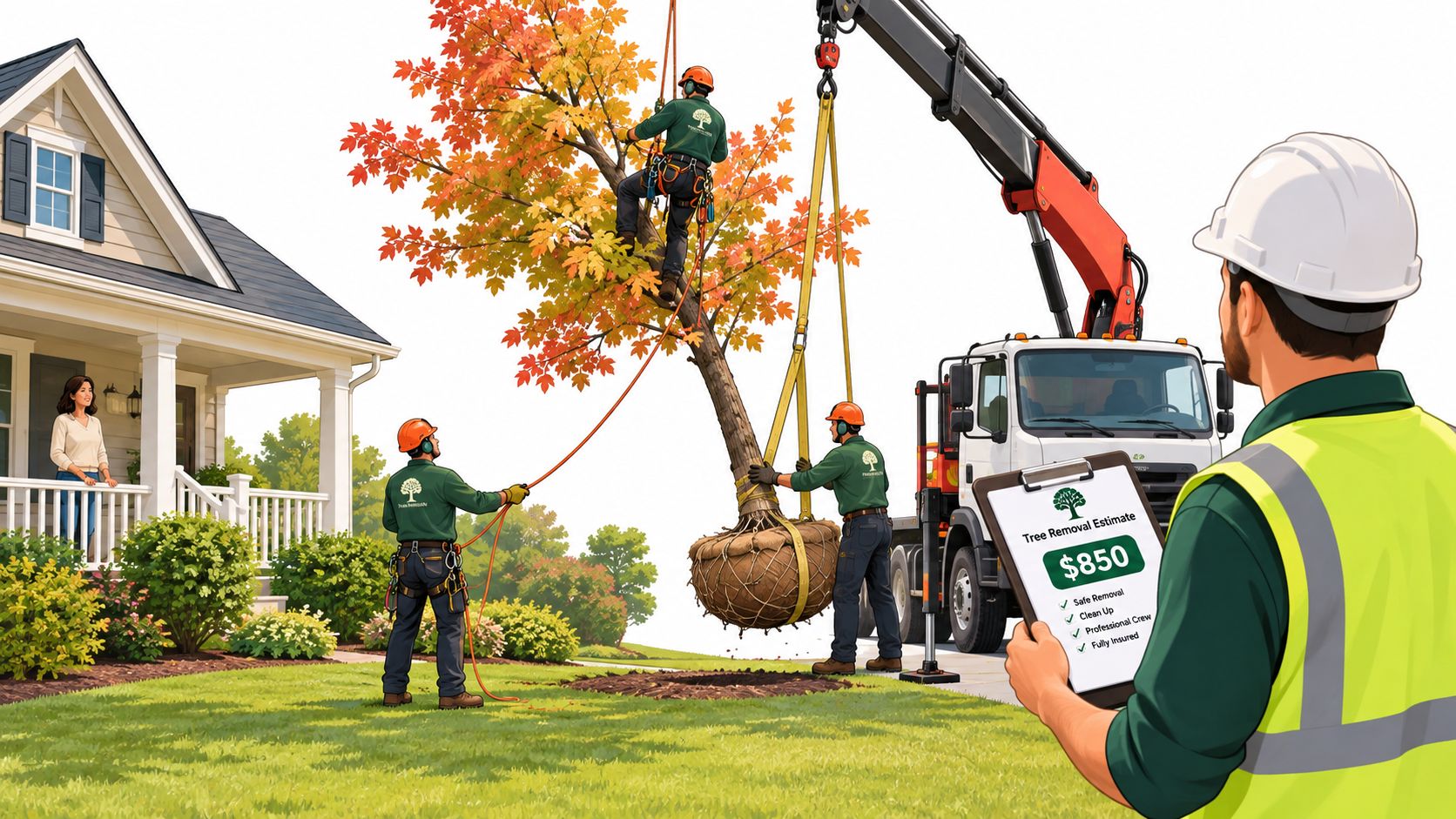
Three North Atlanta situations show how a removal estimate changes with production demands, using the same benchmarks as above (tree removal pricing guide). The species affects cutting and handling, but access, drop-zone risk, and equipment usually decide the final figure.
| Scenario | Typical Range | Key Cost Drivers |
|---|---|---|
| Small front-yard tree with easy access | $150 to $450 | Low height, open drop zone, simple cleanup |
| Tight-access backyard oak | $450 to $1,200 | Hand carry-out, sectional cutting, extra labor |
| Mature tree over a house needing crane access | $1,000 to $2,000 | Controlled dismantling, rigging, equipment staging |
The same pricing guide supports these scenario ranges (tree removal pricing guide). A small front-yard removal in Roswell can remain near the lower band when the crew has clear access, a safe landing area, and little material to haul. A backyard oak in Woodstock or Acworth requires more labor when a narrow gate prevents equipment access and the crew must carry and lower sections by hand.
A mature tree over a roof is a production and risk problem, not just a tall-tree fee. Rigging, controlled dismantling, and crane staging protect the structure, but each step adds equipment, setup, and coordination. The estimate should show those items rather than burying them inside one vague total.
Storm work follows the same pattern. A tree lying in an open yard may need straightforward cutting, while a trunk pinned against a garage or tangled near service lines requires controlled handling and a slower pace.
Use the table as a comparison point, not a promise. If your site resembles the crane scenario, a low quote that omits rigging, equipment, or cleanup may leave you paying for those services later.
Getting Accurate Quotes You Can Actually Compare
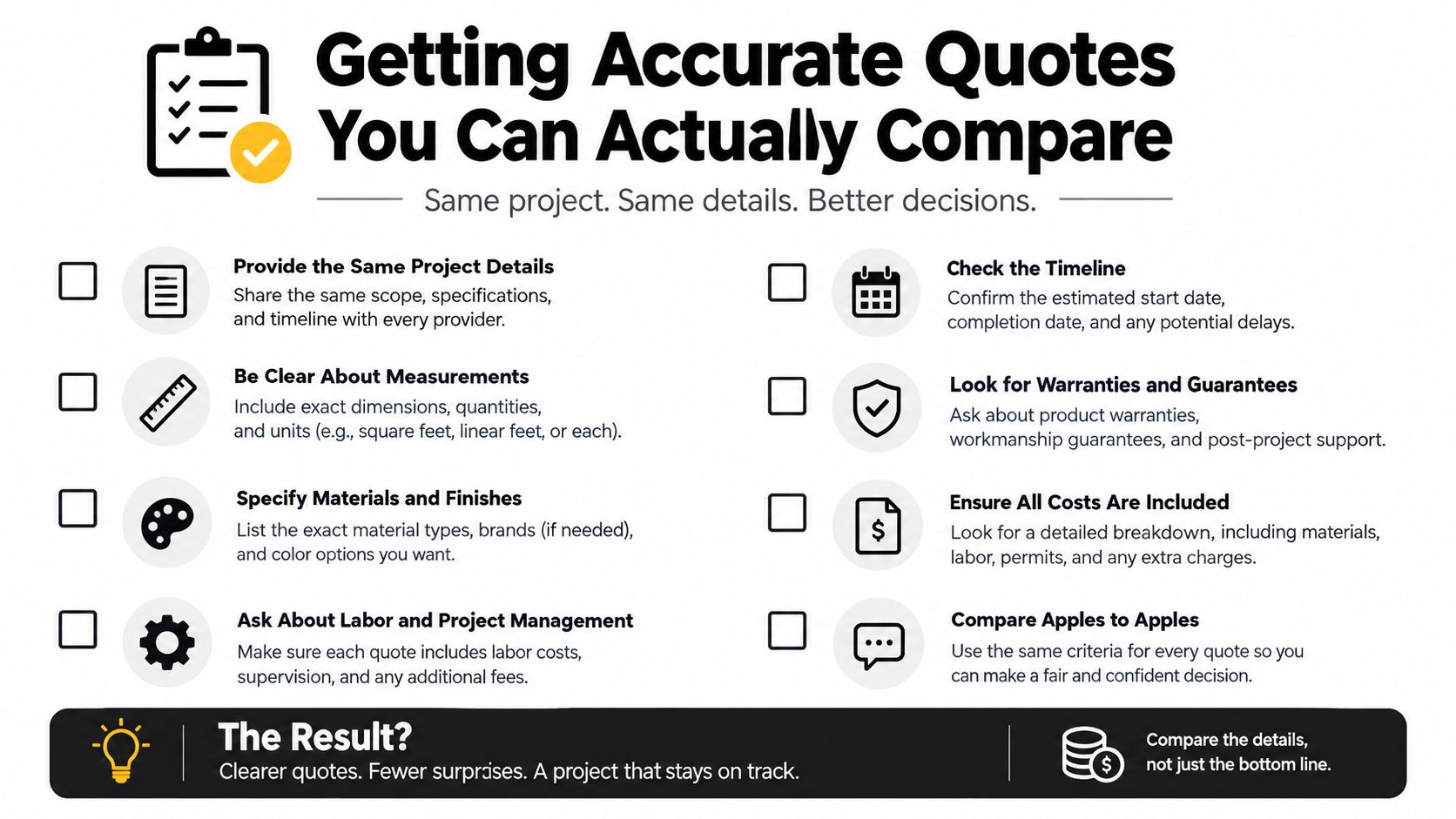
If you want comparable bids in Marietta, Roswell, Alpharetta, or Johns Creek, give each contractor the same facts. A quote built on incomplete information is just a guess with professional formatting.
What to measure before you call
- Total height. Estimate the full height, not just the visible trunk.
- Trunk diameter. Measure around 4.5 feet above grade, the standard point used in tree work.
- Lean and defects. Note cracks, decay, split unions, and obvious movement.
- Drop zone. Identify what's under the canopy, including roofs, patios, pools, and fences.
- Equipment access. Check gates, slopes, soft ground, and driveway limits.
- Overhead utilities. Flag any nearby power lines before anyone starts talking price.
- Debris handling. Ask whether wood is left, stacked, chipped, or hauled off.
- Stump work. Clarify whether stump grinding is included.
A written estimate should separate removal, rigging or crane work, stump treatment, cleanup, haul-away, and any permit or inspection item. That's the only way to know whether two companies are really bidding on the same job.
If you've ever compared service quotes in another trade, the logic is the same as the approach outlined in win more plumbing quotes from Growth 4 Trades. Scope clarity wins. Ambiguous scope creates price noise.
You can also use a tree service estimate page like this one as a reminder of what a professional written quote should include before you sign anything.
Permits and Atlanta's Replacement Rules
A removal quote can look reasonable until Atlanta's tree protection rules add replanting or tree-fund costs. The permit question affects the project budget, not only the paperwork.
The rule that catches people off guard
For private property inside Atlanta city limits, trees at least 6 inches in diameter at breast height generally require a permit. Pine trees use a 12-inch threshold. The city's arborist inspection and inspection report are available without charge, while the larger expense may arise if the property fails minimum tree-cover requirements and the city requires replacement trees or payment into the tree fund. The Atlanta permit and tree protection information explains the city's requirements, and the filing steps are covered in this Atlanta tree removal permit guide.
A free permit does not make the whole job free. Compliance can add replacement planting, tree-fund payment, or scheduling delays. Jurisdiction matters too. East Cobb, Roswell, Milton, Cherokee County, and Gwinnett County may apply different rules, so a neighbor's experience is not a reliable basis for your estimate.
Practical rule: confirm who pulls the permit, who pays for required replacement, and whether the quote treats the tree as regulated or exempt.
Before cutting begins, confirm:
- Jurisdiction. Establish whether the property is inside Atlanta city limits or another city or county.
- Diameter. Measure the trunk at 4.5 feet above grade.
- Tree condition. Document whether it is dead, hazardous, or storm-damaged.
- Replacement obligation. Ask whether replanting or tree-fund payment applies.
- Permit responsibility. Get the filing responsibility in writing.
A “tree removal near me” search can produce a quote for the tree while leaving site compliance unresolved. Treat permit, replacement, and tree-fund requirements as separate line items when comparing bids.
When Insurance Does and Does Not Pay
The insurance answer is narrower than expected. Reporting indicates that homeowners insurance generally does not cover removal when a fallen tree is sitting in the yard and hasn't damaged a covered structure. When the tree hits a house, garage, or another covered structure, structural damage and related removal may be covered, depending on the policy terms and deductible (recent reporting on tree damage and homeowners costs).
That distinction matters after a storm in Cobb County or Cherokee County. A standing hazardous tree is one expense. A tree down in the yard is another. A tree on the roof is a third. Crane-grade storm response is the fourth, and it's usually the most expensive because the crew has to work under pressure, around damage, and often with limited access.
How to think about the claim path
If the tree only blocks access, the removal bill may land below your deductible, which means you're likely paying out of pocket anyway. If the tree damaged the structure, document the roofline, the impact point, the weather, and the time of failure before anything gets moved. Photos and a clear arborist assessment help if the claim is reviewed later.
The safest move after a storm is not to assume coverage. It's to document first, contact the insurer when needed, and get the hazard secured. Delaying action because you expect insurance to absorb the full bill can backfire when debris, rot, or further movement makes the site worse.
For a deeper look at the claim side of the issue, see tree falling on house insurance.
Working with an ISA Certified Arborist
A good written estimate should read like a scope, not a guess. It should list the tree, the access, the hazards, the debris plan, the stump plan, and any permit or insurance wrinkle that could change the final bill. That's especially important for emergency tree removal, where speed matters but the scope still has to be clean.
What to verify before you approve the work
- Credentials. Ask whether an ISA Certified Arborist evaluated the tree.
- Insurance. Confirm the company carries the coverage it says it does.
- Equipment. Check whether the crew has the right gear for cranes, rigging, or confined access.
- Cleanup scope. Ask whether haul-away and debris chipping are included.
- Stump pricing. Separate stump grinding from tree removal unless the quote clearly bundles both.
- Replacement planting. If local rules require replanting, ask whether that's included or separate.
Bundling services can lower the total when the crew is already on site. Combining removal with stump grinding and debris cleanup often creates a cleaner project and fewer surprise line items. For larger jobs, financing can also make sense when the work sits near the top of the normal range and the tree is a safety issue, not a cosmetic one.
One option Atlanta homeowners can check is Richmond Tree Experts GA, which provides tree removal, stump grinding, and arborist-based evaluations through ISA Certified Arborists. That matters because a written arborist estimate is easier to compare than a phone ballpark, especially when the tree is leaning, storm-damaged, or near a structure.
If the tree is near power lines, on a roof, or visibly unstable, don't make it a DIY tree cutting service project. OSHA's line-clearance and storm guidance treats those jobs as trained-work situations for a reason, and the wrong cut can turn a manageable problem into an emergency.
For a straightforward estimate, a safety check, or help sorting out a fallen tree, contact Richmond Tree Experts GA. If you're in Marietta, Roswell, Kennesaw, Woodstock, Acworth, Canton, or nearby North Metro Atlanta, ask for a written site visit so you can compare the full scope, not just the headline price.

