

You walk out to the mailbox in Marietta or Roswell and the pine still looks green from the street. A week later the crown looks thinner, and a crust of resin sits on the bark. That is how southern pine beetle damage usually shows up on a North Atlanta lot. The needles have not browned, but beetles may already be cutting the living tissue under the bark.
A quiet statewide forecast does not clear the one mature pine beside the house. Yards in Cobb County, Cherokee County, Kennesaw, Woodstock, Acworth, and Canton can hold a drought-stressed tree that fails while the county average stays low. I would treat that single stem as a property decision, not a regional headline. If it leans toward a roof, a driveway, or a line, crown color is the wrong thing to wait on.
Signs of Southern Pine Beetle Damage at Each Stage
You can stand on the curb in East Cobb and swear the pine is fine. The top is a little sparse. Sticky resin has crusted on the trunk. From the driveway it still reads as a living tree.
Southern pine beetle damage is a girdling injury, not chewed foliage. Adults bore through the bark and cut winding galleries in the phloem and cambium, the tissues that move water and sugars. Once that ring closes, green needles can hide a stem that is already dying. Discoloration lags behind lethal cambial damage, so color alone is a late clue.
The stage guide below is the checklist I use before anyone talks about tree removal or tree pruning.
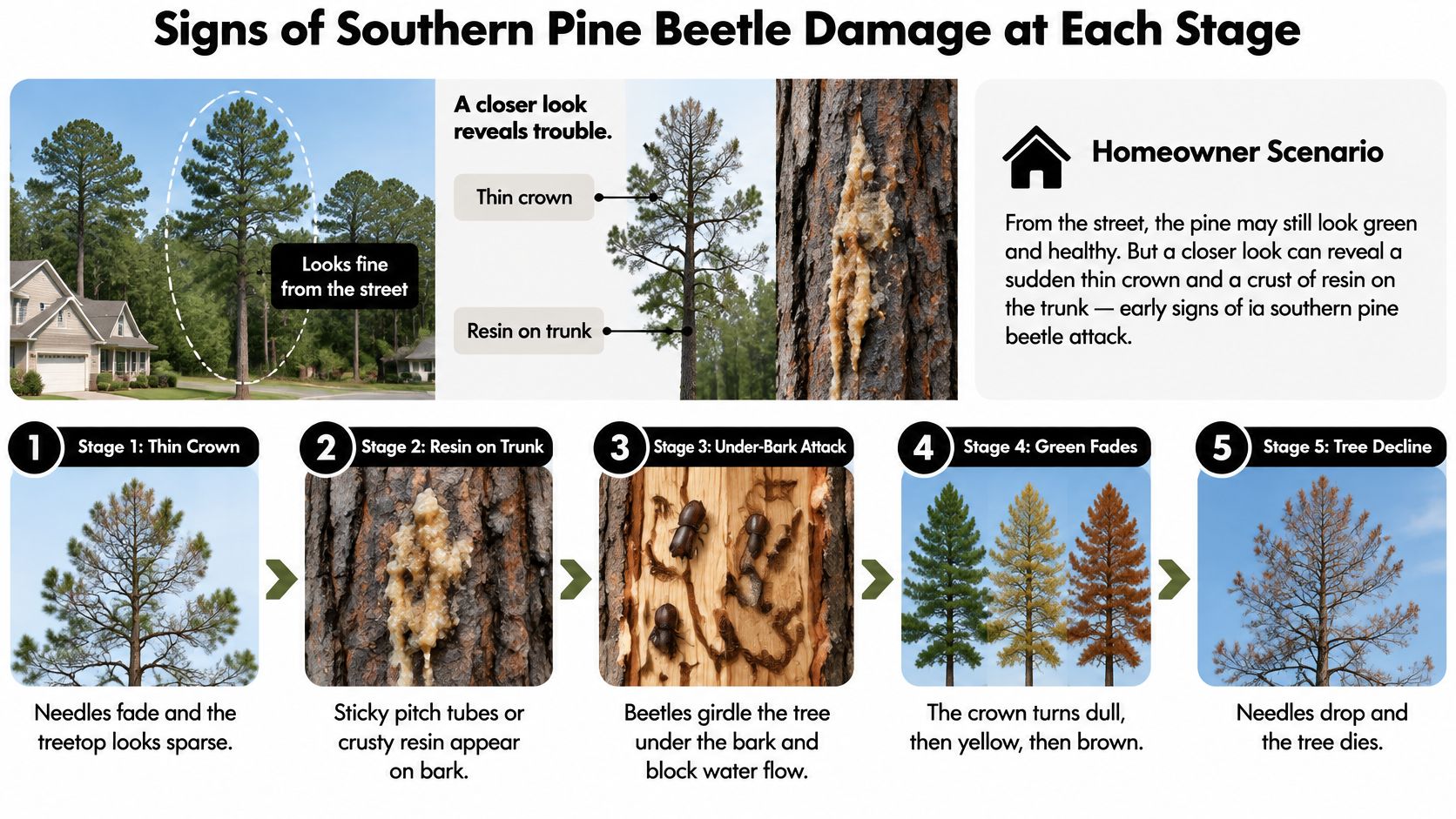
What each stage shows on the trunk
| Stage | Crown | Trunk and bark | What it means |
|---|---|---|---|
| Early attack | Needles still green, crown may look normal | Soft, gummy pitch tubes and reddish-brown boring dust (frass) at the base | Cambial damage may already be underway |
| Mid-stage | Pale-green to yellow needles | Pitch tubes and frass spreading up the trunk | Tree is likely doomed; act now |
| Late stage | Red crown | Bark loosening, galleries full of beetles | Infestation is established and spreading |
| Dead tree | Brown needles, thinning crown | Bark sloughing, dead cambium | Hazard risk rises as the wood dries |
Pitch tubes are small, soft, popcorn-like blobs of resin on the bark. Frass is reddish-brown powder in bark crevices or piled at the base. One blob can be a failed attack the tree pushed out. Several fresh tubes plus fresh dust, on a trunk that also has a thinning top, is a different story.
Check the base and the mid-trunk, not only the side you see from the porch. Peel back a loose flake only if the bark is already failing. You are looking for galleries in the inner bark, not a pretty cross-section. A fading crown with clean bark may be drought, soil compaction, or another insect. A green crown with fresh pitch and frass can already be a hazardous tree removal candidate if it stands over a roof.
A short clip of attack signs is worth watching before you decide the tree is only thirsty.
A ten-minute field check
Do these three things together and write the date on the note. A photo without a date is hard to compare next week.
- Pitch tubes: Circle the trunk at chest height and again higher if you can see the bark safely. Count fresh, soft tubes, not old gray crust.
- Frass: Look in bark cracks and on the soil or mulch at the base. Reddish-brown dust that was not there after the last rain is new boring.
- Crown color: Note green, pale-green, yellow, red, or brown, and whether the fade starts at the top. Record it with the trunk notes, never by itself.
Practical rule: If two of the three are positive, stop guessing from the sidewalk and get the bark checked before the next hot week.
Needle fade can also come from root loss, lightning, or construction fill. A clear side-by-side of those lookalikes is in this information on unhealthy pine trees from The Green Advantage. Use it so you do not book a tree cutting service for a pine that only needs water and space.
Telling Southern Pine Beetle Apart From Other Pine Beetles
Homeowners often hear "bark beetle" and assume every pine killer is the same insect. The response is not the same. Ips engravers usually work in stressed tops and fallen wood. The black turpentine beetle stays low, around the base and stump. The southern pine beetle is the one that can mass-attack the mid and upper trunk and move through a group of pines.
| Beetle | Typical host | Where it attacks | Visible sign |
|---|---|---|---|
| Southern pine beetle | Loblolly, shortleaf and other southern pines | Mid and upper trunk, in the phloem | Pitch tubes, S-shaped galleries, reddish-brown frass |
| Ips engraver | Southern pines, mainly stressed or fallen tops | Upper crown and branches | Fine boring dust, galleries in thin bark of tops |
| Black turpentine beetle | Pines, often weakened or recently cut | Lower trunk, stump and root collar | Large, heavy pitch masses at the base |
How to use the table on the tree in front of you
Start with height on the stem. Heavy pitch the size of a large blob, only on the bottom few feet, points to black turpentine beetle, especially after mower wounds, fresh cuts, or a logging scar. Fine dust in the thin bark of the upper crown, or in a broken top lying in the yard, points to Ips. Small pitch tubes from the mid-trunk upward, with winding S-shaped galleries packed in the inner bark, point to southern pine beetle.
Gallery shape is more reliable than needle color. Ips galleries tend to branch in Y, H, or I patterns. Black turpentine galleries are short, wide, and patchy. If you cannot see the pattern safely, do not climb a dying pine to get it. A bark sample from already loose bark, kept in a sealed bag with the date and the tree's location, is enough for a species check.
A certified arborist or your county extension office can confirm the beetle from that sample. Guessing the species is how people spray the wrong part of the tree.
Our tree disease identification guide walks through the same trunk-versus-crown split for other Metro Atlanta problems, so you are not treating a top-kill the way you would treat a mid-trunk mass attack. If several pines in a Woodstock or Canton yard show mid-trunk tubes at once, that pattern matters more than a single brown branch after a storm.
How Beetles Spread and Why Georgia Pines Stay at Risk
A pine shading a deck in Acworth can still be a falling hazard in a year the state calls quiet. Adults bore through the bark and cut winding egg galleries in the phloem and cambium. Larvae feed there, then emerge and fly. The beetle is not eating needles. It is cutting the tree's plumbing. In a mass attack, many beetles hit the same stems in a short window. Resin that would drown a few insects cannot push out a crowd. Blue-stain fungi that ride with the beetles clog water-conducting wood and speed the kill.
One infested stem becomes a spot. New adults and reemerging adults move to nearby pines, often in a rough circle over the following weeks. Drought-weakened trees are the easiest to overwhelm because resin pressure is already low. Flooded pockets stress roots the same way. Overcrowded groups give the beetles a short flight to the next host. Oaks across the street are not the target. The next pine in the group is.
What Georgia's record actually says
The Georgia Forestry Commission reports that southern pine beetles have killed more than $254 million worth of pine trees in the state since 1972, an average annual loss exceeding $7 million. More than 35 years of aerial surveys tie outbreaks to weather stress, including drought and, in some places, flooding. Drought shows up as a trigger in both the Piedmont and the mountains. Those statewide totals still leave the decision on one lot: whether the stressed pine beside the house is already a spot, or only a tree that needs watching.
The 2026 Georgia prediction report recorded a statewide average of 26 southern pine beetles per trap per day, down from 33.5 in 2025, and no county with a greater-than-50% predicted outbreak probability. West-central Georgia was still the highest-risk region. Carroll County had a 47.9% chance of exceeding 50 spots. Coweta, Floyd, Heard, Paulding, and Polk ranged from 28.2% to 41.4%. Paulding sits on the edge of the North Metro yards people drive through every day. I would not treat a forecast under 50% as a clean bill for the pine over a roof.
Age and drought stress on that one tree matter more than the county label. If it stands in a pine group, new adults have a short hop to the next stem. A crown color change you can date to the past month is more useful than a vague memory that it "looked off last summer." Crown color alone cannot tell you whether beetles are still in the wood or already gone. If the first answer is yes and either of the other two fits, walk the trunks this month.
On a single lot, the practical moves are water during dry spells, enough spacing that beetles do not have a short flight, and no fresh wounds while resin pressure is low. That is the core of practical tree disease prevention. A county that is not in outbreak can still hold the tree that drops on a roof.
Choosing a Response Once Beetles Are Confirmed
A confirmed infestation changes the decision from saving that pine to protecting nearby trees and people. If beetles have colonized the stem, watering or spraying the tree will not reverse the damage. For a pine beside a house, driveway, or power line, assess the falling hazard as well as the risk to neighboring pines.
| Situation | Recommended action | Buffer or timing | Reason |
|---|---|---|---|
| Active infestation in a tree | Cut-and-remove or cut-and-leave | Keep an uninfested buffer at least as tall as the infested trees | Interrupts beetle development |
| Established infestation | Insecticide spraying generally not recommended | Not applicable | Coverage can be poor in tall urban pines, with risk of drift |
| Drought-stressed pine, not attacked | Preventive irrigation | About 1 inch of water per week during drought | Helps maintain the tree's defenses before attack |
| Dead or heavily infested tree near a house or line | Have the hazard assessed by an ISA Certified Arborist | Promptly, before the wood dries and becomes brittle | Addresses the falling hazard and nearby attack risk |
UGA Extension Paulding County recommends cutting and removing or cutting and leaving infested trees, with an uninfested buffer at least as tall as the infested trees. In an established infestation, spraying is generally not recommended. Mississippi State Extension's guidance on bark beetles in urban pines recommends about 1 inch of water per week during drought for prevention. It also explains the limits of spraying tall urban pines, including poor crown coverage and drift onto nearby areas. Regional beetle activity can decline while a dead pine over a driveway remains a property-level hazard.
What works, and what does not
Cut-and-remove is often the more practical choice beside a house, pool, or parking area: the infested wood leaves the site. Cut-and-leave may suit a larger stand where hauling is impractical, but it is a poor fit when people, vehicles, or structures are within the drop zone. Leaving a red-crowned pine to see if it recovers is not a treatment. Once beetles have colonized the stem, the tree is not restored by watering or spraying.
Irrigation is preventive, not curative. Apply water slowly to the root zone of green, unattacked pines during drought rather than sprinkling the trunk every day. Avoid injuring the base with string trimmers while trying to maintain the tree's defenses.
A dead or heavily infested pine near a house, driveway, or power line needs a prompt hazard assessment. Drying wood can become brittle, making delay a safety concern. Richmond Tree Experts GA provides emergency tree service, including storm damage response, and its ISA Certified Arborists assess trees before pricing work.
Confirm, cut, then walk the buffer
Confirm the beetle and determine whether the tree is actively infested. Then choose cut-and-remove or cut-and-leave, keeping the recommended uninfested buffer. Inspect pines within it for fresh signs of attack. If the tree is near a structure or line, factor the falling hazard into the removal decision; saving brood wood on site may be a poor trade-off where people or property are exposed.
For one lot, a low regional forecast does not make an infested pine beside a house safe. The decision should account for both the tree's condition and what lies within its reach.
Local Resources for Confirming Beetle Damage in Georgia
You do not need four agencies for one backyard pine. You do need the right one for the question you are asking, and you should show up with the same dated notes.
Georgia Forestry Commission publishes the aerial survey and trap counts behind statewide and county forecasts. Forest health staff are the people to call when a cluster of pines, not a single yard tree, looks infested, so the find can enter statewide monitoring. Bring the spot location, the number of trees with pitch, and whether the color change is days old or months old.
University of Georgia Extension, through your county office, can confirm species from a bark sample and put the find in local outbreak context. UGA Extension also publishes the storm-damage guidance that matters after a pine is already leaning or down: life and property first, no work on a tree tangled with a utility line until the utility has cleared the line, and uprooted or strongly leaning trees treated as unlikely to stand back up. That is the decision frame for storm damage tree cleanup in Marietta, Roswell, and the rest of North Metro Atlanta.
Mississippi State Extension is a regional reference for preventive watering and for why urban sprays often cannot be applied safely. Site limits still differ. A wooded acre in Cherokee County is not a tight lot in Kennesaw with a neighbor's pool under the drift path.
ISA Certified Arborists are the people who should read bark and galleries, not only crown color, when a tree stands over a structure. Search the ISA directory for Atlanta-area certification, and ask whether the visit includes the trunk. A crown-only glance will miss an early attack.
When you call any of them, ask three things: what to bring, how soon someone can look, and whether the find will be recorded. Have the photos, the date, and a rough distance to the nearest pines ready so nobody is working from a different story.
Do not start tree trimming or DIY cutting on a confirmed, dying pine while you wait. Broken hangers and stored tension in a failing stem are how untrained cuts turn into injuries.
Protecting Neighboring Pines and Getting a Certified Diagnosis
Prevention is a routine, not a single treatment. After one tree is confirmed, the next likely targets are the pines you can see from that stem. Inspect them soon, then again on a set day, not "sometime this month."
On each visit, check the base and the mid-trunk for fresh pitch tubes and frass, and log the date so a change is visible. Thin overcrowded groups so the remaining pines are not competing for the same water. In a managed pine stand, a common vigor benchmark is thinning to a basal area of 80 square feet per acre or less. A residential lot is not that stand. Spacing, root zones, houses, and driveways change the cut, so an urban tree needs a site-specific read before anyone applies a forestry number.
Avoid wounds in dry weather. Mower scars, fresh pruning cuts on a stressed pine, and soil piled over the root flare all make the tree easier to overwhelm. Tree trimming and tree pruning still belong in the plan when they remove hangers or reduce a target, but they are not a substitute for removing a tree that is already brooded out. Cabling a healthy pine with a weak union can be worth it. Cabling a red-crowned pine is not.
When the safety problem comes first
A dead or heavily stressed pine near a home is a safety problem first and a beetle problem second. Call when a tree is confirmed, when a dead or leaning pine stands near a structure, or when several trees show symptoms at once. The same call fits after wind, when you need fallen tree removal, a blocked drive cleared, or a hanger taken out of a crown before the next storm.
An ISA Certified Arborist should examine bark and galleries, confirm the species, and say whether the tree needs to come down, can be pruned back to health, or is fine to leave alone. That scoping visit sets the buffer and the removal plan. It is also the right moment to price emergency tree removal against a scheduled cut. Every job should be looked at before it is priced, with a written estimate before work starts, so you are not agreeing to a crew speed you have not defined. Fast response matters when a stem is on a house. It does not replace the hazard check.
Richmond Tree Experts GA has ISA Certified Arborists on staff for Metro Atlanta assessments, including Marietta, Roswell, and nearby North Metro lots. You can call 770-974-3964. If you want to see how certified staff fit a trunk inspection rather than a drive-by bid, start with our page on certified arborists near me.
Your next move is three steps: photograph the pitch tubes and the crown, note the date and the distance to the nearest pines, then request an assessment. Early action leaves removal, a careful prune, or a decision to leave the tree alone all on the table. Waiting until the bark sloughs mostly leaves hazardous tree removal.
Richmond Tree Experts GA helps North Atlanta homeowners sort southern pine beetle damage from drought stress, then handles hazard cutting, pruning, and storm cleanup with licensed, insured crews. If a pine near your house is showing pitch tubes or a sudden thin crown, visit Richmond Tree Experts GA to request an arborist assessment before the next wind event.

