

Stump grinding is usually the homeowner's responsibility, but the contractor doing the work should carry general liability, workers' compensation when required, and coverage that addresses underground damage. If those protections don't match the job, you could be left arguing over a damaged line, structure, or injury after the crew has packed up.
A tree has come down across a Marietta driveway, the power company has been called, and the immediate danger is over. Now the stump remains beside the walkway, close to irrigation and a retaining wall. Before a grinder arrives, sort out whose policy applies to what. That's the part homeowners often discover too late, whether they're arranging stump grinding in Roswell or looking for emergency tree removal after a storm.
After the Storm, Before the Claim
A storm-related tree loss and the stump left behind aren't automatically treated as one insurance event. Your homeowner policy may address damage to an insured structure, subject to your policy terms and deductible. Grinding the remaining stump is often maintenance or site restoration, not a covered loss. Don't assume the insurer will pay for it just because the tree came down during a covered storm.
There are three separate insurance conversations:
- Your homeowner policy may respond to covered storm damage to the home or other insured property. Call your insurer, document the scene, and ask what your policy covers before authorizing work that could change the evidence.
- The contractor's liability policy may respond if the crew damages your property or injures someone else. That protection depends on what the policy covers, including the work being performed.
- Workers' compensation is for qualifying employee injuries, not damage to your house, driveway, or irrigation system.
Practical rule: Photograph the tree, the stump, and nearby damage before cleanup starts. Then ask the adjuster and contractor separate questions. One party's coverage doesn't replace the other's.
That distinction matters after a tree removal, fallen tree removal, or storm damage tree cleanup job. A tree on a roof is a different claim question from a stump left in a yard. If you're coordinating work after a storm in another region, this hurricane cleanup guidance for Suncoast homeowners offers a useful reminder to document conditions and organize cleanup carefully.
For a leaning tree or a tree split over a sidewalk, don't treat urgency as a reason to skip documentation. Purdue Extension recommends prioritizing risk assessment after severe weather and considering whether a tree poses an imminent or likely danger to people, property, or activities before cleanup or removal begins (Purdue Extension storm-damage guidance). Call a qualified tree service, keep people away from unstable limbs, and clarify the scope before the stump grinder starts.
The Four Coverage Layers a Stump Grinding Contractor Must Carry
“Are you insured?” is too vague to protect your property. Ask which policies apply to the actual job, and whether the contractor's insurer knows the company performs stump grinding, stump removal, and work near underground lines.
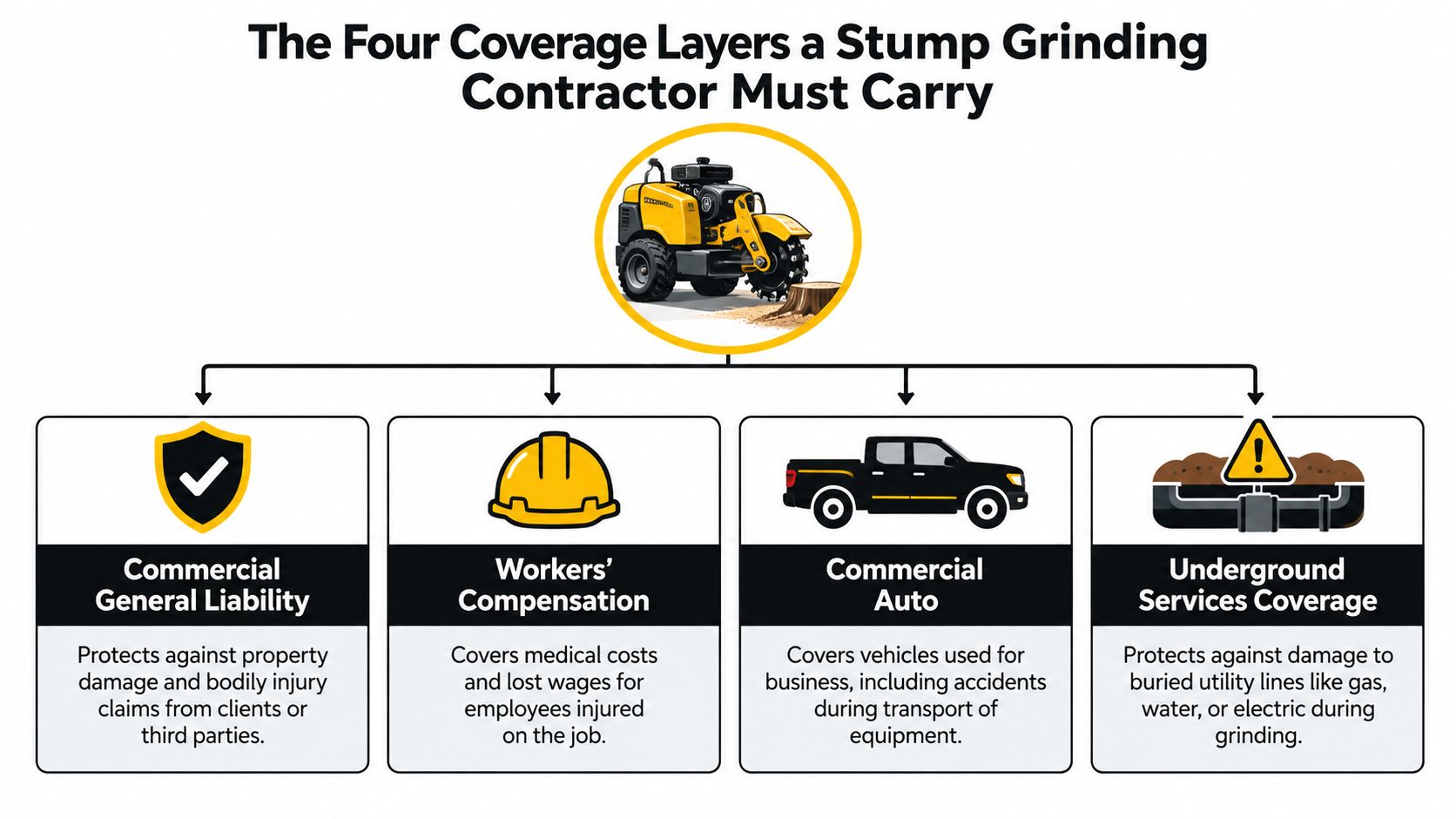
Commercial general liability is the layer to ask about if flying debris cracks a window or an operation damages a customer's property. Workers' compensation is the crew's job-injury protection. Commercial auto applies to business vehicles and transportation exposures. Underground and completed-operations coverage should be reviewed for damage to buried property and claims that surface after the crew leaves.
Georgia's workers' compensation threshold is easy to misunderstand. Coverage becomes a statutory requirement when a business regularly employs three or more people, and that count includes full-time, part-time, and seasonal workers, as well as corporate officers and LLC members (Georgia State Board of Workers' Compensation FAQs). A two-person crew may not trigger that requirement by headcount alone, but don't mistake that for a guarantee of financial protection if a worker gets hurt. Ask whether the contractor carries coverage and confirm it's active.
If a worker is injured, workers' compensation and employer responsibilities can get complicated quickly. This overview of insurance requirements for injured workers provides additional background, but a homeowner should still verify the contractor's coverage directly.
For a North Metro tree service, name the coverages when you call. Ask for general liability, workers' compensation, commercial auto, and written confirmation that stump grinding and underground exposures aren't excluded. This overview of tree-service insurance requirements can help you frame the questions. A contractor who answers clearly is easier to hire than one who says only, “We're covered.”
Why a Certificate of Insurance Is Not the Same as Coverage
A certificate of insurance (COI) is useful paperwork, but it isn't the policy. It can show that a policy was reported as active when the certificate was issued. It doesn't, by itself, prove that stump grinding, underground damage, or the exact work in your contract is covered.
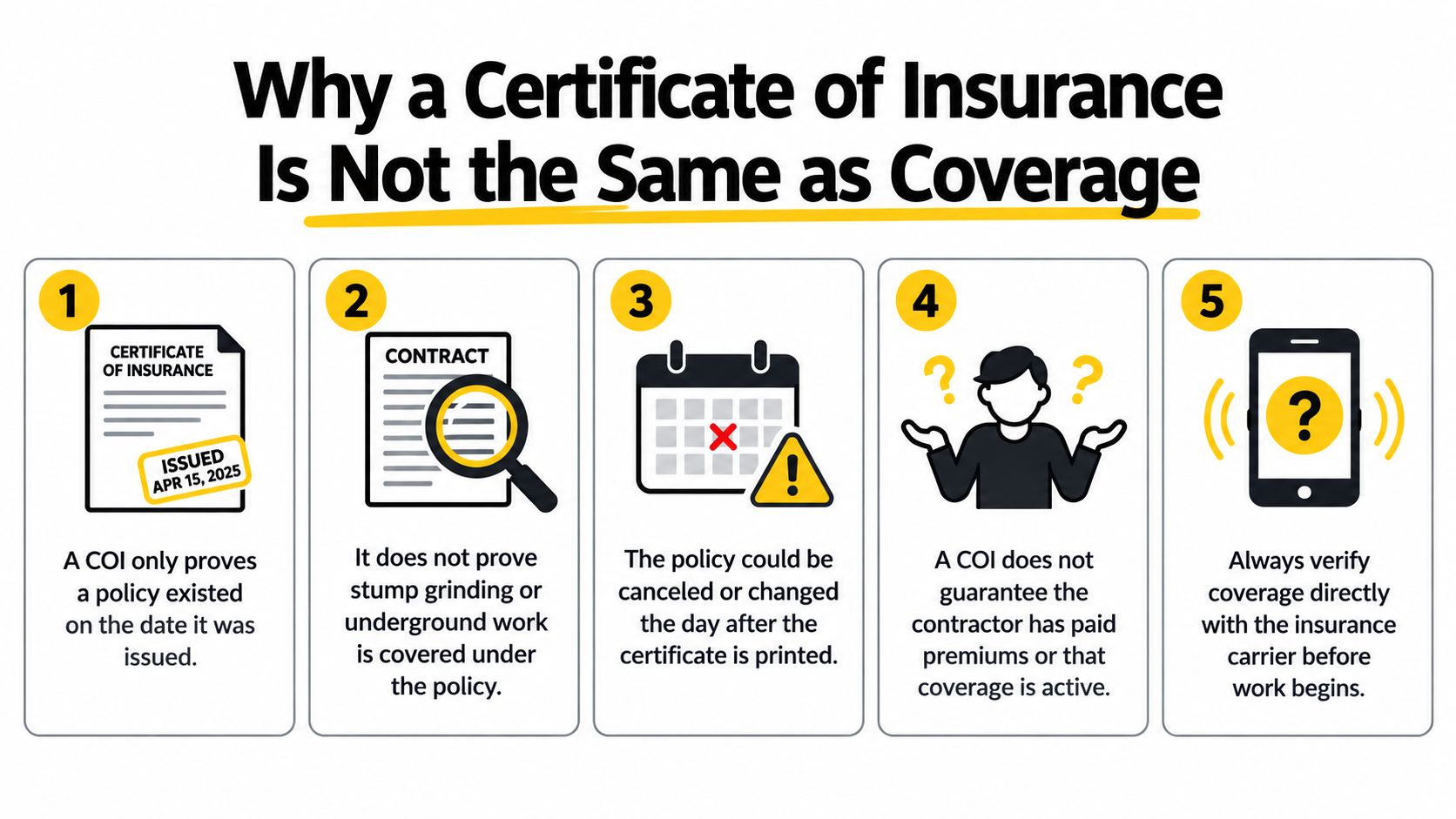
Here's what can make a COI misleading: a policy may exclude stump grinding or underground work, limit coverage for utility damage, restrict subcontractor work, or fail to address completed operations. A certificate that lists a liability limit won't reveal every exclusion or endorsement that affects the job. Insurance guidance specifically warns that some tree-service or general-liability policies restrict or exclude stump grinding, stump removal, underground work, or utility-damage exposures, so the operation should be disclosed during underwriting (tree-removal contractor insurance guidance).
Ask the contractor to verify these points with the insurance agent or carrier before work begins:
- Operations description: Does the policy cover stump grinding and stump removal, not just general landscaping or tree trimming?
- Exclusions and endorsements: Is underground-property damage covered? Are completed operations, contractual liability, and subcontractor work addressed?
- Project requirements: If a property manager or HOA needs additional-insured status, can the contractor provide the required endorsement rather than just list the organization on a certificate?
A county tree-service solicitation in Georgia provides a concrete example of commercial requirements: it specifies $1,000,000 in general liability per occurrence, $1,000,000 in automobile liability per occurrence, and workers' compensation/employer's liability limits of $1,000,000 for accident, disease per employee, and disease policy limit. It also calls for proof before contract execution and continuous coverage during the contract term (Georgia county tree-service solicitation). Those limits are that buyer's requirements, not a universal residential standard. The useful lesson is to match paperwork to the work and contract, not to assume a certificate answers every question.
Covered Scenarios Versus Non-Covered Scenarios
Homeowners often ask why an insurer may consider a storm-damaged tree claim but refuse to pay for grinding the stump. The answer is that the event, the damage, and the requested work are distinct. Coverage depends on your policy and the facts of the loss, so get the insurer's position before you treat stump removal as part of an approved claim.
| Scenario | Homeowner policy | Contractor coverage | Notes |
|---|---|---|---|
| A storm-damaged tree hits an insured structure | May apply, subject to policy terms | May apply if the crew causes additional damage | Photograph damage and contact your insurer promptly. |
| A fallen tree blocks access but damages no insured structure | Depends on policy language and circumstances | Applies to covered damage caused by the contractor | Don't assume removal or stump grinding is automatically paid. |
| A stump from a tree removed long ago needs grinding | Usually a maintenance expense, not a storm claim | Applies if the contractor causes covered damage | Ask for a written scope and verify underground coverage. |
| A tree is removed for appearance or a property sale | Usually not an insured loss | Applies to covered contractor-caused damage | Cosmetic or seller-prep work is ordinarily a direct homeowner cost. |
| A hazardous standing tree threatens people or property | Depends on the policy and circumstances | Applies to covered contractor-caused damage | Document the risk and check local authorization requirements. |
Atlanta distinguishes fallen trees from hazardous standing trees. The city says a permit isn't needed for a fallen tree, but homeowners should photograph the failure before removal. For a hazardous tree, the owner should contact the Arborist Division, obtain authorization, photograph the imminent danger, and submit a completed Dead, Dying, and Hazardous application with photos within five business days (City of Atlanta storm-damage guidance).
That process matters if you're arranging hazardous tree removal, emergency tree removal, or tree cutting service in Atlanta. In Marietta, Kennesaw, Woodstock, Acworth, or Canton, check the relevant local authority rather than assuming Atlanta's rules apply. Insurance approval and permit requirements are separate questions.
Documenting a Claim Before, During, and After the Crew Arrives
Good records help everyone distinguish pre-existing damage from damage caused during work. Make documentation part of the job, whether you've called for stump grinding, tree pruning, or storm damage tree cleanup.
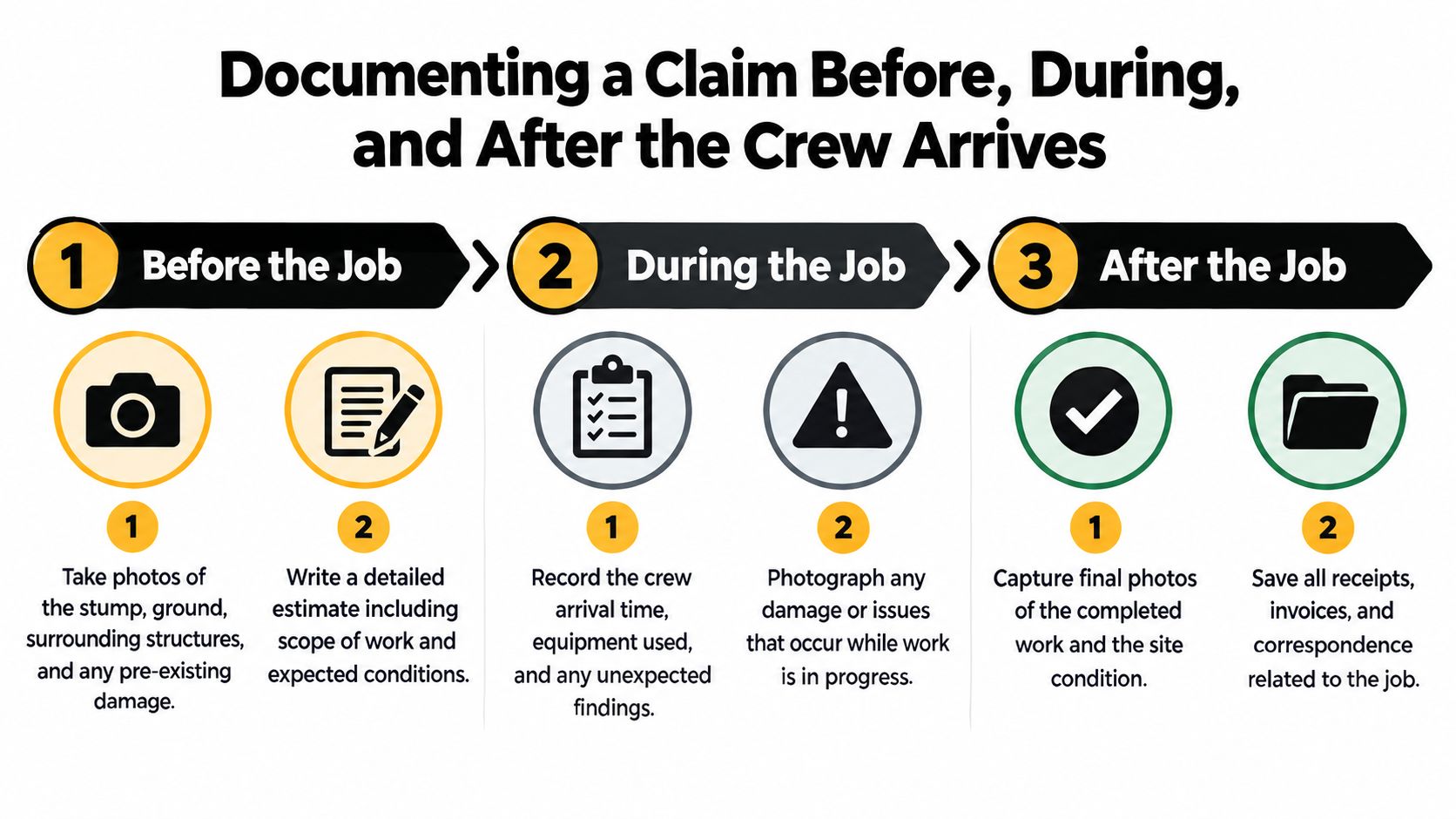
Before the job
Photograph the stump from several angles, the surrounding ground, nearby structures, and any existing cracks or damage. If the work follows a storm, save relevant weather and claim correspondence. Get a written estimate that states what the crew will grind, how deep it will work, whether chips will stay on site, and what cleanup is included.
Mark visible irrigation heads and private garden features with the contractor before work begins. Ask who will arrange utility locating where subsurface work requires it, and don't assume a public locate will identify homeowner-installed irrigation or lighting.
During the job
Walk the site with the crew lead. Confirm equipment access, protection for nearby property, and the work area. Keep a record of arrival, unexpected findings, and any damage as it happens. The work authorization should say who is responsible for utility locating, customer-supplied information, and damage reporting.
After the job
Take completion photos before the crew leaves. Keep the final invoice, paid receipt, signed authorization, and the contractor's COI together. If damage occurs, photograph it promptly, notify the contractor and insurer, and avoid changing the area before you've been told whether an inspection is needed.
Storm cleanup should start with a risk assessment, not an automatic decision to remove every damaged tree. For more on arranging storm-damaged tree removal, keep the focus on the tree's condition and the people or property it could reach. Your documentation should support that assessment and show what work the contractor was authorized to perform.
Deductibles, Reimbursement, and the Real Cost Math
An insurance claim isn't automatically the cheaper option. Compare the covered loss, your deductible, and the work the insurer has approved before deciding whether to file.
A stump-grinding bill is often separate from storm damage to a structure. If the only work is removing an old stump or improving a yard, you may be paying directly. If a tree has damaged a home, speak with the adjuster about the covered property damage and ask whether stump removal is included under your policy. Don't count on reimbursement for work that hasn't been approved.
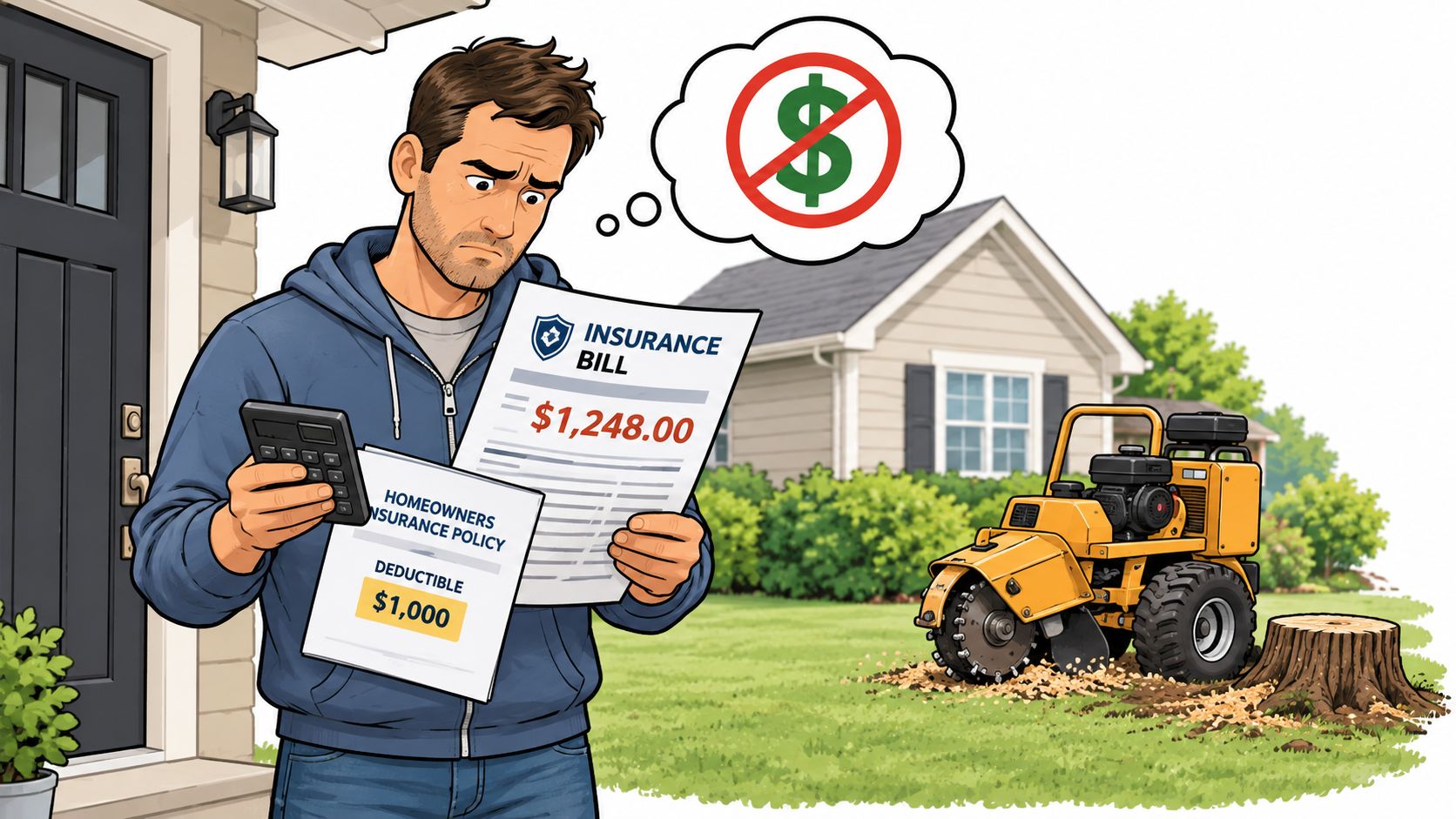
If the contractor damages a buried line or a structure, that's a different conversation from filing for a storm-damaged tree under your own homeowner policy. Ask the contractor to notify their carrier and provide claim details. Don't let anyone blur a contractor-caused loss into a homeowner maintenance expense.
Liability coverage is also a real cost for small operators, not a decorative line on a bid. In an NFIB survey, 30% of small-business owners ranked liability insurance cost and availability as their second most important insurance concern (NAIC small-business insurance overview). That context supports a practical point: a suspiciously low quote that comes with no verifiable coverage isn't necessarily a bargain.
Before filing, ask your insurer what the policy covers, what deductible applies, and whether the stump work is part of the claim. Then compare that answer with the contractor's written estimate. For a standalone grinding job, paying out of pocket may be more straightforward than trying to turn routine yard work into an insurance claim.
Working With an Insured Atlanta-Area Crew Without Getting Burned
The lowest bid can become the expensive one if the contractor's policy excludes the work or the crew damages a line that nobody planned to protect. When you compare a tree service in Marietta, Roswell, Kennesaw, Woodstock, Acworth, or Canton, assess the paperwork and job plan alongside the price.
For commercial work, buyers set their own requirements. A Georgia county solicitation calls for $1,000,000 general liability per occurrence, $1,000,000 automobile liability per occurrence, and workers' compensation/employer's liability limits of $1,000,000 for accident, disease per employee, and disease policy limit, with coverage maintained through the contract term. That's a project-specific example, not a blanket rule for homeowners. Property managers should compare their contract requirements with the contractor's policy and endorsements before onboarding.
Watch for a cash-only operator with no verifiable business details, no workers' compensation information, or vague answers about underground exclusions. Ask whether the crew uses subcontractors and whether those workers' coverage is verified. If you need a licensed and insured crew, ask what credentials the arborist holds and what experience the team has with stump grinding near hardscape, irrigation, and utilities. An ISA credential can help you assess professional expertise, but it doesn't replace insurance verification.
Use this script when you call:
“Does your policy cover stump grinding and underground damage? Can you confirm the coverage is active, explain any relevant exclusions, and send a written scope with the estimate?”
Then ask how the crew will protect nearby windows, vehicles, fences, and planting beds. If you're deciding between providers, this guide to questions to ask a tree removal service can help you compare answers. A reliable contractor should explain the job plainly, provide current paperwork, and offer a free estimate without making you chase basic details.
Your Stump Grinding Insurance Checklist and Common Questions
Before signing, keep the checklist short and firm:
- Policy confirmation: Get a current COI and verify the coverage with the contractor's insurance contact.
- Work scope: Confirm stump grinding is covered and underground damage isn't excluded.
- Crew protection: Ask whether workers' compensation is active and whether subcontractors are covered.
- Written agreement: Specify the stump, grinding scope, cleanup, utility-locate responsibility, and how damage will be reported.
Will stump grinding raise my insurance rates? A claim can affect your policy history, but the outcome depends on your insurer and circumstances. Ask your carrier before filing a claim for routine grinding.
What if the crew hits a buried line? Photograph the damage, notify the contractor immediately, and contact the affected utility or service provider. Ask the contractor to report the incident to their insurer.
Do I need a permit in Cobb or Cherokee County? Requirements depend on the location and type of work. Check with the relevant city or county before removing a hazardous standing tree or starting land clearing; don't assume Atlanta rules apply elsewhere.
How should I document a hazardous tree? Photograph the danger and obtain a professional risk assessment. DeKalb County says a tree threatening human life or property may be removed without prior notice when the danger is documented through a certified tree professional's risk assessment (DeKalb County homeowner tree-removal guide).
If you need tree removal, tree trimming, emergency tree removal, stump grinding, or a documented estimate in North Metro Atlanta, start by asking for a clear scope and verifiable coverage. Those records make it easier to manage the job safely and respond if a claim arises.
Richmond Tree Experts GA provides tree removal, stump grinding, and arborist services for Atlanta-area homeowners and properties, with ISA Certified Arborists and professional equipment. For a documented estimate and practical guidance on your tree-care needs, visit Richmond Tree Experts GA.

