

A tree pruning chainsaw is justified only for a large limb larger than roughly 3 to 4 inches that you can cut from stable ground with the bar below shoulder height. Every other case belongs to hand tools, a rated pole saw for work above roughly 9 feet, or an arborist.
The popular advice gets this backwards. It starts with bar length, battery size, and which compact saw feels easiest in one hand, as if a smaller saw makes an overhead limb safer. It doesn't. Diameter matters, but height, tension, footing, and what's under the limb decide whether you should cut at all. A light saw over your head, from a ladder, over a driveway in Marietta or Roswell is still the wrong job setup. Read the limb first and let the tool follow.
When a Chainsaw Belongs on the Limb
Most homeowners searching for a tree pruning chainsaw want permission to handle one limb today. I'd start with a stop rule instead. If you can't stand on stable ground, keep the bar below shoulder height, clear a drop zone, and stay clear of wires, you don't have a chainsaw job.
Match the Tool to the Wood in Front of You
Twigs don't need power. Smaller branches you can control with two hands don't need a chain either. Neutral extension guidance summarized by Iowa State University Yard and Garden Extension puts hand pruners on twigs, loppers on smaller branches, and pruning saws on branches up to roughly 3 to 4 inches, reserving chainsaws for large branch removal.
That order protects you and the tree. A pruning saw gives you control on wood small enough to support or guide. A chainsaw adds speed, but it also adds kickback, a moving chain, and far less forgiveness when the limb shifts.
Read this table from the top and stop at the first row that matches your yard. If two rows fit, the stricter one wins.
Which tool this pruning job needs
| Situation | Right tool | Chainsaw is out when |
|---|---|---|
| Twigs and small shoots | Hand pruners | Any powered cut is being considered |
| Smaller branches two hands can control | Loppers | The bar would be longer than the wood |
| Branches up to about 3 to 4 inches | Pruning saw | Footing is soft, sloped, or cluttered |
| One large limb, stable ground, bar below shoulder height | Chainsaw and the three-cut | Wires, a roof, a drive, or tension are in play |
| Work above roughly 9 feet | Rated pole saw or aerial crew | The saw would be over shoulder height or used from a ladder |
| Limb near a service drop or against a house | Utility or arborist crew | Anyone plans a homeowner cut |
| Hanging broken limb or widow maker | Storm crew | Someone would stand under it to trim |
| More than half the canopy already gone | Arborist survival call | The plan is cosmetic cleanup with a saw |
Why Compact and Battery Powered Don't Change the Verdict
A small saw is useful only inside its limits. If you're comparing a homeowner option for small, ground level work, a 6-inch battery chainsaw with charger shows the category clearly, but its size doesn't fix unstable footing, overhead wood, or a limb under tension. Don't use compact dimensions as a reason to reach higher or stand on a ladder.
Timing matters too, and it's worth checking the best time to prune trees before you remove live wood that could wait for a better season. Deadwood is different from a live structural limb, and the reason for the cut should be clear before the chain moves.
Water oaks and pines across Cobb County and Cherokee County can hide decay inside a thick looking limb. Thickness alone doesn't prove the wood is sound or predictable. The single case that may continue is narrow: one large, sound limb, at ground level, clear of structures and lines, with room for it to fall.
Gear and Checks Before the Saw Starts
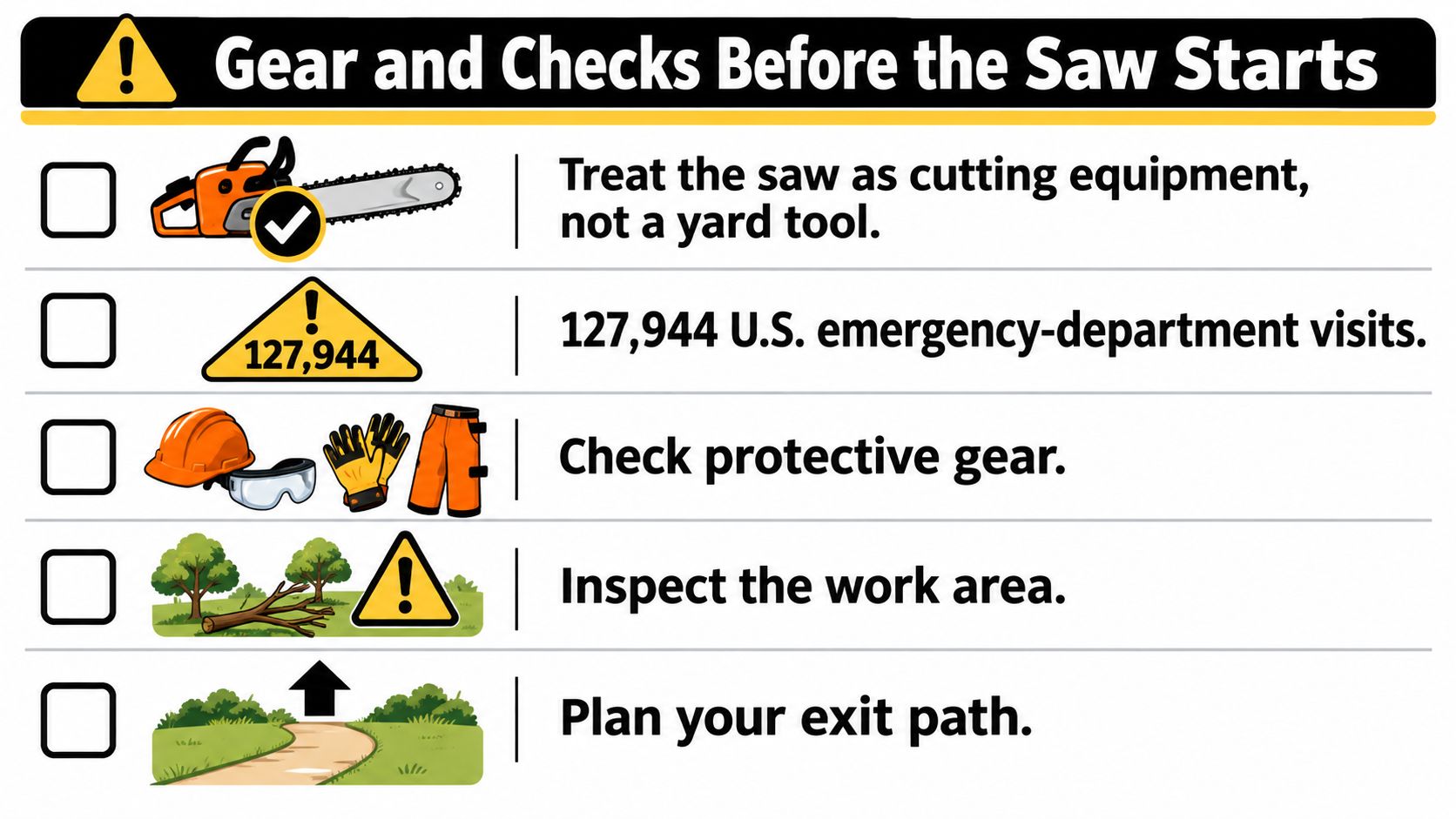
Treat a tree pruning chainsaw as professional cutting equipment, not as a faster pair of loppers. A Penn State Extension summary of a peer-reviewed study estimated 127,944 people in the United States were treated in emergency departments for chainsaw related injuries from 2018 through 2022, about 70 emergency visits per day. That same summary reported landscaping accounted for 92 nonfatal injuries and 33 fatal injuries in the occupational categories, the highest counts among the listed sectors.
Pruning raises the risk because you're rarely cutting a log that's sitting still on the ground. You're working around branch tension, awkward stance, overhead deadwood, and a limb that can roll or drop early. The checks below take minutes. Skipping them is how a routine Saturday cut turns into an emergency.
Use this visual checklist as your pre start walkthrough before fuel goes in or a battery clicks on.
Inspect the Saw and Dress for a Chain Strike
Start with the machine. Confirm the chain brake engages, the chain is sharp and properly tensioned, bar nuts are tight, and the chain moves freely with the saw off. A dull chain forces you to push, and pushing is where control goes. If you're unsure about cutter geometry, review the correct chainsaw sharpening angle rather than guessing with a file.
Wear the full set every time:
- Head protection: Wear a hard hat for overhead deadwood and falling stubs.
- Eye and hearing protection: Use rated eye protection and hearing protection for gas saws and loud work sites.
- Hand and leg protection: Wear gloves with grip and chainsaw chaps that cover the front of both legs.
- Foot protection: Wear slip resistant boots with a defined heel, never sneakers on wet leaf litter.
The human cost behind that list is not theoretical. The OSHA tree care issues document estimated approximately 1 fatality per 1,000 tree trimmers and about 1,100 nonfatal occupational injuries annually. In OSHA hurricane response observations in that document, missing or improperly used PPE appeared in approximately 55% of entries.
Clear the Ground and Name Your Exit
Look up before you look at the cut. Check for deadwood, hanging branches, service drops, and power lines. Then look down and clear brush, hoses, irrigation heads, and anything that could catch your boot.
Mark where the limb should land and keep people, pets, and cars out of that zone. Pick an escape path away from the expected fall and keep it open. Shut the saw off or set the brake before walking through brush or carrying the saw between positions.
If you can't name the drop zone and the escape path, you're not ready to pull the trigger.
Keep both hands on the handles. Don't cut a spring pole or a limb that's bent and trapped, because stored tension can whip the wood when fibers release. Stop for wind, rain, fatigue, poor visibility, or footing you wouldn't trust with the saw switched off. On residential lots in Kennesaw, Woodstock, Acworth, and Canton, pedestrians, vehicles, buildings, and utility lines complicate the drop zone quickly, so a clear lawn on paper may not be clear in practice.
How to Make the Three Cut
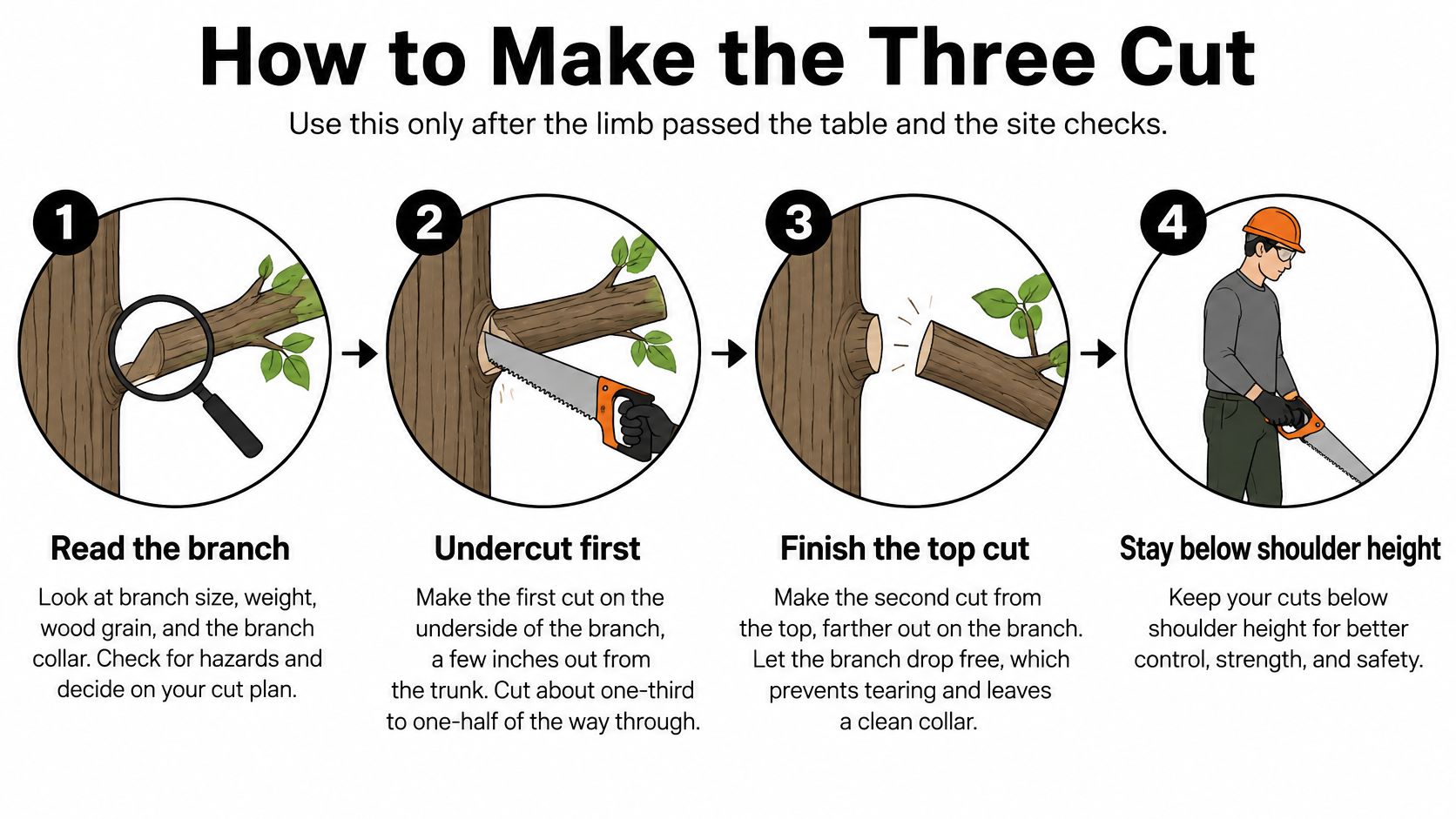
Done right, this sequence strips weight off the branch in stages so bark can't peel down the trunk and the final wound stays small. Use it only after the limb passed the tool table and the site checks. No order of cuts rescues a limb that should never have met a chainsaw.
The steps below show the order and the shoulder height limit in one view.
Read the Load Before the First Cut
Stand at the cut point and decide which way the limb wants to fall. Check the attachment for cracks, included bark, a split union, or soft decay, because any of those can let the limb go earlier than your plan. A falling branch rarely drops clean. It clips lower limbs on the way down and kicks sideways, so walk the landing lane once more from the angle where you'll be standing.
The U.S. Forest Service trail management terms and training material describes a three cut sequence for branches too large to support by hand and warns against running a chainsaw above shoulder height, where control drops and a thrown chain can reach your face or chest. Anything you can't reach from firm, flat footing belongs on a rated pole saw or with a crew working from a bucket truck or climbing line. A ladder under a running saw is a bad trade no matter how short the limb looks from the ground.
The Three Cuts in Order
Make the undercut first. Cut shallowly on the underside, just outside the branch collar, about a quarter of the way through. This scores the bark so it can't peel in a long strip down the trunk when the limb drops. Keep the guide bar clear of dirt and let a sharp, properly tensioned chain do the work.
Make the top cut farther out. Move a few inches beyond the undercut and cut from above until the limb separates and falls, leaving a short stub. As the wood starts to go, step off along your escape path. Don't chase the cut, reach under the limb, or try to steer falling wood with a free hand.
Remove the stub at the collar. Shut the saw off before you approach, then restart in position. Make the final cut just outside the branch bark ridge and branch collar, leaving the raised collar intact. A flush face looks tidy for a week and opens a bigger wound for years. A long stub dies back and does the same damage from the other direction.
Practical rule: The collar is the finish line. If you removed it to get a flat face, you made the wound bigger, not cleaner.
What This Sequence Does Not Fix
Don't paint the wound. Don't bore cut into a limb you can't see through, and don't plunge the bar tip into crowded wood where a hidden stub can grab the chain and kick it back at you. Keep the bar out of soil. One pass through dirt dulls cutters enough that the next cut turns into a shove.
The whole sequence also assumes wood carrying no stored load. A spring pole, a limb pinned under a fallen tree, or a branch bent under tension can whip the instant the last fibers release. Those pieces get relieved in small staged cuts with rigging, ropes, and distance between the saw and the wood, which is exactly the kind of setup a crew brings.
Take a thick water oak limb over open lawn in East Cobb, reachable below shoulder height with nothing underneath. That cut fits this sequence. Put the same limb over a porch roof, a fence corner, or a service drop and the mechanics stop mattering, because the cost of a bad drop changed. Boring, open, and predictable is what you want. If the limb is interesting, it's a crew job.
Cuts That Close and Cuts That Fail Later
A fast, pale cut is not automatically a good prune. Homeowners often judge tree trimming by how smooth the face looks that afternoon. The tree judges it over the next several seasons by whether it can compartmentalize the wound and grow closure wood over it.
That only works if the collar stays, the wood isn't crushed, and you didn't tear a strip down the trunk. A dull chain chews instead of slicing, leaving jagged fibers that slow closure. A flush cut removes the very tissue the tree uses to seal the wound. A long stub dies, decays, and holds the wound open from the other direction.
Topping Is Not Hazard Reduction
The worst version of this mistake is topping, where someone cuts a trunk or major limbs back to stubs to make a tree smaller. The UGA Extension guidance on tree topping warns that topping stimulates fast growing water sprouts with weak attachment points, making them more likely to break during wind, ice, or snow. That guidance recommends selective canopy thinning early in a tree's life to reduce wind loading instead.
Don't take a heading cut on a leader just because it makes the saw fit or gets a limb off a roofline today. You're trading one clearance problem for a cluster of weakly attached sprouts at height. If the goal is hazardous tree prevention in Roswell or Marietta, targeted tree pruning that preserves strong branch structure beats a smaller looking crown full of stubs every time.
Shade today is not safety tomorrow if the regrowth is attached to a stub.
Sanitation on a Bar and Chain
Cut quality also includes what you carry to the next tree. The University of New Hampshire Extension pruning fact sheet recommends cleaning pruning tools between cuts, especially when moving between related healthy and diseased trees, using isopropyl alcohol or a 10% bleach solution.
On bar and chain equipment, start by removing packed sawdust and sap from the bar groove and around the sprocket with the saw off and the battery or plug lead removed. Then wipe accessible cutting surfaces when you're moving from a suspect tree to a healthy one. It's slower than production cutting and won't sterilize every link perfectly, so order matters. Work healthy trees first, isolate the suspect tree last, and don't carry wet, diseased sawdust across a Saturday route through Alpharetta or Johns Creek.
That sanitation step can't rescue bad technique. It won't restore a collar you cut off, close a torn wound, or make a topped crown sound. Skip wound paint as well. When you finish, you should be able to look at the cut and answer one question without guessing. Is the collar still there?
Storm Limbs and When to Call a Crew
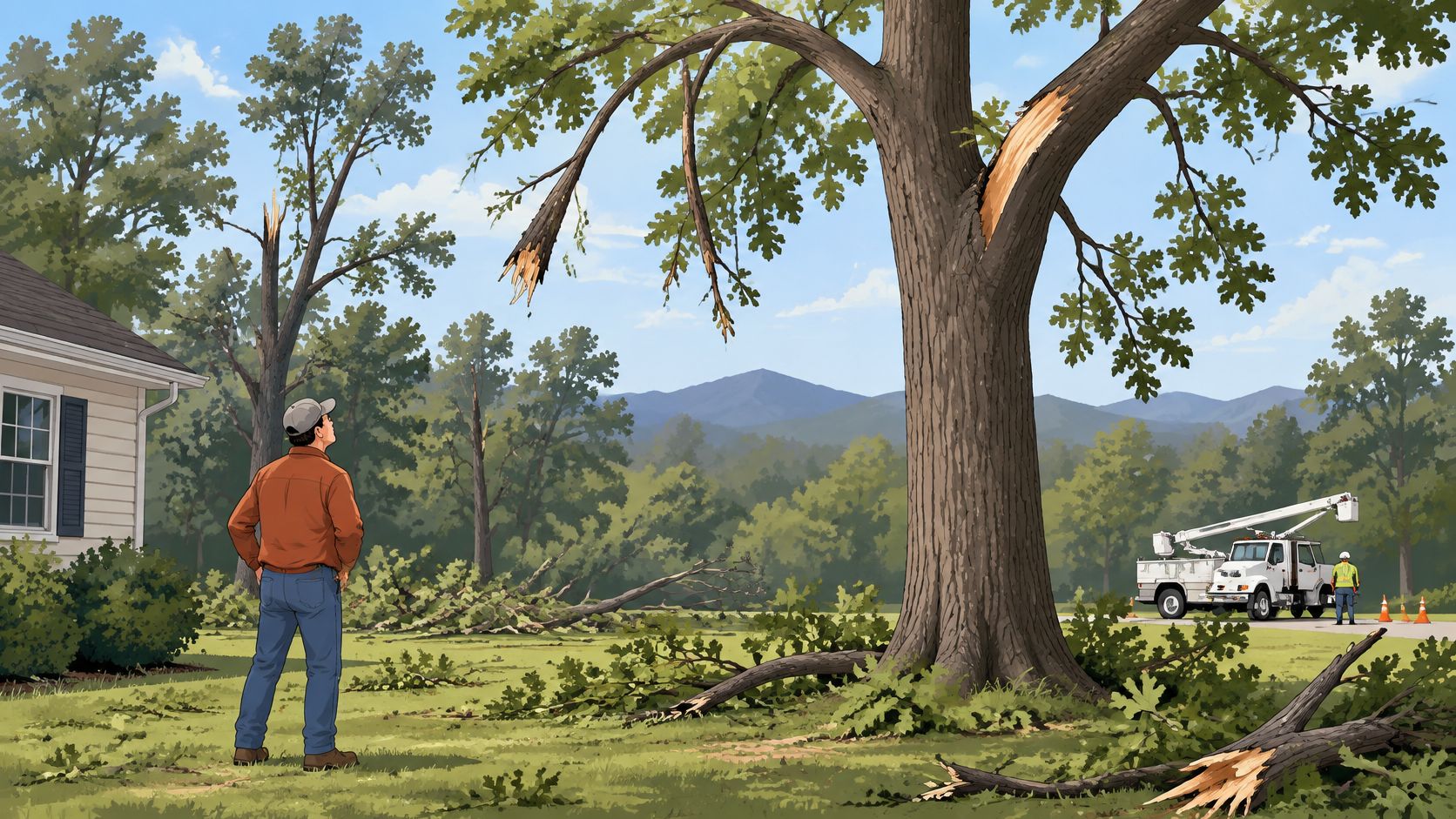
After a North Georgia storm, the most dangerous wood is often still in the tree. Ground debris looks messy, but broken limbs hung up in the canopy are what fall on people during cleanup.
Start by looking up from a distance, the way you would before walking under any damaged tree.
Sort Storm Wood by Threat, Not by Mess
The UGA Extension Forsyth County storm damaged tree guidance identifies hanging broken branches, often called "widow makers", as falling hazards and says homeowners should assess the damaged tree, nearby trees, and the surrounding area before pruning or removal. It also says larger jobs should be handled by professionals.
A limb on a roof, wood hanging over a line, a trunk across the drive, or a tree leaning toward the house calls for tree removal with rigging and controlled lowering, where crane support keeps additional damage from happening. Standing under a hanging limb to trim its tips is how cleanup turns into an injury.
Power lines end the discussion. UGA Extension guidance on damaged trees tells homeowners to stay off any tree involving a downed power line until the utility company has made the area safe. That includes a limb resting on a service drop to the house, not only the big lines along the street.
If the tree is stable, no lines are involved, and broken wood is small and reachable from the ground, prompt removal of dead and broken pieces is reasonable. Everything else waits for an assessment. Rank threats to people and the structure first, then access, then debris. A tidy yard comes last.
The Survival Threshold Changes the Job
Some storm damaged trees cannot be pruned back into shape. The UGA Extension Lincoln County damaged tree guidance sets a practical threshold: when more than 50% of a tree's branches and leaves are gone or damaged, the tree is unlikely to survive through the next growing season. Past that point, cosmetic tree trimming wastes money and leaves a declining, hazardous tree standing over the same roof.
Decision-stage questions belong here. How much tree removal costs, whether a permit is needed, what the signs of a dangerous tree look like, and how quickly a crew can respond all depend on access, targets, and whether removal, pruning, or monitoring is right. At Richmond Tree Experts GA, every job is looked at by an ISA Certified Arborist before it is priced, and the scoping arborist tells you whether the tree needs to come down, can be pruned back to health, or is fine to leave alone.
Watch how a professional evaluates storm work before anyone starts a saw, then compare that to the tree in your yard.
For documentation and insurance, act before cleanup crews haul evidence away. The FEMA page on removing a tree from private property says homeowners should document tree damage and assess immediate dangers before arranging removal, and it recommends contacting the home insurer because many policies cover tree removal when a disaster-caused tree damages the home or blocks access. FEMA also clarifies it does not directly remove trees from private property.
Take photos from the street and from each side of the house, including where the tree contacts the structure. Stay off a damaged roof to get a better angle. For planned follow up after the emergency work, the storm damaged tree removal service covers how hazardous, dead, and storm damaged trees are scoped, including tight access and crane assisted work when a tree cannot be dropped in one piece.
Hire or DIY After a Storm
Use the table below as a same day sorting tool after storm damage in Marietta, Roswell, Alpharetta, Milton, Johns Creek, or Cumming. When wood is already on the house and you need a crew at midnight, you are already in the right-hand column.
Hire or DIY after a storm
| Situation | Homeowner DIY | Call a crew |
|---|---|---|
| Small dead limb, tree stable, reachable from ground | Reasonable with pre-cut checks | Optional |
| Ground-level limb that passed every check | Careful three-cut | Not needed |
| Limb on roof, hanging over drive or line | No | Crew same day |
| Tree leaning on house or split at trunk | No | Crew and insurer |
| More than half the canopy damaged | No cosmetic trimming | Arborist survival assessment |
| Limb over service drop or downed power line | No | Utility, then crew |
A legitimate tree service puts an arborist on the tree before anyone quotes a number and can explain the difference between tree removal, corrective tree pruning, and leaving the tree alone. Ask who assessed it and what standard the cuts follow. Good tree trimming and pruning means crown thinning, deadwooding, and clearance cuts to ISA standards rather than topping.
The same visit often raises the next decisions. A removed tree may need stump grinding so the area can be replanted or graded. Several damaged trees on one lot may turn into land clearing and lot preparation rather than a single removal. Get those scoped separately instead of assuming storm work includes them, and expect the crew to haul away every branch before they leave.
Cost questions deserve a straight answer, but no honest crew can price hazardous tree removal from diameter alone. Height, lean, decay, targets under the canopy, crane access, and whether wood is already on a structure drive the number. Permit rules vary by city and by where the tree sits on the lot, so confirm requirements before scheduling non-emergency tree removal in Cobb County or Cherokee County. Work that makes a home safe comes first, documentation right behind it.
If the wood can still fall on someone while they cut it, they're already too close.
Request an assessment when any row in the table points to a crew, when you cannot confirm the tree is stable, or when more than half the canopy is gone. That call separates a pruning cut from tree removal work, and they are different jobs with different equipment.
If a limb is over your roof, on a line, or past what you can cut safely from the ground, contact Richmond Tree Experts GA for an assessment by an ISA Certified Arborist before anyone prices the work. The company handles tree removal, tree pruning, stump grinding, and tree appraisals across Marietta, Roswell, Alpharetta, Johns Creek, Milton, Cumming, and the surrounding North Metro Atlanta counties, with crane assisted removal for hazardous, dead, and storm damaged trees in tight access. The scoping arborist will tell you plainly whether the tree should come down, be pruned back to health, or be left alone.

