

A pine limb is on the shingles over a Marietta bedroom, or a hanger is still swinging above a Cherokee County drive after last night's wind. You're searching tree pruning near me because you want that wood gone before the next cell, and you don't want a crew that tops the crown or saws past the property line. A lot of those results treat winter as automatic permission, or treat "the branch is on my side" the same way. Neither one is a work order.
Sort the yard into three calls: book now, schedule, or stop. A limb on a roof, a blocked drive, or wood that may be under tension is a professional job, not a weekend chainsaw project. Deadwood and roof clearance can wait for a planned visit. A hollow, badly leaning, or uprooted trunk is often removal. Cosmetic rounding can wait for a better month.
The towns behind those searches are the ones we work in: Marietta, Roswell, Kennesaw, Woodstock, Acworth, and Canton, plus East Cobb, Cobb County, Cherokee County, Alpharetta, Milton, Johns Creek, and Cumming. Name the hazard, what sits under it, and who is allowed to cut before anyone starts the saw.
What Your Tree Needs Before You Book
Use this split before you book tree removal, tree trimming, or a storm cleanup. The right response is not the same for a hanger, a young double leader, and a neighbor's limb.
| Situation | Right response | Who should do it |
|---|---|---|
| Limb on a roof or blocking a drive | Remove the hazard soon; do not DIY the load | Equipped professional crew |
| Hanger or split leader after wind | Prompt assessment, not a wait for winter | Professional crew |
| Deadwood over a house, drive, or play area | Selective deadwooding on a scheduled visit | Trained pruning crew |
| Branches near a power drop or overhead line | Stop and assess clearance before any cut | Line-aware qualified crew |
| Young tree with two competing leaders | Formative pruning while cuts are small | Arborist or skilled pruner |
| Neighbor branch crossing the line | Proper cuts only, limited live canopy, written agreement | Agreed qualified cutter |
| Hollow, severely leaning, or uprooted trunk | Often removal rather than pruning | ISA arborist evaluation |
| Shape-only trim with no target below | Can wait for a suitable season | Small hand work or a scheduled crew |
Book the hazard the same day
A limb on a house, a drive you can't use, or a split leader after wind is emergency tree removal territory, not a trim you save for leaf drop. The Georgia Forestry Commission says homeowners should attempt only minor debris cleanup after storm damage. Don't try to move large trunks or limbs alone, and don't try to take down leaning trees or large branches resting on roofs. Storm-damaged wood can be under tension and snap when it's moved. The Commission also notes that historically more people are injured by chainsaws than by the storm that caused the damage.
That is the line for fallen tree removal on a home, a dangerously leaning pine, and a blocked access route. Photograph the attachment, whatever sits underneath, and any overhead line. Keep people and pets out of the drop zone. Stay off a ladder under damaged wood.
Schedule the cut that isn't failing
Deadwood over a house, drive, or play set is real work, and it can go on a scheduled visit. So can clearance that isn't already touching the roof. On a young tree, two competing leaders should be corrected while the cut is still small. Waiting until those stems are the size of a fence post turns a hand-saw job into a structural defect.
Stop when the job isn't pruning
A branch that only crosses the property line is limited pruning, not a reason to strip one side of the crown. Get the line, the owner, and a written agreement straight before anyone cuts. A hollow, severely leaning, or uprooted trunk is often hazardous tree removal. That keep, prune, or remove call belongs to an arborist before a saw comes out. A shape-only roundover, with nothing under the crown, can wait.
Practical rule: If the wood can hit a person, a roof, or a drive, don't turn it into a Saturday project.
The cut itself, the month you choose, and who should be on the property are the next decisions. A good pruning visit names those before the truck is booked.
The Cut That Lets the Tree Seal
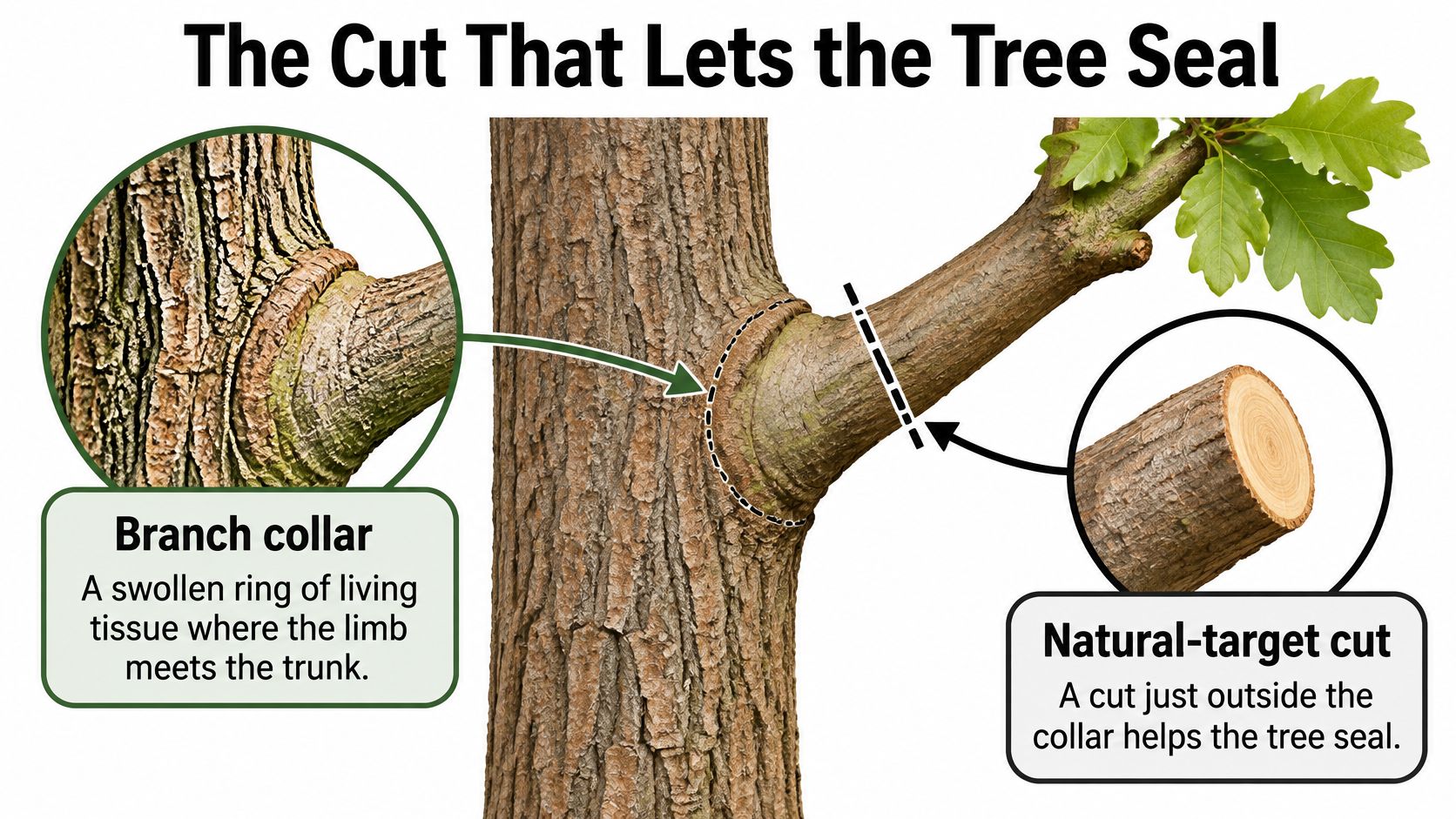
The branch collar is the tree's bandage roll. It's the swollen ring of living tissue where the limb meets the trunk. A natural-target cut sits just outside that collar and outside the branch bark ridge. That is the cut that lets the tree seal.
What a bad cut does
Cutting through the collar, leaving a stub, or flushing the limb flat against the trunk opens a bigger wound. The collar holds the living tissue that grows woundwood. Take the collar off and you impair compartmentalization, the process the tree uses to wall off decay. On a mature water oak over a Roswell roof, or a pine beside a retaining wall in Woodstock, that torn bark becomes the next structural problem, not a clean finish.
The ANSI A300 pruning standards call for a natural-target cut just outside the branch collar, without cutting through the branch bark ridge, leaving a stub, or making a flush cut. The same guidance favors the smallest cut that meets the objective and calls for precutting large limbs so bark doesn't tear and the stem doesn't split.
The three-cut sequence
For a limb too heavy to hold while you finish the cut, use three cuts in this order:
- Undercut. Saw the underside first so the bark can't strip down the trunk when the limb falls.
- Outer top cut. Move out along the limb and drop the weight away from the collar.
- Final cut. Come back and finish just outside the collar, not into it.
Skip the undercut and the falling limb peels a slab of bark. That wound is larger than the pruning cut you meant to make, and it shows up later over driveways, turf, and walls that already sit in a tight drop zone.
What belongs on the work order
A written plan should name deadwood removal, clearance, reduction, and any work on codominant stems. Our tree trimming covers crown thinning, deadwooding, and clearance from roofs, drives, and lines, cut to ISA standards rather than topped.
Topping is the opposite. It chops the crown back to stubs, then the tree pushes a thicket of weak sprouts. Topping is not an ISA pruning objective, and it doesn't make a tall pine safer over a Kennesaw roof. Crown thinning, deadwooding, and clearance are the jobs that belong on a North Atlanta work order.
Reject a bid that can't name the objective or the cut. "We'll trim it" is not a specification.
When to Prune and When Waiting Is Safer
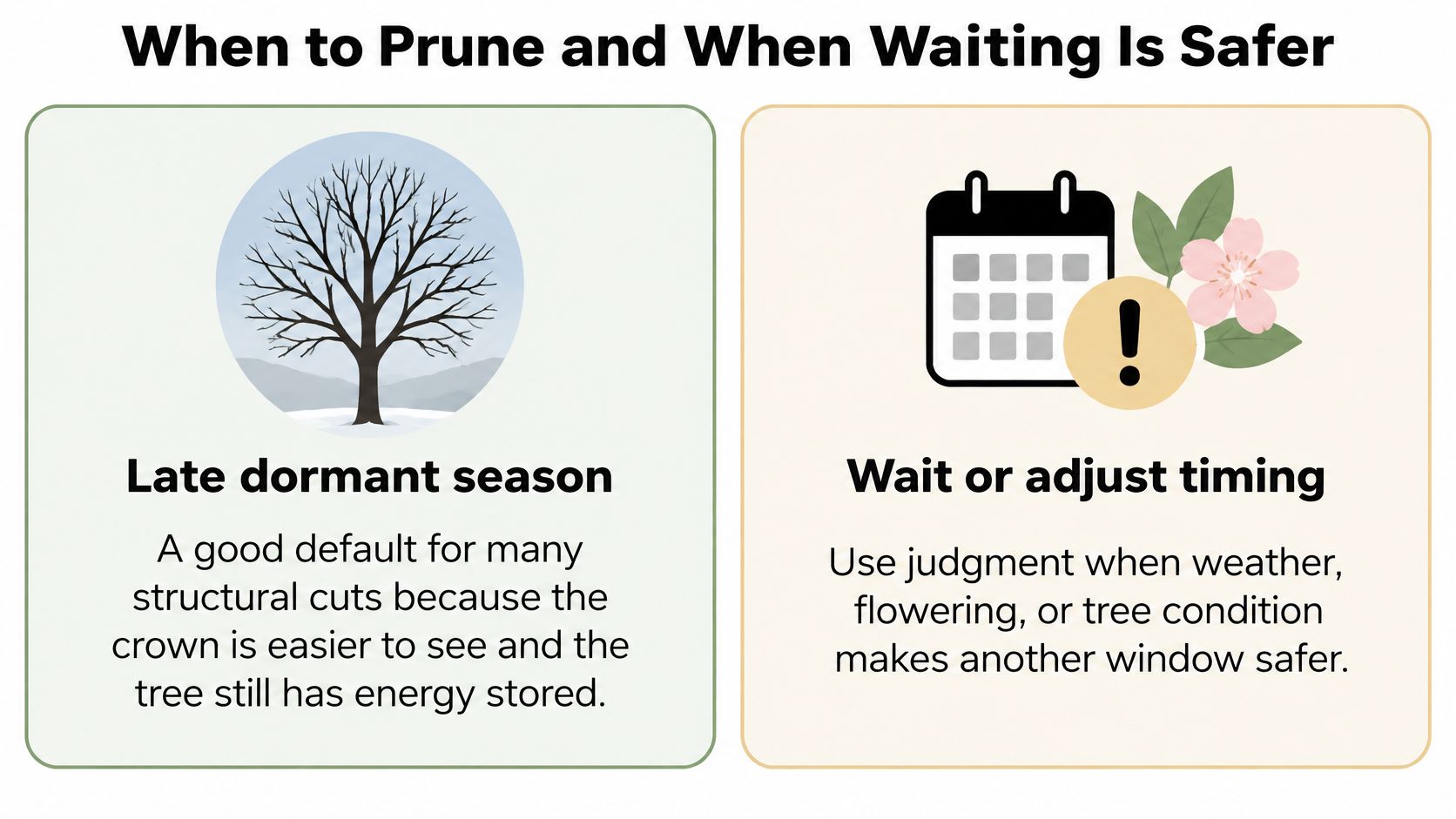
Winter is not always the best time to prune. Late dormant season, before spring bud break, is a solid default for many structural cuts because you can read the crown and the tree still has stored energy. It is not a calendar you can stamp on every oak, pine, and storm break from Marietta to Canton.
Cold months can slow the seal
Purdue Extension, summarizing U.S. Forest Service research, found that beech and oak wounds made in December and February closed significantly more slowly than wounds made in April and October. A convenient dormant cut can stay open longer, which leaves more time for pathogens and weather stress. That tradeoff matters on water oak, willow oak, and other mature hardwoods over older houses in Roswell, East Cobb, and Acworth. Species, vigor, disease, and cut size should set the date. A fixed "we only prune in January" promise doesn't.
USDA conservation guidance puts routine pruning after leaves fall, and it says storm-damaged limbs should be handled soon after the event so jagged wounds, insect exposure, and hazards to people and property don't sit there. The same guidance says timing should account for nesting and breeding of arboreal species. "Winter is always best" gets unsafe when a broken limb hangs over a target. Cutting immediately is also the wrong call when it strips live crown for looks or disturbs an active nest.
More on how we sort those months is in our note on the best time to prune trees.
| Work type | Best window | Reason |
|---|---|---|
| Structural or clearance pruning on healthy trees | Late dormant season, before spring bud break | Canopy is easier to read and stored energy supports recovery |
| Beech or oak cuts | Avoid December and February when possible | Wounds closed more slowly in those months than in April and October |
| Storm-broken or hanging limbs | As soon as it is safe, not after leaf drop | Jagged wounds, insect entry, and targets below raise the risk |
| Young competing leaders | Early, while cuts are small | Smaller defects are easier to correct |
| Deadwood or reduction on mature trees | Scheduled, with selective cuts | Avoids large live-canopy removal in one visit |
| Trees with active nests | Delay non-urgent work until nesting ends | Protects breeding wildlife |
What the work order should name
Young competing leaders get formative pruning early. Mature trees get selective deadwood, clearance, or reduction, not a huge live-canopy removal in one visit. A defensible work order names the objective, the maximum live crown coming off, the cut sizes, and any post-storm hazard. It doesn't promise one season for every tree.
If something can hit a person, a roof, or a drive, don't wait for a preferred month.
When Only an Arborist Should Cut
A limb over a roof, a hanging branch beside a driveway, or a tree close to overhead wires can turn routine pruning into hazardous work. Contact with a power line is a serious danger, even when a person, tool, or branch does not appear to touch the conductor.
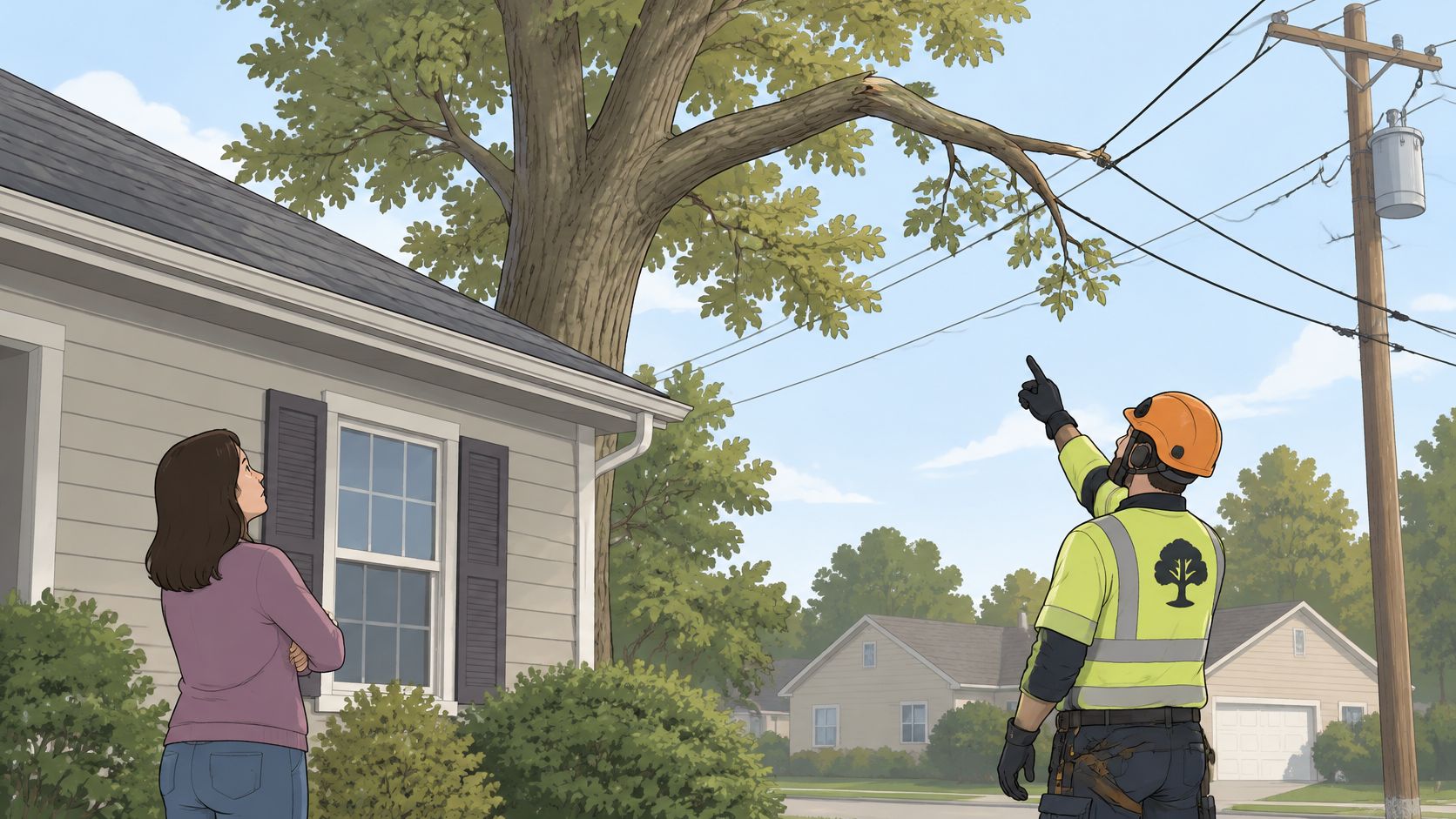
If a branch, rope, lift, or tool could reach an energized line, stop and arrange professional help. Don't climb a ladder against a hanging limb or cut wood under tension. For work near wires, review guidance on tree trimming near power lines.
Before hiring, ask an ISA Certified Arborist to assess whether the tree should be kept, pruned, or removed. Confirm utility clearance before any cutting, and get licensing and insurance details in writing. Richmond Tree Experts GA's ISA-certified arborists provide tree risk evaluations and consultations. The scoping arborist explains whether the tree needs removal, can be pruned, or can safely remain.
A declining pine or oak may have options if its problems are caught early. A written tree prescription sets out a plan for a tree the owner wants to save, which may include cabling or soil care. Pine beetle activity, oak decline, and root compaction can sometimes be addressed with pruning or targeted care. Book the consultation before agreeing to cutting.
What a Pruning Crew Does on the Property
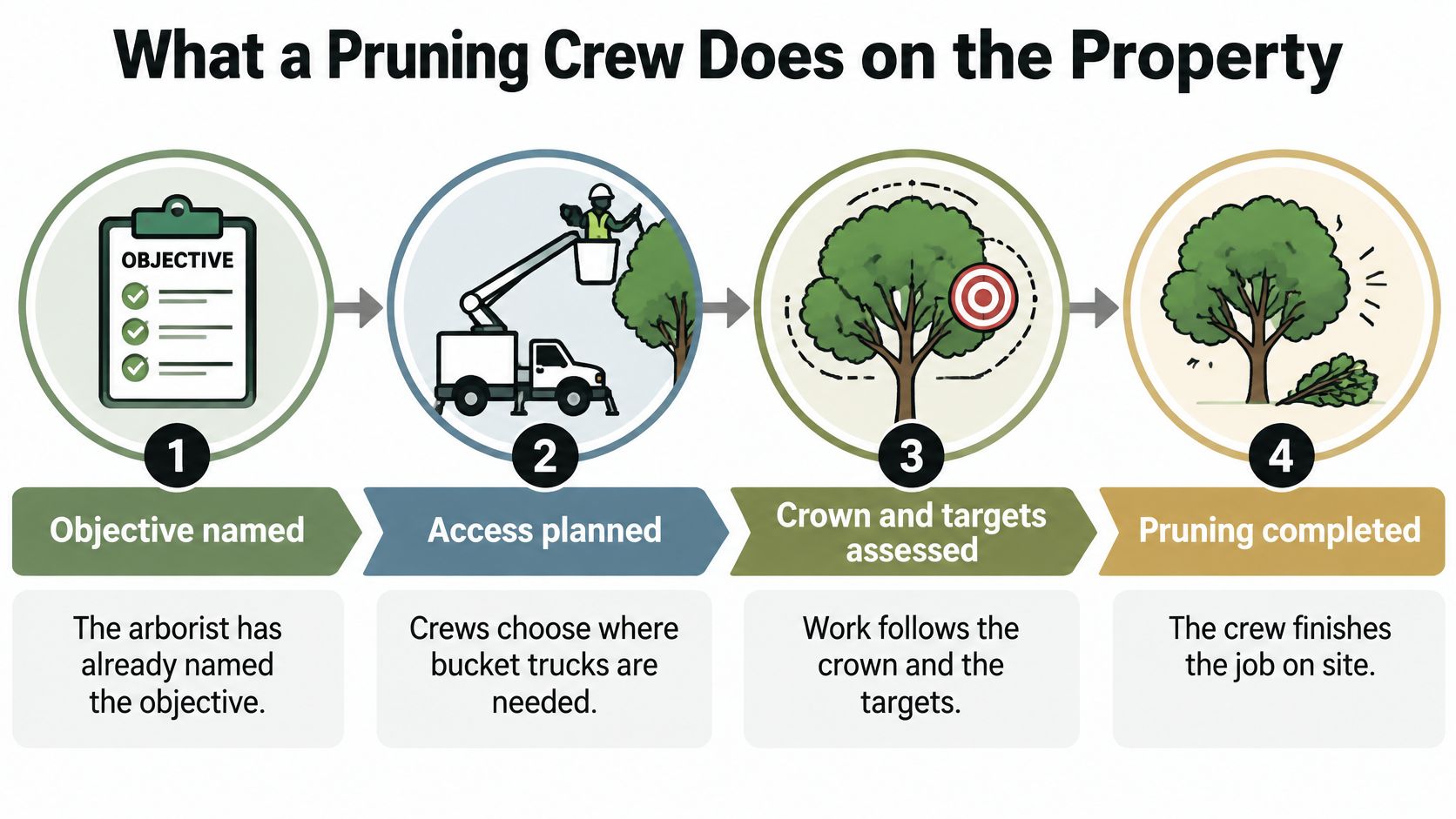
Say the arborist has already walked a water oak in East Cobb. The objective is written: deadwood over the patio, clearance off the roof, and one reduction on a limb aimed at the neighbor's glass. That sheet is what the crew works from. It isn't a slogan about a "full trim."
How the crew gets into the crown
Where the crown and the targets require it, we do precision pruning from bucket trucks. The bucket keeps climbers off the trunk of a tree you're trying to keep. On living trees, spike-less tree care matters because climbing spikes wound the stem you're paying to preserve. A pine you're removing can be climbed differently. A pine you're keeping should not come out of the day with a ladder of new holes.
The cuts are crown thinning, deadwooding, or clearance, finished at the collar. On a tight Marietta or East Cobb lot, the drop zone is the job. Lawns, walks, turf, walls, and patios can't take a free-falling limb, so the crew rigs the wood and protects the hardscape under it. Brush doesn't stay as a pile for you to deal with on Sunday. Crews haul away every branch before they leave.
When the scope has to change
Sometimes the arborist gets into the crown and the tree isn't a pruning candidate. It's hazardous, dead, storm-broken, or in the way, and no collar cut will make it safe. Tree removal then covers that hazardous, dead, storm-damaged, or in-the-way tree, including crane-assisted and tight-access work. Stump grinding can follow on a later visit with a stump grinder sized to finish the stump the first time. That handoff is a scope change with its own price. It isn't a pruning method, and it shouldn't be slipped in as "we cut a little more."
What you should see before the truck leaves
- Named cuts done. Deadwood, clearance, and any reduction on the sheet are finished, and nothing extra was taken "while we were up there."
- No topping stubs. The crown isn't chopped back to pegs.
- Targets cleared. Roof, drive, glass, and play areas match the objective.
- Yard clear of branches. Brush is gone, not stacked at the curb unless that was the agreement.
- License and insurance confirmed in writing before the day starts.
- A free estimate was the start of the job, not a surprise add-on.
- Storm calls follow the company's written response schedule. Don't treat a web ad as an arrival window.
If any of those are missing when the chipper pulls away, the visit isn't finished.
What Moves the Price
There isn't one honest dollar figure for every lot in Cobb, Cherokee, Forsyth, or Gwinnett. Access, height, targets, lines, debris, and urgency move the price. A storm hanger on a structure costs more to answer than a planned weekday prune.
| Cost factor | Raises the price | Keeps it lower |
|---|---|---|
| Access | Tight lot, fence, or no truck access | Open drive and room to stage |
| Height and spread | Tall crown over the house | Small ornamental or low limbs |
| Target below | Roof, glass, turf, or wall that needs rigging | Open lawn with a clear drop |
| Utility lines | Clearance case that must stop near energized lines | No overhead conductors in the work zone |
| Debris | Full haul-away of a large crown | Small volume the crew can remove quickly |
| Urgency | Storm hanger or tree on a structure | Planned weekday prune |
| Scope change | Arborist finds removal or stump grinding is required | Pruning alone meets the objective |
Compliance can change the scope too. Atlanta's guidance allows pruning branches that cross a property line without a permit only when less than 20% of the live canopy is removed, proper cuts are used, and the work doesn't leave the tree unbalanced or unstable. Removing a tree at least 6 inches in diameter needs inspection and approval. "The branch is on my side" isn't unlimited cutting, and city rules aren't the same in every North Metro jurisdiction.
Estimates are free anywhere we work. An arborist visits the tree and gives a written price, usually the same day, with no pressure, and new customers get a 20% discount. If the visit shows removal or stump grinding is required, that work gets its own estimate. Ask for each cost factor line by line. Itemized invoices for landscaping jobs are a useful model for comparing bids on the same terms instead of a single round number.
Permit, Cost, and Response Questions
These are the questions people ask once the limb is already a problem. Short answers first. The detail sits in the matching decision above.
Do I need a permit to remove a tree?
Inside the City of Atlanta, removing a tree at least 6 inches in diameter needs inspection and approval. Pruning a branch that crosses the property line needs no permit only when less than 20 percent of the live canopy comes off, proper cuts are used, and the tree stays balanced. Marietta, Roswell, Alpharetta, Milton, Johns Creek, and the counties write their own rules, so confirm the city or county before you cut. A generic "no permit for pruning" line is how people turn a trim into regulated tree injury.
Do I need a permit for land clearing?
In Cherokee County, yes for real lot work. Cherokee County regulates clearing and grading of one acre or more through a Land Disturbance Permit, and clearing and grading under one acre through an Erosion Control Permit. Removal or destruction of trees counts as regulated activity, as does soil disturbance within 200 feet of state waters. Don't treat stump removal plus grading in Canton or Woodstock as ordinary tree cutting.
Development projects have a second gate. The county won't issue the Land Disturbance Permit until its arborist finds the work complies with the Tree Preservation and Replacement ordinance, and the Tree Preservation and Replacement plan generally must be prepared by a Registered Architect, an ISA Certified Arborist, or a Licensed Forester unless the project is exempt.
How much does tree removal cost?
No single figure fits every lot. Height, access, rigging, lines, debris, and whether the call is planned or a storm response are the factors that set it. Compare written scopes, not a neighbor's price.
How quickly can a crew respond to a storm call?
Confirm the storm response window in writing before you book. This isn't a promised arrival time. Fallen trees on homes, leaning trunks, and blocked drives belong with an equipped crew, and the schedule you agree to is the one that counts.
What are the signs a tree is dangerous?
A hanger, a split leader, a hollow trunk, a severe lean, or an uprooted root plate is a hazard, not a shaping job. Utility contact risk and wood under tension belong in that same stop-and-call group. Deadwood over a target can be scheduled. Shape with nothing underneath can wait.
Call for a Written Pruning Estimate
A limb over a roof, drive, or wire needs prompt attention. Call Richmond Tree Experts GA at 770-974-3964, or request a written tree pruning estimate. Estimates are free: an arborist visits the tree and provides a written price. The company has worked on Metro Atlanta trees since 1985.
Send photos of the whole tree, the problem limb, and the roof or drive below it. Include any nearby wire and name your city so the crew can consider access. Richmond Tree Experts GA serves areas including Marietta, East Cobb, Roswell, Woodstock, Acworth, Canton, Alpharetta, Milton, Johns Creek, and Cumming.
At the visit, ask whether the tree should be pruned, removed, or left alone. Clarify the pruning objective and whether the work affects a neighbor or needs to account for lines, nests, or storm damage. A sound estimate explains the proposed work and price, not just a seasonal trim. Homeowners can compare how companies explain their services through resources such as landscaping business marketing strategies.
Richmond Tree Experts GA offers pruning, removal, and stump grinding. Request a free estimate for the tree on your property, then review the written scope before booking.

