

When you're planning for tree work, the first question on your mind is almost always the same: "What's this going to cost me?"
The short answer is that a combined tree removal and stump grinding job in the Atlanta area can run anywhere from $350 for a small, simple removal to well over $2,500 for a massive, complex tree. The final invoice really boils down to the tree's size, where it's located on your property, and its overall condition.
Answering Your Core Question: How Much Will It Cost?
Getting a handle on the potential investment from the get-go is key to planning your project without any surprises. While no two tree jobs are exactly alike, understanding the general price spectrum is the perfect starting point. The cost isn't just a number pulled out of thin air; it’s a careful calculation based on the labor, equipment, and risk involved.
Think of it this way: taking out a small, young pine from the middle of your open front yard is a pretty straightforward job. But when you’re talking about a massive, 80-foot oak that's leaning dangerously over your house? That's a whole different ballgame. That job requires a specialized crew, heavy-duty machinery like a crane, and a ton of careful planning, all of which directly impacts the final price. For a general look at how different outdoor services can be priced, some companies offer helpful pricing information that gives you a baseline.
A Quick Look at Atlanta Pricing
Let's put some real numbers to this. In busy, tree-lined communities like Cumming and Johns Creek, these services are a common necessity for homeowners and property managers alike. Based on 2025 data, just grinding the stump alone averages around $368, but that can range from $100 to over $1,400 depending on how big and stubborn it is.
To give you a clearer picture, here’s a quick breakdown of what you can generally expect to pay for the combined job of removing the tree and grinding the stump.
Estimated Tree Removal and Stump Grinding Costs in Atlanta
This table gives you a ballpark idea of the typical price ranges for both services together, based on the size of the tree. It’s a great tool for setting a preliminary budget for your project here in the Atlanta area.
| Tree Size | Typical Height | Estimated Combined Cost Range |
|---|---|---|
| Small | Under 30 feet | $350 – $750 |
| Medium | 30 to 60 feet | $750 – $1,800 |
| Large | Over 60 feet | $1,800 – $4,000+ |
These numbers are a solid starting point, but remember that your specific situation will determine the final quote.
Beyond the Basics: What Influences the Quote?
The ranges above give you a good baseline, but several other factors can push the price up or down. Any certified arborist will need to assess these variables during an on-site visit before giving you a firm, written estimate.
The two biggest factors that drive cost are almost always size and accessibility. A bigger tree means more work, more specialized gear, and a larger crew. A tree tucked away in a tight spot or near obstacles instantly ramps up the project's complexity and risk.
Here are the key variables we look at:
- Tree Diameter: A wider trunk doesn't just mean more wood to haul away; it means a much beefier stump that needs to be ground down.
- Accessibility: Is the tree tangled up in power lines, crammed against a fence, or looming over your roof? Tricky access requires more time, precision, and safety measures.
- Tree Health: A dead, dying, or decaying tree can be unpredictable and far more dangerous to take down, which often translates to higher labor costs to ensure a safe removal.
Understanding these core components will help you make sense of the quotes you receive and choose the right team for the job. For an even deeper dive into the numbers, check out our comprehensive guide on https://richmondtree.com/tree-removal-cost-atlanta/.
The Key Factors That Determine Your Final Price
The price for tree services can seem all over the map, but it’s definitely not arbitrary. Think of a professional tree removal project like a custom build—the final cost comes down to the materials, complexity, and labor involved. A simple pine chair is one thing; a hand-carved oak armoire is another entirely.
It's the same with trees. A small, easy-to-reach tree in an open yard versus a giant, hazardous oak leaning over your home are two completely different jobs. They represent different levels of work, risk, and equipment needs, and the price will reflect that.
Understanding what goes into your quote helps you see the value behind the numbers. Every estimate from a reputable Atlanta arborist is a detailed calculation. They assess not just the tree but the entire environment around it to create a safe, efficient plan. This methodical approach ensures the tree removal and stump grinding cost accurately reflects what the job actually demands.
Tree Size: The Most Obvious Cost Driver
The single biggest factor that will move the needle on your bill is the tree's size—both its height and its trunk diameter.
A taller tree means more work for climbers, more complex rigging to lower branches safely, and more ground crew to manage the cleanup. A wider trunk means more wood to cut, handle, and haul away. It also leaves behind a much bigger stump, which takes more time and horsepower to grind down.
For example, a 25-foot decorative pear tree might only take a small crew a couple of hours. But an 80-foot Southern Red Oak? That could easily be a full-day project needing a crane, multiple climbers, and a large team, pushing the cost well into the thousands.
This diagram shows how different factors come together to shape your final price.
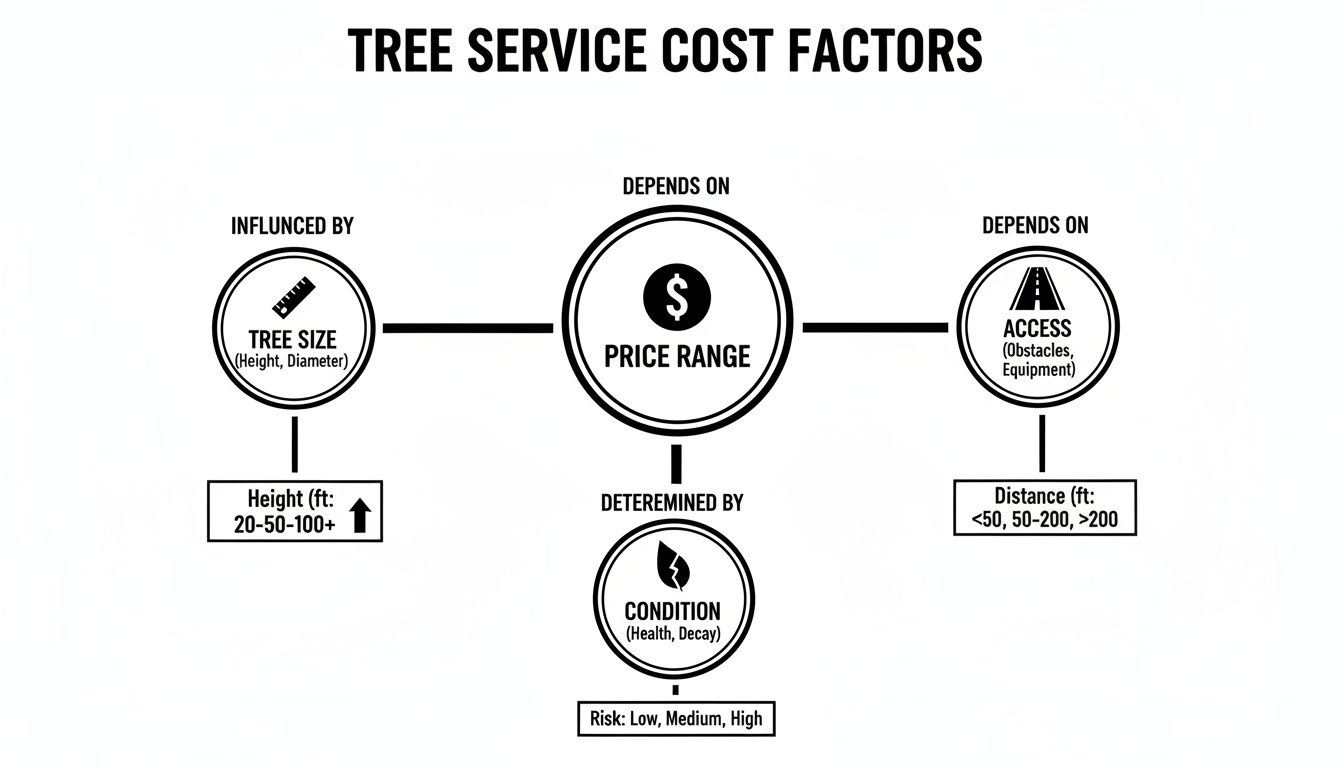
As you can see, the tree’s physical stats are just one piece of the puzzle.
Accessibility: Where Your Tree Is Matters
A tree's location is just as crucial as its size. If it's standing in the middle of a flat, open yard with nothing around it, that's the simplest and cheapest scenario. The real costs start to climb when a tree is in a tricky spot.
A professional's quote isn't just for taking the tree down; it's for taking it down safely without a scratch on your property. Obstacles dramatically increase the time, skill, and equipment needed to pull that off.
Here are a few common challenges that will add to the final price:
- Proximity to Structures: Is the tree hanging over your house, garage, or deck? Crews have to use advanced rigging techniques to carefully lower each piece, preventing any damage.
- Nearby Utilities: When trees are tangled in power lines or growing over underground pipes, the job requires extreme caution and sometimes coordination with utility companies. That means more time on the clock.
- Limited Access: If the tree is tucked away in a tight backyard with no room for a bucket truck, the entire job has to be done by climbers. That's far more labor-intensive and takes longer.
- Slopes and Obstacles: Working on a steep hill or navigating fences, sheds, and delicate landscaping adds a layer of complexity and risk, which requires specialized safety setups.
Tree Condition and Species: The Final Variables
Finally, the tree's health and what kind of tree it is play a big part. A healthy, strong tree is predictable. But a dead or decaying one can be dangerously unstable. The wood might be brittle and snap unexpectedly, demanding extra care—and sometimes specialized gear—to ensure it comes down safely.
The species of the tree also makes a difference, especially when it's time for stump grinding.
- Hardwoods: Dense woods like Oak, Hickory, or Maple are much tougher to cut and grind. They wear down chainsaw chains and grinder teeth faster, which means more time and resources.
- Softwoods: On the other hand, softer woods like Pine and Cedar are generally easier and quicker to process, which can sometimes lead to a slightly lower cost.
Each of these elements—size, location, and condition—builds on the others to form the final, accurate tree removal and stump grinding cost on your estimate.
Stump Grinding Versus Full Stump Removal
Once your tree is safely down, you’re left with the last piece of the puzzle: the stump. What you do next is a bigger deal than you might think, affecting both your final bill and what you can do with your yard later. You’ve got two main routes to go, and knowing the difference is key to making a smart investment in your property.
Think of it this way: stump grinding is like a cosmetic touch-up, while full stump removal is more like major surgery. Each one has its own purpose, its own process, and—you guessed it—its own price tag. Picking the right one means you won't overpay for a service you don't need, or worse, get a job done that doesn't actually meet your goals. This choice directly shapes the final tree removal and stump grinding cost.
What Is Stump Grinding
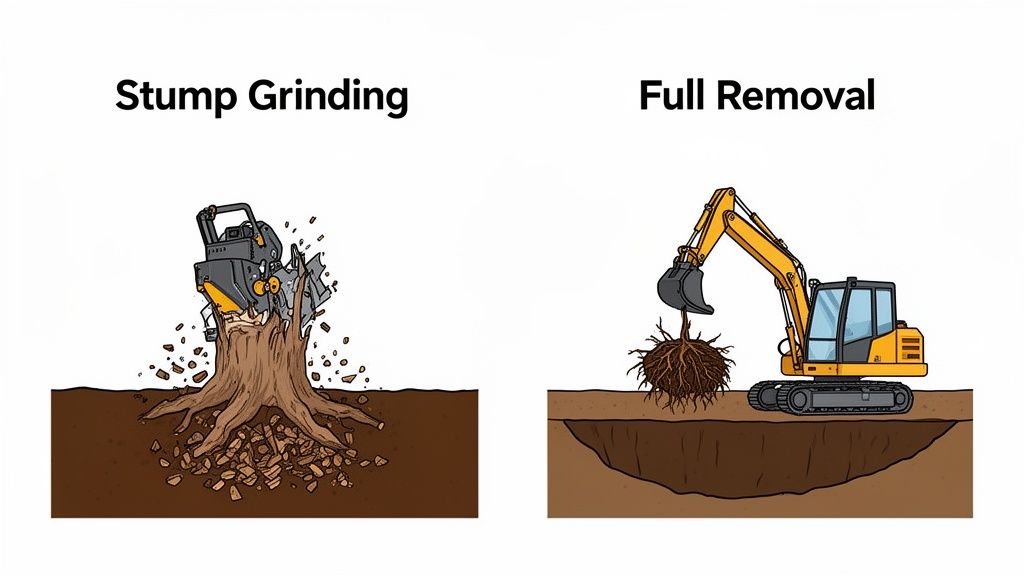
Stump grinding is by far the most popular and practical way to handle a leftover stump. It doesn't actually pull the entire root system out of the ground. Instead, we bring in a powerful machine with a high-speed cutting wheel that literally grinds the stump down into small wood chips.
The machine chews the wood down to anywhere from 4 to 12 inches below the surface. That's deep enough to get rid of the eyesore, allowing you to throw down some topsoil, plant grass, and make it look like a tree was never there. It’s quick, clean, and doesn't tear up your whole yard.
Stump grinding is all about getting the surface of your lawn back. It’s the perfect fit for homeowners who just want to reclaim their yard and get rid of a tripping hazard without a massive excavation project.
When To Choose Full Stump Removal
Full stump removal, on the other hand, is a whole different ballgame. This is a heavy-duty job where we bring in equipment like a backhoe or excavator to physically dig out and yank the entire stump and its main root ball from the ground. As you can imagine, this leaves a pretty big hole that has to be filled back in.
This aggressive approach is really only necessary in a few specific scenarios.
- New Construction: If you're pouring a new foundation, patio, or driveway where the tree was, you need that stump and its roots completely gone to ensure the ground is stable.
- Replanting a Tree: You can't just plant a new tree on top of a ground-out stump. The old, decaying roots below will get in the way of the new tree's growth. Full removal gives you a clean slate.
- Stopping Regrowth: Some stubborn tree species (like Crepe Myrtles or Elms) will try to send up new sprouts from the old root system. Full removal is the only guaranteed way to stop them for good.
Because it involves heavy machinery, a ton of labor, and backfilling a big hole, full stump removal costs a lot more and is much more disruptive to your landscape. To really see how these two stack up, you can dive deeper into our guide on stump grinding vs removal.
Comparing Stump Grinding and Full Stump Removal
To help Atlanta property owners choose the right service for their needs and budget, here’s a straightforward, side-by-side comparison.
| Feature | Stump Grinding | Full Stump Removal |
|---|---|---|
| Process | Grinds the stump below ground level with a specialized machine. | Excavates the entire stump and major root ball with heavy machinery. |
| Cost | More affordable, typically priced by the stump's diameter. | Significantly more expensive due to labor, equipment, and backfill. |
| Intrusiveness | Minimal impact on the surrounding lawn and landscape. | Highly disruptive, leaves a large hole that needs to be filled. |
| Ideal For | Planting grass, improving yard aesthetics, removing hazards. | New construction, replanting a tree in the exact same spot. |
| What Happens to Roots | The main root system is left underground to decay naturally. | The entire root ball is physically ripped out of the ground. |
For most homeowners in the Atlanta area, stump grinding is the clear winner. It’s faster, way more affordable, and perfectly handles the most common goal: getting a nice, level lawn back. Full removal is a specialized service, reserved for when the ground itself needs to be completely clear for a future project.
Beyond the Base Quote: Additional Costs and Local Rules
When you get a quote for tree work, it's easy to focus on the main number. But that initial price usually covers just the core tasks—felling the tree and grinding the stump. The final tree removal and stump grinding cost can shift based on a few extra services and the maze of local regulations we have to navigate here in the Atlanta area.
Think of it like buying a car. The sticker price gets you the basic model, but things like hauling away the mess or dealing with city permits are the optional upgrades. They add real value but also adjust the final bill. Let's break down what those potential add-ons and administrative hurdles look like so you can build a truly accurate budget.
Common Add-On Services That Affect Your Bill
Once the tree is down and the stump is gone, you’re left with a mountain of wood chips, logs, and branches. A standard quote often assumes that debris stays on-site, but most homeowners want their yard back. That’s where these extra services come in.
Each one requires more labor, specialized equipment, and time, which will naturally be reflected in your final invoice.
- Debris Hauling: This is the full clean-up. We load every last log, branch, and wood chip into a truck and haul it away for you. Without this, you’re left to figure out what to do with the debris.
- Wood Chipping: A great middle ground. Instead of hauling away bulky branches, we can run them through a wood chipper right on your property. This turns them into valuable mulch you can use in your garden beds, and it’s often more cost-effective than full disposal.
- Topsoil and Seeding: After we grind a stump, the hole is filled with a mix of soil and wood chips. To truly restore your lawn, we can dig out that mixture, fill the space with nutrient-rich topsoil, and plant new grass seed. It's the final touch for a seamless repair.
These services deliver that clean, professional finish, so it’s always a good idea to ask your arborist if they're included in the base price or listed as separate line items on the quote.
Understanding Atlanta Area Tree Ordinances
Atlanta and its surrounding communities—from Milton and Roswell to Forsyth County—are serious about protecting their urban canopy. You can't always take down a tree just because it’s on your land. Many cities have strict tree protection ordinances that safeguard what are often called "specimen" or "heritage" trees due to their size, species, or age.
Trying to remove one of these protected trees without the right permit can land you with some hefty fines.
Navigating local regulations is a job in itself. Every city and county has its own rulebook. A certified arborist doesn't just know the laws; we handle the entire permitting process for you, making sure your project is 100% compliant from start to finish.
This bit of administrative legwork is a crucial service. It protects you from penalties and helps preserve the community's beautiful trees. The cost of pulling permits is usually a separate fee, but it saves you the massive headache of wrestling with city paperwork.
The Premium for Emergency Services
Georgia storms don't wait for business hours. When a tree comes crashing down on your roof or blocks your driveway, you need help, and you need it now. Emergency tree services are available 24/7, but they do come at a premium.
That higher cost covers getting a crew out to you immediately—often in the middle of the night or on a holiday—and accounts for the increased risks of working in dangerous storm conditions. It’s more expensive, yes, but that urgent response is essential for securing your property and preventing even more damage.
For example, looking at tree removal and stump grinding costs across Atlanta's key suburbs like Marietta and Gwinnett County, the numbers can vary. Data shows that just the stump grinding portion can average $368, with 2026 projections ranging anywhere from $195 to $609, mostly depending on the stump's diameter. In the rocky Georgia soils you find in Milton or Forsyth, those costs can jump by 50% or more because of the wear and tear on our equipment. If a stump is right up against a fence or on a steep hill in a place like Roswell, that can easily add another $50–$100 to the job. You can dig deeper into these specifics with this helpful guide on stump removal cost factors.
How to Reduce Costs Without Sacrificing Safety
Everyone loves a good deal, but when it comes to tree work, the lowest bid can easily become the most expensive one you’ll ever get. Trying to slash your tree removal and stump grinding cost by cutting corners is a recipe for disaster. Any money you think you're saving upfront can vanish in an instant with one broken window, a damaged roof, or a serious injury.
The good news? There are plenty of smart, safe ways to manage your budget without taking reckless chances. It’s all about planning ahead and knowing where you can find real savings.
Forget the temptation of a risky DIY job or hiring the uninsured guy with a chainsaw. Let's talk about the practical strategies the pros use to make a project more efficient and affordable for everyone involved.
Schedule During the Off-Season
One of the easiest ways to save a few bucks is to book your tree work when arborists aren't so swamped. Here in the Atlanta area, tree service companies are busiest in the spring and summer, especially right after a big storm rolls through and the emergency calls start flooding in.
But once late fall and winter arrive, things usually slow down. This dormant season is the perfect time to schedule any non-urgent tree removals. Because crews have more flexibility, you can often find more competitive pricing. Some estimates suggest you could save 20% or more just by being strategic with your timing.
Hiring a fully insured and certified arborist isn't an expense; it's a critical investment. This one decision is your best protection against the catastrophic costs of property damage, liability claims, and injuries that can arise from hiring an unqualified or uninsured crew.
Bundle Your Tree Care Projects
Got more than one tree that needs attention? Bundling all the work into a single visit is a fantastic way to get more bang for your buck. Think about it: a big part of any tree job's cost is just getting the crew and all that heavy equipment out to your property.
When you have them take down two trees or grind three stumps in one go, you're only paying for that initial mobilization cost once. The price to grind a single stump is always going to be higher on a per-stump basis than grinding four of them back-to-back. It's a "volume discount" that makes the whole job more efficient for the crew and more affordable for you.
Handle the Small Stuff Yourself
A huge chunk of the labor on any tree job is the cleanup. If you're willing to roll up your sleeves, you can often knock a fair amount off your final bill by handling some of these tasks yourself.
Here are a few safe ways to pitch in:
- Keep the Firewood: If you have a fireplace, ask the crew to leave the larger sections of the trunk. They can cut them into manageable lengths, and all you have to do is split and stack them. You get free firewood, and they save time on hauling.
- Use the Wood Chips: Stump grinding and chipping can create a mountain of wood chips. Instead of paying to have them hauled away, keep them! It's fantastic, free mulch for your garden beds that helps hold in moisture and keep weeds down.
- Manage Small Debris: Offer to take care of raking up the small twigs and branches left behind. Just make sure you discuss this with your arborist beforehand so it's clearly noted on the quote.
Your Checklist for Hiring a Qualified Atlanta Arborist
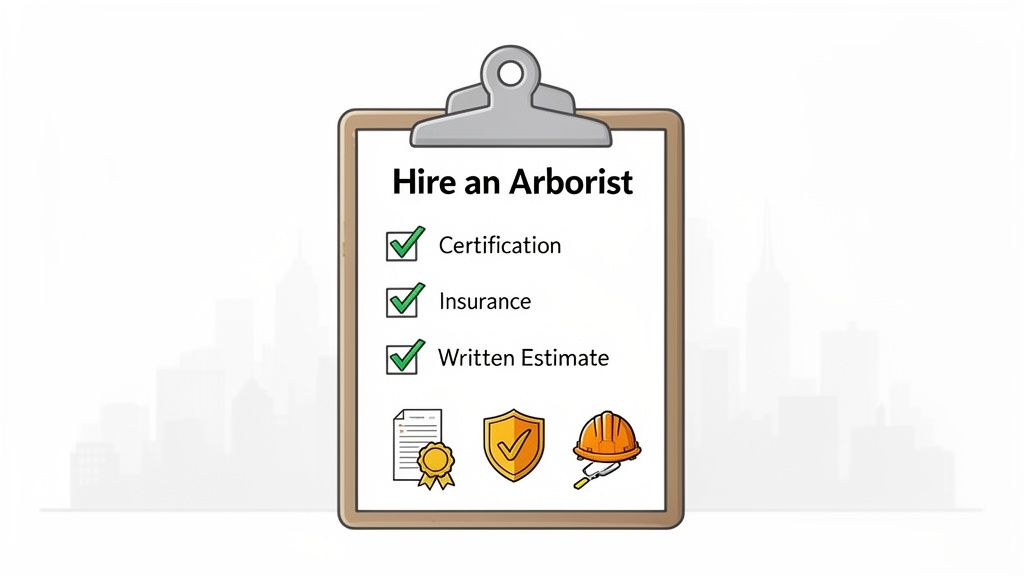
When you're ready to hire a tree service, this is easily the most important decision you'll make. It’s tempting to just go with the lowest bid, I get it. But when you’ve got heavy machinery and complex, dangerous work on your property, expertise and safety have to come first.
A cheap, uninsured operator can quickly turn a straightforward job into an absolute financial nightmare.
To protect your home and make sure the work is done right, you need a partner who is qualified, insured, and acts like a true professional. This checklist will walk you through the vetting process, helping you confidently pick a top-tier Atlanta arborist and understand the real value behind their tree removal and stump grinding cost.
Verify Credentials and Insurance
This first step is completely non-negotiable. Before you even talk about the price, you need to confirm the company has the right credentials and, most importantly, the right insurance. This is your number one shield against liability.
- ISA Certification: Ask them point-blank: "Do you have an International Society of Arboriculture (ISA) Certified Arborist on your team?" This certification is the gold standard in the tree care world, proving a deep, tested knowledge of tree biology, safety protocols, and industry best practices. You can learn more about why it pays to work with a certified arborist in Atlanta and what that expertise means for your project's success.
- Liability Insurance: This is what covers any accidental damage to your property during the job. If a branch falls and hits your roof or fence, their policy should cover it—not your homeowner's insurance.
- Worker’s Compensation: This one is absolutely crucial. It protects the company’s crew if they get hurt on your property. Without it, you could be on the hook for their medical bills.
Don't ever feel awkward about asking for a certificate of insurance sent directly from their insurance provider. Any reputable company will get this for you without hesitation. It's the only way to be 100% sure they're actually covered.
Insist on a Detailed Written Estimate
A verbal quote or a number hastily scribbled on the back of a business card is a massive red flag. A professional estimate is a detailed document that breaks down every part of the job, making sure there are no nasty surprises on the final bill.
Your estimate should clearly spell out:
- Scope of Work: Which specific trees are coming down and which stumps are getting ground out. No ambiguity.
- Equipment to be Used: It should mention any special machinery, like cranes or bucket trucks, needed for the job.
- Cleanup and Debris Removal: Does the price include hauling away all the logs, branches, and wood chips? This needs to be specified.
- Total Cost and Payment Terms: A clear, final price and how they expect to be paid.
Try to get estimates from at least three different certified companies. This isn't just about price shopping; it lets you compare the professionalism and thoroughness of each arborist.
Review Reputation and Spot Red Flags
Finally, do a little homework. A company's track record usually tells you everything you need to know. Jump on Google or Yelp and see what past customers are saying about their experiences.
The demand for tree services is growing like crazy. The global tree stump removal market is now a massive $12 billion industry, and North America alone accounts for $2 billion of that each year. This growth is fueled by development in major hubs like Atlanta's own Forsyth County and Milton.
This boom, which is expected to continue through 2032, directly reflects the growing needs of homeowners in places like Johns Creek and Roswell. This high demand also means more fly-by-night outfits are popping up, making it even more important to do your due diligence. You can read more about the growth in the tree service industry to understand the trends.
Got Questions About Tree Service Costs? We've Got Answers.
As you get closer to scheduling your project, a few final questions always seem to come up. It's completely normal. Getting clear, honest answers is key to budgeting correctly and knowing exactly what to expect. This is where we clear up some of the most common things we hear from Atlanta homeowners about the nitty-gritty details of tree removal and stump grinding costs.
Think of it as our final chat before the work begins. We'll walk through how things are priced, what to expect with insurance, and what happens after the job is done, so you can move forward with total confidence.
How Do You Price Stump Grinding?
This one comes up a lot. People want to know how we figure out the cost of grinding a stump. Thankfully, it’s much more straightforward than pricing a full tree removal, which involves a ton of variables like risk and accessibility.
The industry standard, and how we do it, is to price the job per inch of the stump's diameter. We measure the stump at its widest point, right where it meets the ground. A good ballpark figure for a typical stump is between $3 and $5 per inch. So, for a stump that's 20 inches across, you'd be looking at a cost somewhere between $60 and $100. Just keep in mind there might be a minimum service fee to get the crew and heavy equipment out to your property.
Of course, a couple of things can nudge that price up or down:
- Tree Species: Grinding a stubborn oak stump is tougher on our equipment than a soft pine, so hardwoods might cost a little more per inch.
- Accessibility: If the stump is on a steep hill or wedged in a tight spot, we might have to add a small surcharge to cover the extra labor and care involved.
Will My Homeowners Insurance Help with the Cost?
This is a big one, and the short answer is: it all depends on why the tree is coming down.
Your standard homeowners insurance policy generally won't cover the cost of removing a tree just because it's sick, old, or doesn't fit your new landscaping vision. Insurance companies see that as regular property maintenance, which falls on you as the homeowner.
However, your policy will almost certainly kick in if a storm knocks a tree over and it damages a covered structure—like your roof, garage, or fence. In that situation, the insurance company will typically pay to have the tree removed from the structure so repairs can begin.
A crucial point here: insurance usually covers getting the tree off your house, but not necessarily hauling every last branch away from your yard. It's always a smart move to review your specific policy and have a quick chat with your agent.
Can I Plant a New Tree Where the Old One Was?
Absolutely! Once a stump is gone, that spot can feel like the perfect place for something new. But you can't just dig a hole in the wood chips and expect a new tree to thrive. The area needs a little TLC first.
The stump grinding process leaves behind a mix of soil and wood shavings. As those wood chips break down, they temporarily suck nitrogen out of the soil—a vital nutrient your new tree needs to get established.
To set your new tree up for success, you'll need to:
- Dig Out the Old Stuff: Excavate the area where the stump was, removing the blend of wood chips and soil. Go at least a foot deep and make the hole wider than the new tree's root ball.
- Bring in the Good Stuff: Backfill the hole with fresh, nutrient-rich topsoil or a high-quality garden soil mix.
- Plant a Little to the Side: If you can, it’s best to plant the new tree slightly off-center from where the old trunk was. This helps it avoid running into any large, stubborn roots that might have been left deep underground.
Ready to tackle that troublesome tree or stump with a team you can trust? The certified arborists at Richmond Tree Experts GA are here to provide a clear, detailed estimate and expert service for your property in Atlanta, Cumming, or Roswell. Contact us today for a free consultation!
Have a stump you want gone? Richmond Tree Experts has worked on Marietta and Metro Atlanta trees since 1985, and every job is looked at by an ISA Certified Arborist before it is priced. Start with stump grinding, or see everything we do: tree removal, stump grinding and arborist services across Cobb, Fulton, Cherokee, Gwinnett and DeKalb counties (service areas).
Call (770) 974-3964, 7am to 11pm every day, or request an estimate online.

