

A basic one-tree arborist report often costs about $150 to $500 in 2026, while a formal tree risk assessment typically costs about $250 to $750 or more. Use the table below to match the fee to the document you really need.
The expensive mistake isn't always paying for testing. It's paying for an opinion that your insurer, buyer, or permit reviewer won't accept. For a North Atlanta homeowner, the right starting point is who needs the paper and what decision they must make.
What North Atlanta Homeowners Pay in 2026
2026 tree risk assessment cost by deliverable
| Assessment | Typical 2026 range | What you receive | Best used for |
|---|---|---|---|
| Quick single-tree opinion | $100–$250 | Visual look, often verbal or a short note | One obvious tree, no formal filing |
| Level 2 TRAQ-style assessment | $150–$300, per Best Trees to Plant | Documented ground inspection and rating | Homeowner safety decision |
| Basic arborist report, one tree or small lot | $150–$500, per LegalClarity | Written condition and recommendation | Sale, dispute, or simple permit question |
| Formal tree risk assessment | $250–$750 or more, per HomeAnswer | Defects, likelihood, targets, and recommendation | Insurer or attorney file |
| Level 3 advanced assessment | $300–$500 or more | Testing, decay checks, or aerial inspection | Hidden defects or a high-value tree |
| Multi-tree or development report | $450–$700 or more, per ArborStar | Several trees and a site write-up | Construction or a small lot plan |
| Structured assessment, published start | From about $650, per Urban Forestry Guide | Full structured risk file | When the reviewer expects a formal method |
| Large commercial report | Often over $1,000 | Multi-tree documentation and mapping | Campus, claim, or managed landscape |
These are published benchmarks, not a flat North Atlanta price menu. The advanced-assessment range comes from the same Best Trees to Plant pricing guide as the basic assessment range; the commercial-report benchmark comes from LegalClarity. The quick-opinion allowance is for preliminary screening, not a substitute for a formal filing.
For a homeowner in Marietta, Roswell, Kennesaw, Woodstock, Acworth, or Canton, the tree and the intended document determine the quote. Height, trunk diameter, what sits underneath the crown, and the crew's working room all matter, so prices are set on site.
A free estimate isn't a paid report
A removal estimate answers a work question: what will the contractor charge to take this tree down? A decision-grade report answers a different question: what defects exist, what could be struck, and what action is justified?
Don't assume a written work price includes photographs, a risk rating, testing, or a letter addressed to your insurer. Those are deliverables that need to appear in the proposal.
At Richmond Tree Experts GA, our arborists visit the tree and provide a free, no-pressure written estimate anywhere we work, usually the same day. That pricing visit doesn't mean every formal assessment or specialized test is free.
Buying rule: Pay for the document the recipient needs, not merely for a document called an arborist report.
Match the purchase to its use
For your own safety decision, a documented ground inspection may be sufficient. For a sale, insurance file, dispute, or city submission, identify the recipient before the arborist writes anything.
Property boundaries can create a separate expense. If ownership of a fence-line oak is uncertain, HomeProBadge's guide to typical survey prices by property size can help you budget for boundary work. An arborist evaluates the tree; a land survey establishes boundaries.
A cheap verbal opinion can be useful. It stops being cheap when you have to buy the inspection again because the first visit didn't produce an acceptable file.
What a Tree Risk Assessment Includes
Say a willow oak reaches over an East Cobb bedroom, driveway, and basketball hoop. Looking at it from the street might reveal a dead branch, but that view won't establish what's happening behind the trunk or around the root flare.
Think of a house inspection. Seeing a foundation crack from the sidewalk tells you something deserves attention; it doesn't tell you the crack's significance or the repair scope.
A tree assessment follows a structured sequence.
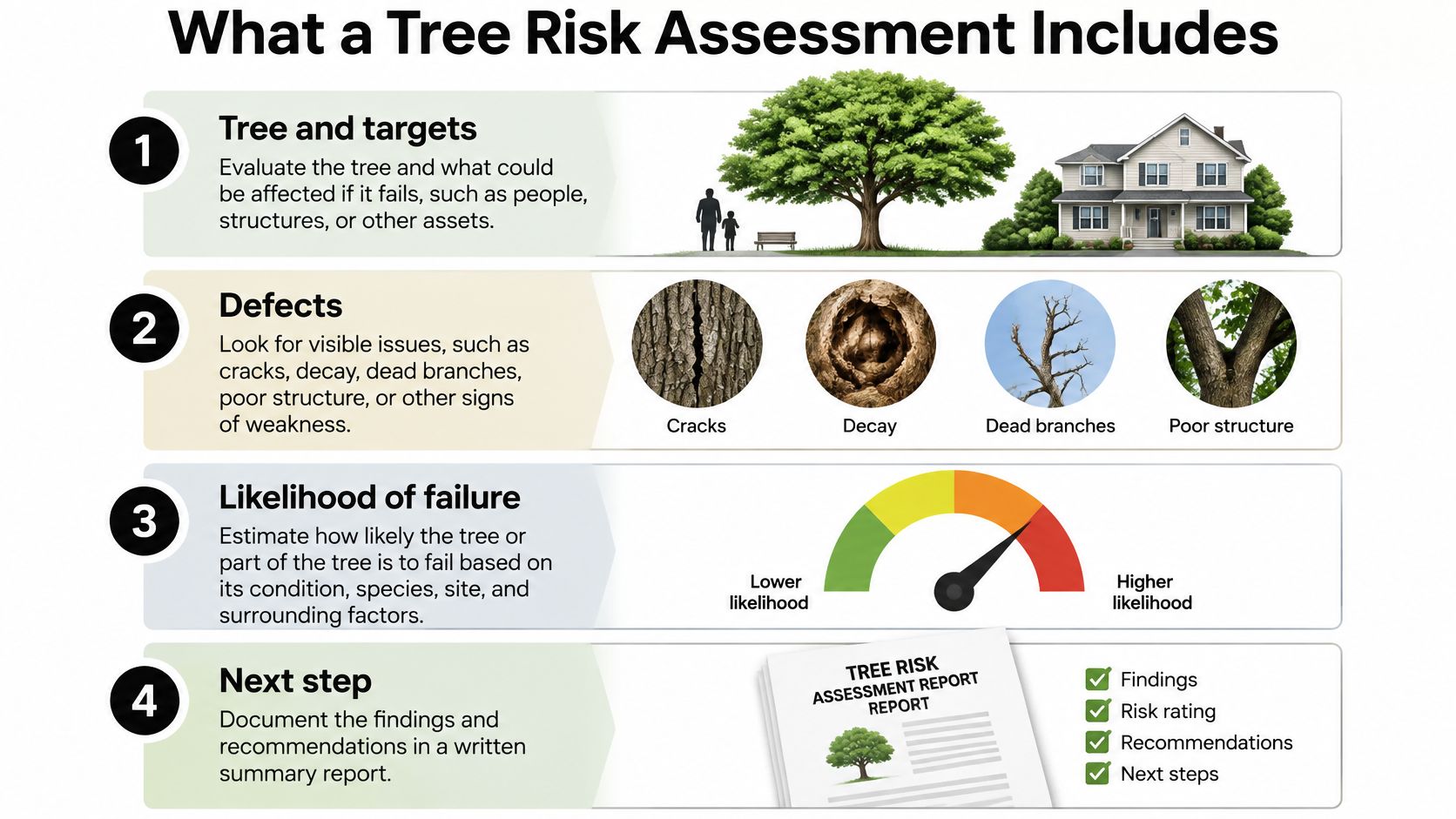
Screening versus a ground inspection
Level 1 is a limited visual screening. It can flag an obvious concern from a walk-by or other restricted view, but a casual screening doesn't provide the same basis for a decision as a complete inspection.
Level 2 is the usual homeowner decision product. The arborist walks around the tree where access permits, examines the trunk, crown, root flare, and lean, and records relevant targets. A parked car, occupied bedroom, frequently used sidewalk, and open lawn don't represent the same exposure.
The ISA basic tree risk assessment form organizes the work around the site, targets, tree condition, likelihood of failure, consequences, and mitigation. That structure is why an assessment is more than identifying a crack and recommending tree removal.
The written summary should connect the observation to the recommendation. For example, a defective limb over the driveway may justify selective pruning without condemning the whole tree.
When tools become necessary
Level 3 adds investigation when the basic inspection leaves a material question unanswered. That could mean an aerial inspection, decay testing, or closer examination of roots. The useful test is the one that could change the decision, not the one that produces the most impressive-looking printout.
A sound-looking trunk can conceal decay. Conversely, a cavity doesn't automatically establish that removal is necessary, because the remaining structure and loading still need evaluation.
Our ISA Certified Arborists perform tree risk evaluations, pre-construction tree prescriptions, insurance claim tree appraisals, and tree care consultations. The report can be scoped for the homeowner's decision or a specific reviewer's requirements.
Before authorizing the assessment, get these items in writing:
- Inspection level: State whether the work is screening, a basic assessment, or advanced investigation.
- Inspection limits: Identify inaccessible areas, excluded roots, or parts of the crown that can't be adequately viewed.
- Written deliverable: Specify photographs, ratings, recommendations, and the intended recipient.
- Follow-through: Separate additional testing, monitoring, and recommended tree work.
Credentials explain part of the professional fee, but they don't replace scope. Ask which level and which document the quote covers.
What Pushes the Quote Up or Down
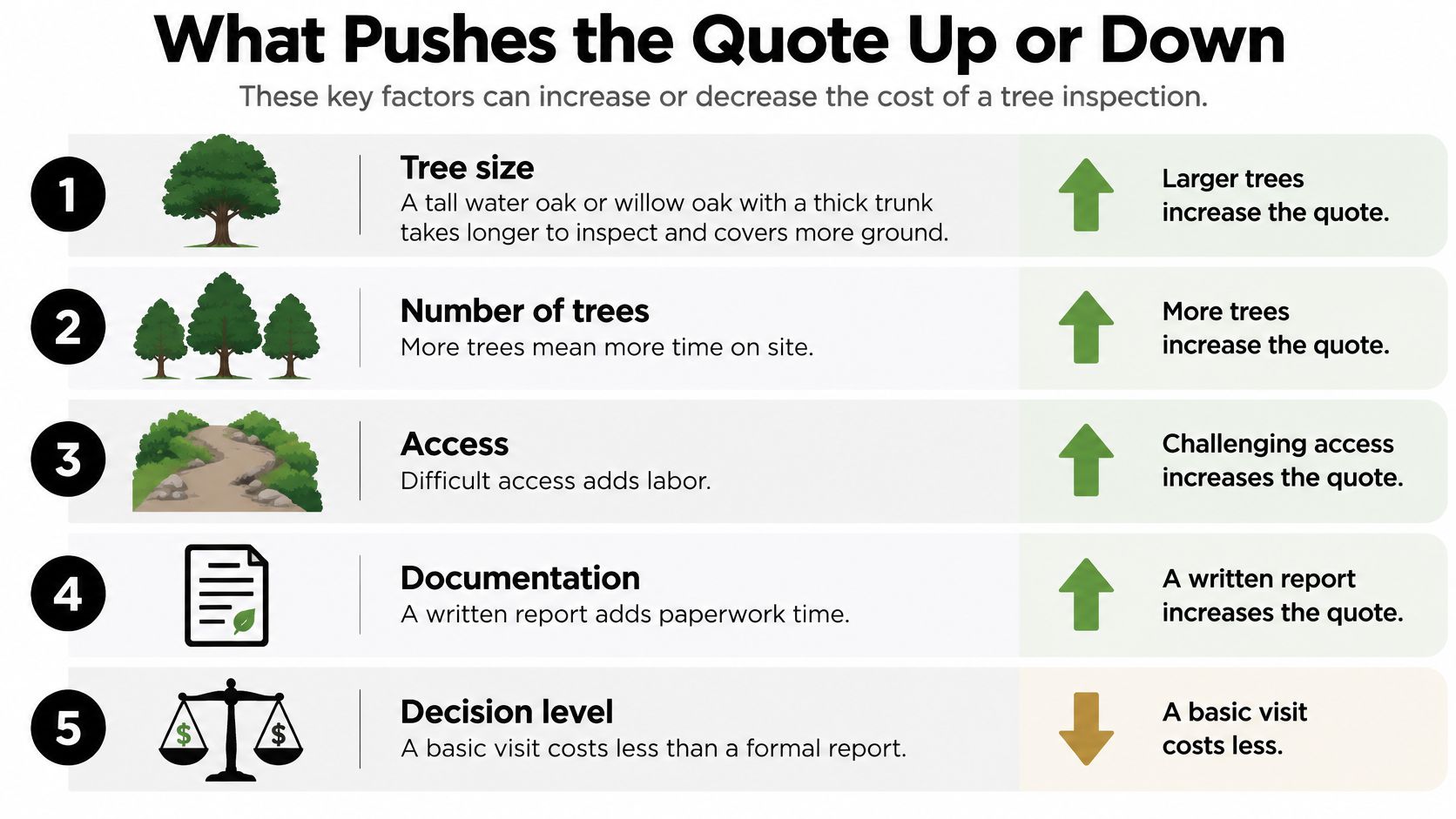
The main drivers of tree risk assessment cost are tree size, tree count, access, targets, and report depth. Testing adds another labor category when the visible evidence isn't enough.
How common site facts change the assessment fee
| Driver | Low-cost case | Higher-cost case | Why the bill moves |
|---|---|---|---|
| Tree size | Small ornamental, clear trunk | Tall oak with a large crown and thick trunk | More crown, more defect checks, larger fall zone |
| Number of trees | One tree | A row, a wooded edge, or a whole lot | Each stem needs its own notes and rating |
| Access | Open yard, easy walk-around | Fence, slope, tight side yard, or no equipment setup | Extra time to see the tree safely |
| Targets under the tree | Open lawn | House, driveway, play area, sidewalk, or utility | Higher consequence and a more careful write-up |
| Report requested | Verbal opinion | Photos, ratings, mitigation, and a form for a reviewer | Documentation hours, not just the visit |
| Testing | None, defects are visible | Decay testing, aerial look, or a return visit | Specialized advanced-assessment time is excluded unless quoted |
A tall water oak doesn't receive a surcharge because it's a water oak. Its size, structure, defects, and surroundings determine how much inspection is needed.
A wooded edge in Woodstock also isn't the same assignment as a backyard ornamental in Kennesaw. The arborist must identify which stems are included rather than write an opinion about the woods as a whole.
Hours and paperwork set the scope
A historical Forest Preserve District of Cook County policy estimated advanced assessments in 2012 at approximately $85 per hour plus expenses, with $85 to $340 in labor for roughly one to four hours on one tree. That's not a current Atlanta rate; it illustrates why a short visit and a detailed investigation can't carry the same fee.
Consider access in an older Marietta yard. A locked side gate, steep rear bank, dense ivy, and a neighbor's fence can prevent a straightforward walk-around. The assessor may need access arranged before returning rather than guess about the hidden side.
The same applies to documentation. A short homeowner note takes less preparation than a report connecting photographs, tree identification, defects, risk findings, and mitigation alternatives.
Keep the alternatives separately priced
A credible proposal names the assessment level and deliverable before listing treatment. Don't accept a single bundled figure that makes the report inseparable from removal.
- Keep or monitor: State what condition should trigger another inspection.
- Prune or support: Price tree pruning, cabling, and bracing as defined work.
- Remove: Separate removal from stump grinding, hauling exclusions, or restoration.
Our tree service estimate process starts with the tree on site, not a universal price inferred from a phone photo. Separate line items let you compare preserving the tree against removing it without losing sight of what the assessment found.
Warning Signs and Emergency Response
If a tree is on a house, blocking access after a storm, or touching a power line, prioritize emergency response over report shopping. Keep people and pets away, contact the utility for wire involvement, and call emergency services if anyone is injured, trapped, or in immediate danger.
OSHA's storm-damage cleanup guidance says to treat every downed power line as energized and establish a work zone extending two tree lengths, or two lengths of the highest point of a downed tree. Don't approach to measure it yourself; crews must evaluate energized wires, stored energy, unstable root plates, and attached or broken limbs before working.
Warning signs and the first action
| Warning sign | First action |
|---|---|
| Tree or limb on a house, roof, or power line | Call emergency removal; keep people and pets back; treat wires as energized |
| Tree blocking a drive or road after a storm | Emergency cleanup first; assess neighboring trees after access is cleared |
| New lean or ground heave near the root flare | Documented Level 2 assessment before anyone works under it |
| Crack or split at a union, or a cavity at the base | Level 2 assessment; ask whether Level 3 testing is included |
| Mushrooms or a hollow sound at the trunk | Level 3 testing if decay may be inside the wood |
| Dead or hanging limbs over a house, drive, or play area | Prune or remove; assess before climbing or cutting |
Don't release a loaded tree yourself
Fallen tree removal can involve bent limbs, compressed trunks, and root plates that move when weight comes off. Cutting the obvious branch first can release the part holding everything in place.
OSHA's tree trimming and removal guidance calls for structural inspection, a planned fall area, a clear retreat path, and control of material under tension. Professional equipment matters, but the cutting sequence and rigging plan matter just as much.
A tree resting on a roof is not stable merely because it has stopped moving.
For storm damage tree cleanup, tell the dispatcher whether the tree touches the building, blocks the only driveway, or involves wires. Ask for the current arrival estimate rather than assuming an advertised fast response means immediate availability.
An urgent crew inspection should precede cutting; a formal report shouldn't delay necessary protection of people. Once the immediate hazard is controlled, evaluate neighboring trees for newly exposed defects, including lightning damage to trees where a strike is suspected.
Atlanta Rules That Change the Next Step
Name the jurisdiction before booking removal. Inside the City of Atlanta, removal may be authorized through a building permit or an application for a dead, dying, diseased, or hazardous tree, according to the city arborist's permitting and replacement guidance.
That guidance also establishes the public-property, replacement, planting, and notice requirements summarized below. These are City of Atlanta rules, not a permit schedule for every North Metro address.
Atlanta tree rules that change the next step
| Rule | What it requires |
|---|---|
| Tree removal authorization | Building permit, or an application for a dead, dying, diseased, or hazardous tree |
| Public-property tree work | Done or directed by a certified arborist |
| Healthy-tree removal | All removed DBH inches must be replaced |
| Replacement size | Generally a minimum 2.5-inch nursery caliper |
| Planting window | Typically November 1 through April 1 |
| Preliminary approval | Can trigger a 15-calendar-day public-notice period for appeals |
| Right-of-way trees | Parks and Recreation generally maintains them; removal needs the city arborist |
Check the sidewalk edge before cutting
The Atlanta right-of-way manual identifies Parks and Recreation's general maintenance role for right-of-way trees, requires city arborist approval for removal, and describes the city's no-net-loss policy. A tree beside your lawn can therefore involve public control even when you routinely mow around it.
Replacement plans also need meaningful tree identification, including size, species, and location. Land clearing and lot preparation aren't just a cutting price when protected trees, public space, or building permits are involved.
Outside Atlanta, verify the local path
A Roswell mailing address doesn't establish the rules for an Acworth property, and Cobb County requirements shouldn't be assumed to govern Cherokee County. Forsyth County and other nearby jurisdictions need their own review.
Use our tree preservation ordinance guidance to frame the questions, then confirm the applicable requirements for the actual parcel.
- Ownership: Establish whether the tree is private, shared, or publicly controlled.
- Authorization: Confirm the permit, notice, or hazardous-tree documentation needed.
- Report recipient: Identify the office that must accept the arborist's findings.
- Aftercare costs: Separate removal, stump grinding, and required replanting.
No report automatically satisfies every city. The letter should be written for the jurisdiction and decision involved, especially near a right-of-way, construction area, utility, or neighboring house.
Choose the Assessment That Matches the Decision
Start with who must rely on the paper. A quick opinion is useful when you need preliminary direction; a buyer, insurer, attorney, or municipal reviewer may need a documented basis for the recommendation.
The report should make the choice understandable to someone who wasn't standing beside the tree.
Buy for the decision in front of you
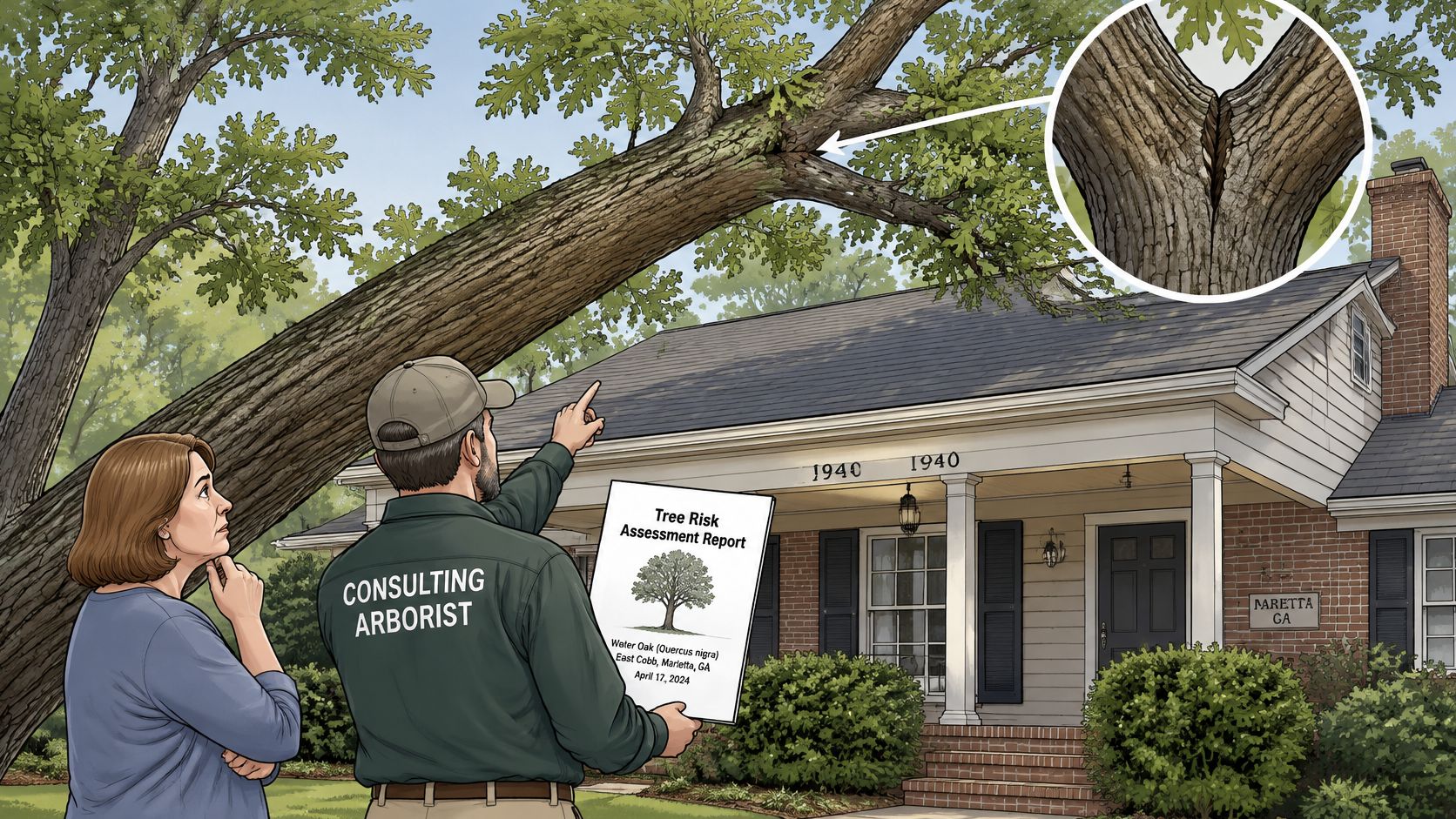
A leaning oak over an older Marietta house: If a cracked union faces a bedroom, book a documented basic assessment to evaluate removal, support, pruning, or monitoring. The useful file connects the defect to that occupied target.
A disputed tree during a Roswell closing: Get a written report the buyer and insurer can retain. A seller's assurance that the tree is healthy doesn't resolve a structural question.
A trunk with suspected internal decay: Ask whether advanced investigation could change the recommendation. Don't pay for testing automatically, but don't accept a confident internal-decay conclusion based only on a distant photograph.
Construction beside a protected tree: You need a prescription addressing the protection zone, fencing, root pruning, and grading limits, not a tree trimming estimate. Our arborists prepare those prescriptions for the project.
Atlanta's building and planning office distinguishes formal submissions from ordinary work inquiries. Tell us at the first call if a city reviewer will read the document.
For additional context before discussing your options, use the video below.
Bring the facts that affect the scope
Have the city, tree count, safe-distance photographs, and a description of what sits under the crown ready. Include the recipient's written requirements when available.
Before booking: Identify the decision first, then authorize the inspection that can answer it.
Our scoping arborist tells you whether the tree needs removal, can be pruned back to health, or is fine to leave alone. If removal is already agreed and no formal filing is needed, a free on-site work estimate may be enough.
We offer a 20% discount for new customers. Confirm its application to your proposed work before authorizing the job; it shouldn't determine which assessment level you buy.
How Richmond Tree Experts Prices and Finances the Work
We serve North Atlanta homeowners in Marietta, Roswell, Kennesaw, Woodstock, Acworth, Canton, and nearby Cobb County, Cherokee County, and North Metro neighborhoods. Every job is looked at by an ISA Certified Arborist before it's priced, and we provide a written estimate before work begins.
That matters when the finding could lead to several different actions. The assessment fee should remain identifiable so you can choose removal, pruning, cabling and bracing, monitoring, or leaving the tree alone.
Price the actual removal plan
If you're searching for tree removal near me because an oak threatens the garage, the removal quote needs to reflect the job beyond the defect. Height, diameter, targets, and access determine whether the crew can make straightforward cuts or needs sectional dismantling, tight-access methods, or crane-assisted removal.
We handle hazardous, dead, storm-damaged, and in-the-way trees, including crane-assisted work. A phone photograph helps explain the concern, but it doesn't replace seeing the setup area and the space beneath the crown.
Keep the work order specific:
- Tree removal: Identify the tree, access plan, and work included.
- Tree pruning: Name the limbs or objectives rather than authorizing an undefined cleanup.
- Stump work: Distinguish stump grinding from stump removal and specify the intended finish.
- Site preparation: Define clearing limits, retained trees, and protection measures before land clearing begins.
For any tree cutting service, request current licensing and insurance documentation appropriate to the work. Equipment alone isn't proof of coverage, qualifications, or a sound removal plan.
Finance the work without obscuring the scope
We offer financing for our services. Obtain the current terms before committing, and compare the financed total with the written work scope rather than judging only the payment amount.
Our arborists also prepare insurance claim appraisals using species, size, condition, and location. An appraisal values a tree after damage or loss; it isn't interchangeable with a risk report about whether a standing tree should remain.
Call (770) 974-3964, daily 7am to 11pm, with the city, the immediate concern, and the document you need. Request the assessment level, written deliverable, and a separate price for any recommended work.
For a leaning tree, storm-damaged oak, or permit question, we offer arborist evaluations and free on-site written estimates to establish the right scope. Visit Richmond Tree Experts GA to request an estimate, and tell us whether you need a homeowner recommendation, a formal report, or urgent removal assistance.

