

So, you’ve had a tree taken down, but now you’re left with the stubborn stump. It’s not just an eyesore; it’s a tripping hazard and a magnet for pests. For homeowners in places like Cumming, Alpharetta, and Roswell, the next logical question is: "What’s it going to cost to get rid of this thing?"
The good news is that you’re looking at a pretty straightforward job. In the Atlanta suburbs, the typical tree trunk removal cost falls somewhere between $100 to $400. Most of the final price tag comes down to the stump's size, where it is on your property, and a few other key factors we'll get into.
Let's be clear about what we're talking about. "Tree trunk removal" almost always means grinding down the stump that’s left after a tree is cut. It’s a separate service from the cost of felling the entire tree.
Your Quick Guide to Tree Trunk Removal Costs in Atlanta
Ballpark Pricing Per Inch of Diameter
The go-to method for a quick estimate is pricing by the inch. A professional will measure the widest part of the trunk at ground level and base their initial quote on that. It’s a simple, effective way to get a rough idea of the cost.
Across the Johns Creek and Marietta areas, you can generally expect to pay between $2 to $5 per inch of the trunk’s diameter. Keep in mind that nearly every tree service has a minimum charge, usually around $100 to $150. This covers the time, fuel, and effort it takes to get their heavy-duty equipment and skilled crew out to your home.
Let's say you have a standard 24-inch stump in your Milton backyard. Based on the per-inch rate, the grinding itself might run between $48 and $120. A bigger 36-inch stump could be anywhere from $72 to $180. Of course, these figures are before the minimum call-out fee is applied. You can always check out national cost averages to see how our local prices stack up.
Key Takeaway: The price-per-inch is a great starting point, but it's not the whole story. The final quote will also be shaped by things like tricky root systems, how easy it is to get equipment to the stump, and even the type of tree it was.
To make things even easier, we've put together a simple table. It gives you a quick snapshot of what to expect for different-sized trunks you'd typically find in Forsyth, Cobb, or Gwinnett County.
Estimated Tree Trunk Grinding Costs in Atlanta Suburbs (by Diameter)
This table provides a quick estimate of tree trunk grinding costs based on the diameter of the stump, reflecting typical pricing in areas like Forsyth, Cobb, and Gwinnett County. Prices can vary based on other factors discussed in this guide.
| Trunk Diameter (Inches) | Estimated Cost Range |
|---|---|
| Up to 12" | $24 – $60 |
| 18" | $36 – $90 |
| 24" | $48 – $120 |
| 36" | $72 – $180 |
| 48" | $96 – $240 |
Use this as a quick reference to set a realistic budget before you start making calls. Now, let’s dig into the specific details that can push these numbers up or down.
Decoding the 7 Key Factors in Your Removal Quote
Ever wonder why one quote for a tree trunk removal can be hundreds of dollars different from another, even for the same stump? It’s a common question we get. While our price-per-inch table gives you a solid starting point, the final tree trunk removal cost is shaped by a handful of crucial details.
Think of it like getting a quote for a paint job. The square footage gives you a baseline, but the final price depends on whether the walls need patching, if the ceilings are vaulted, or if there's a ton of intricate trim work. Stump removal works the same way. The pros in Alpharetta and Johns Creek have to account for several variables to give you an accurate price.
This visual helps connect the dots between the basic measurements, the pricing, and the final service you get.

As you can see, a simple diameter measurement is just the beginning. Every step that follows, all the way to a full-service removal, plays a role in the final price.
1. Trunk Diameter and Depth
Diameter is the most obvious factor, but depth is its hidden partner in crime. A stump that’s nearly flush with the ground is much faster to grind than one sticking several inches out of your lawn.
Even more important is what you plan to do with the spot afterward. If you want to plant a new tree or lay down sod, the grinder has to go much deeper—often 8 to 12 inches below grade—to completely obliterate the core root ball. That extra time and machine work will add to the cost.
2. Property Accessibility
This one’s all about logistics. How easily can our crew get their heavy equipment to the stump? A stump sitting in an open front yard in East Cobb with direct street access is about as easy as it gets.
But things get trickier, and the price goes up, when we run into challenges:
- Backyard Stumps: We have to carefully navigate equipment through narrow gates or along winding garden paths.
- Sloped Ground: Working on hillsides and inclines makes positioning the grinder tougher and adds a layer of risk.
- Close Quarters: Stumps right next to fences, sheds, patios, or your home’s foundation require a surgeon’s precision to avoid any damage.
Each of these obstacles adds labor time and complexity, which naturally gets factored into the quote.
3. Tree Species and Wood Density
Not all wood is created equal. A soft pine or sweetgum stump grinds down like butter. But the dense, tough wood of a mature oak, hickory, or maple tree—all common in Forsyth County—is a different beast entirely. It puts some serious wear and tear on the grinder’s cutting teeth.
A seasoned arborist knows that grinding a 30-inch oak stump might take twice as long and demand more from the machine than a 30-inch pine. This difference in effort and equipment strain is a huge factor in the final tree trunk removal cost.
4. Root System Complexity
What you see on the surface is only half the story. Underneath the ground, the root system can be simple or a sprawling mess. Some trees have a nice, compact root ball. Others, like maples, are notorious for sending out a wide network of massive surface roots.
Grinding down those visible flare roots is often necessary to get a clean, level finish for your yard. This is usually billed as an extra service, sometimes priced by the foot.
5. Equipment and Methodology
Stump grinders are the main tool for the job, but they come in all shapes and sizes. For a tight space in a Roswell backyard, we might use a small, portable grinder. For a monster stump on a wide-open property in Milton, we’ll bring in a large, tow-behind unit. The specific machine needed for your job affects everything from fuel costs and transport logistics to how long the job takes.
6. Cleanup and Debris Disposal
Once the grinding is done, you'll have a big pile of wood chips mixed with soil. The standard service typically leaves these chips piled up in the hole for you to use as mulch in your garden beds.
But you’ve got other options that will affect the final price:
- Full Haul-Away: For an extra fee, our crew will load up and haul away every last chip, leaving your property spotless.
- Topsoil and Seeding: We can also fill the hole with fresh topsoil and seed it with grass for a seamless lawn repair, making it look like the stump was never there.
7. Local Permit Requirements
Good news: the act of stump grinding itself almost never requires a permit in areas like Cherokee or Gwinnett County. However, the original tree removal might have. If a permit was needed to take down the tree, there could be related inspection fees or specific rules about what to do with the stump, which could add a small administrative cost to the project. It never hurts to double-check your local city or county regulations.
Full Tree Removal Versus Trunk Grinding Costs

When folks in Roswell or Johns Creek call us for a quote, one of the first things we need to clear up is the difference between "tree removal" and "tree trunk removal." It's a really common point of confusion, but getting the terms straight is the key to setting a realistic budget. They’re two completely different services with different equipment, risks, and of course, costs.
Let’s put it this way: trunk grinding is like ripping out an old kitchen cabinet. Full tree removal is like tearing down the entire wall. One is a focused, ground-level job. The other involves working at serious heights, dealing with incredible weight, and safely bringing a massive structure down piece by piece.
The tree trunk removal cost we've been talking about is really just for stump grinding—the job of grinding out the base of a tree after it’s already been cut down. It’s a relatively straightforward task with a matching price tag. Full tree removal, on the other hand, is a much, much bigger deal.
Why Full Tree Removal Costs So Much More
Taking down an entire tree isn't just about a guy with a chainsaw. It's a carefully planned operation that requires skilled arborists, heavy machinery, and a solid understanding of physics. A certified arborist doesn't just start cutting; they map out a strategy to dismantle the tree safely, protecting your property and everyone nearby.
Several huge factors make a full removal more expensive than just grinding a stump:
- Working at Height: Our crews often have to climb 60 to 80 feet or even higher into the canopy. That requires extensive training and specialized safety gear.
- Complex Rigging: You can't just let giant branches weighing thousands of pounds crash to the ground. They have to be carefully cut and lowered using a system of ropes, pulleys, and sometimes cranes to avoid crushing your roof, fence, or garden.
- Managing the Entire Canopy: The amount of wood and brush we have to handle is massive. Every single branch and section of the trunk needs to be processed, moved, and dealt with.
- Extensive Cleanup and Hauling: A full removal creates a mountain of debris, from tiny twigs to enormous logs. The labor and equipment needed to chip it all up, load it, and haul it away is a big part of the total cost.
This is why you can't compare the prices for these two jobs. While you can learn more about the specifics of tree stump grinding cost, it's crucial to know which service you're actually asking for.
A Look at Real-World Tree Removal Prices
To really see the difference, let’s look at some numbers. Based on 2025 data from major home service platforms, the average homeowner in the U.S. will spend somewhere between $200 and $2,000 to remove a single tree, with the national average sitting around $750.
Size is the biggest factor. A small tree under 30 feet might only cost $150–$450. A mid-size tree from 30–60 feet will likely run $450–$1,200. And for those towering trees over 80 feet? You can easily expect a bill of $1,000–$2,000 or more. For more pricing insights, check out This Old House.
This means that safely taking down a mature oak shading a commercial property in Alpharetta could cost five to ten times more than removing a small, ornamental cherry tree in an East Cobb backyard. The stump grinding for both might be a separate, smaller line item on the final invoice.
Ensuring You Request the Right Service
Knowing the difference between these services puts you in control. When you call a professional, being clear about what you need helps you get a fast, accurate quote right from the start.
- If you have a standing tree you want gone, ask for a "full tree removal" quote. Be sure to ask if stump grinding is included or if it’s priced separately.
- If the tree is already cut down and only the stump is left, what you need to request is "stump grinding" or "tree trunk removal."
Using the right language saves time, prevents sticker shock, and makes it easier to compare quotes from different tree companies in the Atlanta area. It’s the first step toward getting the job done right.
DIY Removal Vs. Professional Service: A Risk Analysis
It’s easy to understand the temptation to tackle a tree trunk removal yourself. You figure a quick trip to the rental store and an afternoon of hard work could save you a few hundred bucks. The thing is, those perceived savings on a DIY project can vanish in a hurry once you factor in the hidden costs, the real risks, and the high potential for a disappointing outcome.
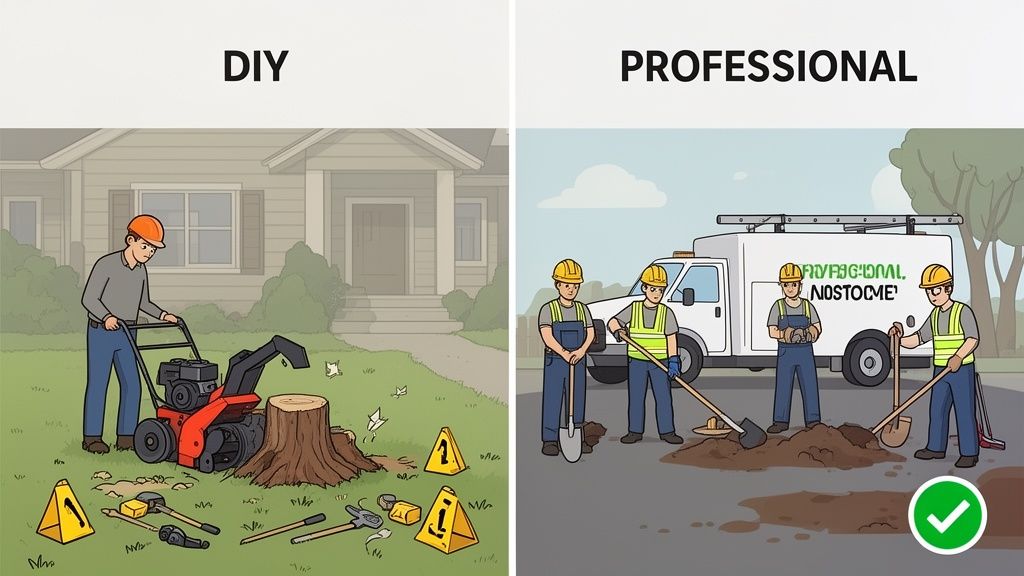
Before you commit your weekend to back-breaking labor, it’s worth weighing the true cost of doing it yourself against the genuine value of calling in the pros. This isn't just about money; it’s about your time, your safety, and what your property will actually look like when you're done.
The Gritty Reality of DIY Stump Removal
For homeowners in places like Cumming or Marietta, going the DIY route usually means one of two things: renting a stump grinder or trying out chemical removers. Both of these paths come with some serious downsides.
Chemical stump removers, which are typically potassium nitrate-based, are definitely the cheapest option up front. But they're also incredibly slow and often don't even work that well. You have to drill a bunch of holes, pour in the chemicals, and then wait… and wait. We're talking months or even years for the wood to get soft enough to hack away at with an axe. This method almost never gets the whole trunk base, leaving your yard with an ugly, rotting hazard for a long, long time.
Renting a stump grinder feels like a more direct approach, but that machine is a beast. It's powerful, heavy, and frankly, dangerous. Without proper training, the risk of injury from kickback or flying wood chips is really high. You’re also on the hook for hauling the thing, figuring out how to operate it safely, and hoping you don't chew up underground utilities, sprinkler lines, or your fence. The rental fee, fuel, and safety gear can easily set you back $200-$400, which starts to eat into those "savings."
The biggest hidden cost of DIY? There’s no guarantee you’ll get the job done right. After a full day of sweat and effort, you might still be staring at a half-ground stump or a shredded, uneven mess in your lawn that’s nowhere near ready for new grass.
The Professional Advantage
Hiring a professional service completely changes the game. It turns a risky, exhausting project into a simple, hands-off solution. Of course, when bringing in any pro, you want to make sure you get a fair price. Learning how to negotiate with contractors is a great skill that gives you the confidence to ensure the terms are clear and the value is there.
A certified team doesn't just show up with commercial-grade equipment; they bring the experience to get the job done fast, safe, and right the first time. They know exactly how to grind the trunk well below the surface, chase down those stubborn surface roots, and handle all the cleanup. Plus, a professional company carries full liability insurance, which protects you and your property if anything unexpected happens. For tricky tree situations, nothing beats an expert's eye; you can see for yourself what a certified arborist in Atlanta brings to the table.
DIY vs. Professional Tree Trunk Removal: A Head-to-Head Comparison
Sometimes, seeing things side-by-side makes the choice crystal clear. Let's break down the key differences between trying to remove a stump yourself and calling in a team like Richmond Tree Experts.
| Factor | DIY Approach | Professional Service (Richmond Tree Experts GA) |
|---|---|---|
| Safety | High risk of personal injury and property damage. | A fully insured and trained crew minimizes all risks. |
| Time Investment | A full day or even a whole weekend, including travel and cleanup. | Typically just 1-3 hours from arrival to a finished job. |
| True Cost | Equipment rental, fuel, safety gear, plus the value of your own time. | One clear, upfront quote with absolutely no hidden fees. |
| Equipment | Consumer-grade rental equipment that can be hard to handle. | Powerful, commercial-grade grinders built for speed and efficiency. |
| Final Result | Often incomplete, leaving roots behind or creating an uneven mess. | A clean, ground-out space, perfectly ready for topsoil and new seed. |
At the end of the day, the professional route not only guarantees a better, safer result but often saves you from the headaches and hidden costs that come with a tough DIY project.
Why Are We Seeing So Many Tree Service Trucks in Atlanta?
If you’ve been driving around Atlanta’s suburbs lately—from Cumming and Johns Creek to Marietta and East Cobb—you’ve probably noticed more tree service trucks than ever before. It's not just your imagination. This uptick is a direct response to how our communities are changing, and it has a real impact on things like the average tree trunk removal cost.
As our neighborhoods in Forsyth, Gwinnett, and Cherokee counties continue to grow, the balance between new construction and our established urban forest gets a little tricky. Trees that once had acres to themselves are now sharing backyards with our homes, families, and power lines. Add in the wild Georgia weather, from intense summer thunderstorms to the occasional ice storm, and our older trees are under a lot of stress. That's where professional assessment becomes a necessity, not just a "nice-to-have."
This Isn't Just About Looks—It's About Safety
Let's be clear: professional tree care has moved far beyond simple curb appeal. Many local municipalities, like Milton and Alpharetta, have specific codes regarding property safety and maintenance. A neglected, hazardous tree or a rotting stump isn't just an eyesore on your property; it can quickly become a liability for the whole neighborhood. This shift turns professional tree service into a core part of being a responsible homeowner.
This isn't just a local trend, either. The global market for tree stump removal is a big deal—valued at $3.46 billion in 2024 and expected to jump to nearly $5.5 billion by 2035. The reasons for this growth are the same ones we're seeing right here in our own backyards: more people living closer together and a greater emphasis on safety standards.
The big takeaway here is that professional tree care is now a crucial investment in your property's value and your community's safety. It’s all about getting ahead of potential problems before they become expensive emergencies.
Making Tree Care a Part of Your Home Maintenance Routine
You wouldn't ignore a leaky roof or clogged gutters, right? Thinking about your trees should be just as routine. A dead or decaying tree trunk doesn’t just look bad; it can pose a serious risk to your home and family, ultimately hurting your property value.
To see how tree care fits into the bigger picture, it helps to think of it alongside other maintenance tasks. This guide on general exterior home repairs does a great job of framing it as one essential piece of the puzzle when it comes to protecting your single largest investment—your home.
Frequently Asked Questions About Trunk Removal Costs
Even with all the numbers and factors laid out, you probably still have a few practical questions kicking around. It's completely normal. Let's walk through some of the most common things we get asked by homeowners across the Atlanta suburbs.
How Long Does Stump Grinding Usually Take?
You might be surprised at how fast this part of the process is. For most typical residential stumps—let’s say anything up to 24 inches across—our crew can be in and out in less than an hour. That includes getting the machine in place, grinding down the stump, and doing a basic cleanup of the area.
Now, a few things can definitely add to that timeline:
- Massive Stumps: If we're tackling a monster trunk over 48 inches or dealing with a dense hardwood like an old oak, it might take closer to 2-3 hours.
- Complex Root Systems: Chasing down and grinding out a web of surface roots takes a bit more time and care.
- Difficult Access: Trying to navigate our equipment through a narrow gate or around delicate landscaping in a Milton backyard will naturally slow things down a bit. We'd rather take our time and do it right.
Will the Grinding Machinery Damage My Lawn or Sprinklers?
This is a huge concern for many homeowners, and we get it. While professional stump grinders are heavy machines, a seasoned operator knows how to protect your property. We'll often lay down protective boards to keep the turf from getting rutted up, especially if the ground is soft.
Before we even start, we’ll ask you to mark any sprinkler heads, irrigation lines, or other underground utilities.
Our goal is to be surgical. We isolate the work area and use precision to remove the trunk with the smallest possible footprint on your lawn and landscape. Clear communication about what's under the grass is the absolute key to a damage-free job.
What Is the Best Time of Year to Remove a Tree Trunk in Georgia?
One of the best parts about stump grinding is that it's a year-round job here in Georgia. Unlike services that depend on soil conditions, grinding is just as effective whether the ground is baked hard by the summer sun or a little damp in the spring.
That said, the ideal time is often when the ground is firm and dry. This simply minimizes any chance of the equipment leaving tracks on your turf. If you can schedule the work during a dry spell in spring, summer, or fall, it's perfect for most properties in areas like Forsyth or Cherokee County.
Do I Need a Permit Just to Grind a Stump?
Almost certainly not. In places like Cumming, Alpharetta, and other Atlanta-area cities, grinding an existing stump doesn't require a permit. The permitting process is almost always tied to the removal of the living tree itself.
If you’re not sure about the rules that applied when the tree came down, our guide to Atlanta tree removal permits has all the local info you'll need.
What Happens to the Wood Chips After Grinding?
Our standard process is to rake the wood chips created during grinding right back into the hole where the stump used to be. This organic material actually makes fantastic natural mulch and helps fill the space.
But if you’re looking for a cleaner, more finished look, you've got options. For an additional fee, we can haul every last chip away, fill the hole with fresh topsoil, and even spread grass seed to get that spot blended seamlessly back into your lawn.
Ready to finally get rid of that hazardous stump and reclaim your yard? The team at Richmond Tree Experts GA has the professional equipment and local expertise to handle any tree trunk removal job in the Atlanta area safely and efficiently.
Get Your Free, No-Obligation Quote Today
Need a tree taken down safely? Richmond Tree Experts has worked on Marietta and Metro Atlanta trees since 1985, and every job is looked at by an ISA Certified Arborist before it is priced. Start with tree removal, or see everything we do: tree removal, stump grinding and arborist services across Cobb, Fulton, Cherokee, Gwinnett and DeKalb counties (service areas).
Call (770) 974-3964, 7am to 11pm every day, or request an estimate online.

