

For homeowners in the Atlanta area, the name Dutch elm disease often brings a sense of dread, and for good reason. It’s an aggressive fungal infection that has been methodically wiping out elm trees across North America for decades, leaving a trail of devastation in its wake.
This disease is responsible for the loss of millions of magnificent trees, completely reshaping countless urban and suburban landscapes. If you have mature elms on your property, understanding this threat isn't just a good idea—it's the first and most critical step in protecting them.
Unpacking What Dutch Elm Disease Really Is
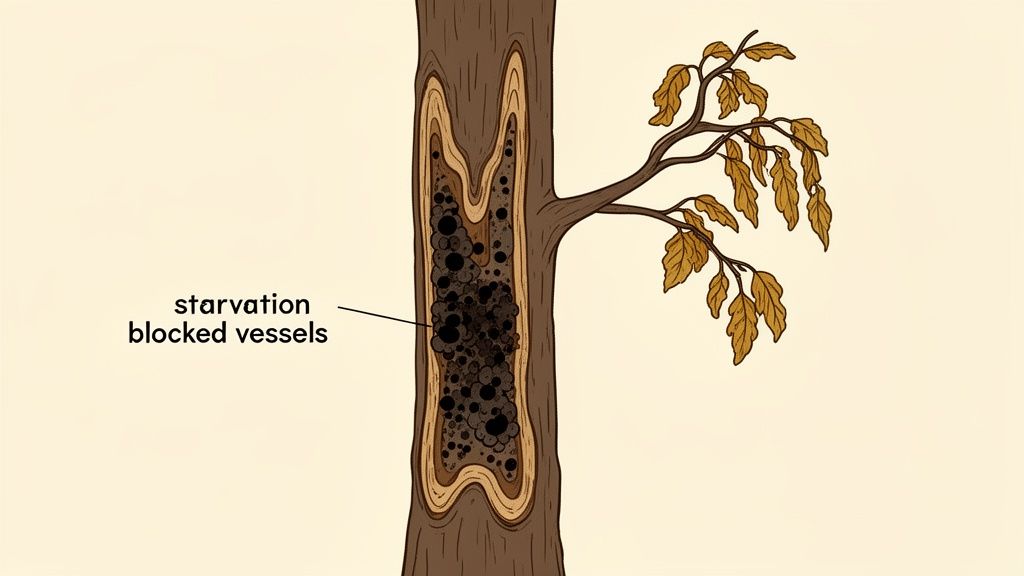
At its heart, Dutch elm disease (DED) is a vascular wilt disease. The culprit is a fungus called Ophiostoma novo-ulmi. To understand how it works, think of a tree’s vascular system like the plumbing in your house. It’s a complex network of tiny pipes (the xylem) that pulls water and vital nutrients all the way from the roots to the highest leaves.
DED essentially creates a catastrophic blockage in that plumbing.
Once the fungal spores get inside the tree, they spread like wildfire through these water-conducting channels. The tree, sensing an invader, tries to defend itself by producing gummy, resin-like substances to wall off the infection. But in a tragic twist, this defense mechanism backfires.
The combination of the fast-growing fungus and the tree's own desperate defenses creates a clog so severe that it literally starves the tree from the inside out. This internal "traffic jam" cuts off the water supply, leading to wilting leaves and, almost always, death.
This process is what makes DED so incredibly fast and lethal. A majestic elm that looks perfectly healthy in the spring can show its first wilting leaves in early summer and be completely dead before the first frost.
For a quick overview, here are the key facts you need to know.
Dutch Elm Disease At a Glance
| Aspect | Description |
|---|---|
| Disease Type | Vascular wilt disease, a fungal infection that clogs a tree's water-conducting tissues. |
| Pathogen | The aggressive fungus Ophiostoma novo-ulmi. |
| Primary Vector | Elm bark beetles, which transport fungal spores from infected trees to healthy ones. |
| Secondary Spread | Root grafts, where the fungus travels between interconnected root systems of nearby elms. |
| Most Vulnerable Host | American elm (Ulmus americana), though most native North American elms are susceptible. |
| Key Symptom | "Flagging" – a sudden wilting and yellowing or browning of leaves on one or more branches. |
| Prognosis | Often fatal, especially in highly susceptible species, if not treated immediately. |
This table captures the essence of the problem, but understanding the key players involved gives you the full picture.
The Key Players in This Tree Tragedy
DED isn't a simple one-on-one battle. It’s more like a destructive partnership between three key players, all working together to bring down a tree.
Here’s a breakdown of this lethal cycle:
- The Pathogen: The fungus, Ophiostoma novo-ulmi, is the agent of destruction. It's ruthlessly efficient at multiplying and clogging the tree's vascular system.
- The Vector: The primary getaway drivers for the fungus are tiny insects known as elm bark beetles. They burrow into the bark of sick or dying elms to lay their eggs. When the next generation of beetles hatches and flies off, their bodies are covered in the sticky fungal spores, ready to infect the next healthy elm they land on.
- The Host: The final piece of the puzzle is a susceptible elm tree. While nearly all North American elms are vulnerable, the iconic American elm (Ulmus americana)—once the pride of city streets across the country—is especially defenseless against this modern, aggressive strain of the fungus.
For an Atlanta homeowner, this means that an infected elm even a few houses down can pose a direct threat to your own trees. The beetles are mobile, the fungus is potent, and the stakes are high. This is why vigilance and proactive care are everything. If you see any signs of trouble, your first call should be to an ISA Certified Arborist who knows what to look for.
How Dutch Elm Disease Spreads Through a Neighborhood

To really get a handle on what Dutch elm disease is, you need to understand how it travels. An infected tree doesn't just die by itself; it quickly becomes ground zero for an epidemic that can tear through an entire neighborhood.
The fungus has two incredibly effective ways of jumping from tree to tree, turning a single sick elm into a community-wide disaster. One path is through the air, courtesy of some tiny, unsuspecting insects. The other is a hidden, underground network connecting trees right under our feet. Both methods are brutally efficient, which explains why this disease can wipe out a whole area’s elm population with shocking speed.
For homeowners, especially in historic Atlanta neighborhoods filled with beautiful, mature trees, knowing these travel routes is the first step in protecting your property.
The Airborne Assault by Elm Bark Beetles
The most common way Dutch elm disease covers ground is by hitching a ride with the elm bark beetle. These little insects, no bigger than a grain of rice, are the main culprits in spreading the fungus far and wide. They’re naturally drawn to elm wood that is stressed, dying, or recently cut—the perfect place for them to breed.
Think of these beetles as unwitting taxi drivers for the fungus. They dig into the bark of an infected tree to feed and lay their eggs. As they tunnel around, their bodies get completely covered in the sticky spores of the Ophiostoma fungus.
When the new generation of beetles grows up and flies out, they immediately look for healthy elms to feed on. They chew on the soft twigs high up in the canopy of a healthy tree, creating tiny wounds. That’s all it takes. The fungal spores rub off the beetle’s body and go straight into the tree’s vascular system.
It takes only one feeding visit from a single contaminated beetle to seal a magnificent elm's fate. Once the fungus enters the xylem, it begins its rapid takeover, clogging the tree's internal plumbing and initiating the wilting process.
This airborne attack is why the disease can pop up on a street that seemed perfectly healthy just a week before. A beetle can easily fly from a sick tree several blocks away, carrying its deadly cargo to a brand-new, unsuspecting host.
The Hidden Underground Highway
The second way the disease spreads is much sneakier because it all happens out of sight. Elms, especially those planted close together like along a street, have a habit of merging their root systems. This underground connection is called a root graft.
This is a huge issue in many established Atlanta communities where elms were planted in neat rows along streets decades ago. Over time, the roots of neighboring trees tangle up and fuse together, creating one big, shared plumbing system.
While these connections are usually fine, they become a superhighway for Dutch elm disease. If one tree gets sick, the fungus can travel directly through its roots and into the roots of every tree it's connected to. It’s a devastatingly fast way for the infection to spread.
- Direct Pipeline: Root grafts give the fungus a direct, internal path, completely bypassing the need for beetles.
- Rapid Progression: The disease can hop from one tree to the next in a single season, setting off a deadly domino effect down the block.
- No Visible Warning: Because the spread happens underground, a neighboring tree can be fatally infected long before it shows a single wilted leaf.
For property managers and homeowners with several elms, this is a critical threat. The health of your tree is directly tied to the health of your neighbor's elms. This is exactly why a certified arborist, after diagnosing one tree, will immediately check the risk to adjacent trees. They may even recommend severing these root connections to stop the disease from advancing underground.
Spotting the Telltale Symptoms of an Infection
Detecting Dutch elm disease early is a race against time. The fungus works so quickly that by the time an entire tree looks sick, it’s often too late. For homeowners, learning to spot the very first, subtle signs of an infection is the single most important thing you can do to give your tree a fighting chance.
These initial symptoms can be surprisingly easy to miss if you aren’t looking for them. They often start high up in the tree's canopy, so a casual glance from the ground just won't cut it. Knowing exactly what to look for—and where to look—can make all the difference.
The First Warning Sign: Flagging
The earliest and most classic symptom of Dutch elm disease is a phenomenon called flagging. The term is a perfect description of what you'll see: a single branch, usually way up in the top part of the tree, suddenly wilts. The leaves on that one branch will turn a sickly yellow or a dull, dehydrated brown, then curl up and droop. It creates a literal "flag" of dying foliage against a backdrop of otherwise healthy green leaves.
This flagging happens because the fungal infection has just begun to clog the water-conducting vessels that feed that specific branch. Think of it as the tree's first cry for help.
- Sudden Onset: This change happens fast, often over just a few days in late spring or early summer.
- Isolated Appearance: At first, it’s just one or two branches, not the whole tree.
- Color Change: Leaves might turn yellow before they turn brown—a condition called chlorosis—as they're starved of water and nutrients.
If you spot a branch that looks like this, treat it as a major red flag. This is the moment to act, because the infection is still relatively localized and might just be manageable.
How the Infection Progresses
Without immediate intervention, that initial flag is just the beginning. The fungus multiplies rapidly, spreading from that first entry point down the branch and into the main trunk. From there, it can invade the rest of the tree, causing the symptoms to escalate dramatically.
As the tree's vascular system gets more and more clogged, the wilting spreads. What started as one flagged branch soon becomes several. The dieback will accelerate, moving from the top of the tree downwards and from the outer tips of branches inwards. Within a few weeks to a couple of months, a huge portion of the canopy can turn brown and drop its leaves, even in the middle of summer.
A key takeaway for homeowners is that the speed of this decline is a dead giveaway. Healthy trees don't typically go from vibrant to dying in a single season. This rapid progression is exactly what makes Dutch elm disease so devastating.
Looking Beneath the Bark
One of the most definitive signs of Dutch elm disease isn't visible on the leaves at all—it's hidden just under the bark. As the fungus colonizes the tree’s xylem (the tissue that transports water), it leaves behind a distinct discoloration.
If you peel back the bark on a wilting branch, you'll see dark streaks in the wood itself.
- Color: The streaks are typically a dark, brownish-purple or a deep chocolate brown.
- Pattern: They follow the grain of the wood, showing up as long, discolored lines.
- Location: This staining will be most obvious in the outermost growth rings of the wood, right underneath the bark.
You can perform a quick check yourself on a small, suspicious twig. Use a pocketknife to carefully shave away the outer bark. If you see this telltale streaking, the odds of Dutch elm disease are extremely high. This is precisely the evidence an arborist will look for before taking a sample for official lab confirmation. Identifying tree diseases can be tricky, and our broader tree disease identification guide can help you distinguish between various common ailments in the Atlanta area.
This trio of signs—flagging, rapid canopy decline, and vascular streaking—are the classic indicators of a Dutch elm disease infection. Spotting any of them should trigger an immediate call to an ISA Certified Arborist. The sooner a professional can confirm the diagnosis, the more options you'll have for treatment and management.
Professional Diagnosis and Treatment Strategies
If you’ve spotted those telltale "flagging" branches or found dark streaking under the bark, your next step is both critical and time-sensitive. Trying to tackle a potential Dutch elm disease infection yourself is a risky gamble. This is a complex, fast-moving disease that absolutely requires a professional eye.
The road to saving an infected elm—or at least protecting its neighbors—always starts with a definitive diagnosis from an ISA Certified Arborist.
An arborist won't just make an educated guess. They'll perform a systematic inspection, looking for the classic symptoms of DED. To be certain, they will carefully collect a sample from a branch that's actively wilting and already shows vascular streaking. That sample gets sent off to a diagnostic lab, where technicians will try to culture the Ophiostoma fungus from it. If the fungus grows, you have undeniable proof.
Getting that confirmation is everything, as it determines every move that comes next.
Developing a Management Plan
Once DED is confirmed, the clock starts ticking. A good response isn't just one action but a coordinated strategy that weighs the tree’s health, its value to your property, and the risk it poses to other elms nearby. This is where an arborist's experience really shines, as they have to balance all the different treatment options.
These strategies usually fall into a few main categories, and the right one depends entirely on how far the disease has progressed. The goal is always to act decisively, whether that means saving the tree or containing the outbreak before it becomes a problem for the whole neighborhood.
Here’s a look at the diagnostic process an arborist follows when making their initial assessment.

This decision tree shows how symptoms progress from early flagging to more advanced signs like streaking and dieback, helping to guide the entire diagnostic process.
Preventative Fungicide Injections
For a healthy, high-value elm that's near a known infection, prevention is truly the best medicine. Arborists can use preventative fungicide injections, applying the treatment directly into the tree's vascular system. It's a proactive defense that essentially makes the tree toxic to the fungus.
The fungicide moves through the tree’s water-conducting tissues and creates a protective barrier that can last for one to three years. It's an effective shield, but it's also an ongoing commitment typically reserved for historic, sentimental, or otherwise irreplaceable trees.
Therapeutic Treatments for Early Infections
If you catch an infection at the absolute earliest stage—usually when less than 5% of the canopy shows symptoms—there's a chance you can save the tree. This approach is aggressive and requires two tactics working in tandem:
- Sanitation Pruning: The arborist will immediately prune off every infected limb. This isn't just a simple trim; it's a precise surgical cut made well below any visible streaking in the wood to remove all traces of the fungus from that branch.
- Therapeutic Fungicide Injections: Right after pruning, a high dose of fungicide is injected. This helps knock out any fungal spores that might have already snuck past the pruned branches into the rest of the tree.
This one-two punch is the tree's only real shot at survival, but even then, success is never guaranteed.
Strategic Tree Removal and Disposal
Unfortunately, once the infection has spread to more than 5% of the crown or reached the main trunk, the tree is almost certainly a lost cause. At that point, the mission shifts from treatment to containment. Quick, safe removal is non-negotiable to stop the tree from becoming a breeding ground for elm bark beetles.
The history of this disease is a grim reminder of why containment is so important. In the 20th century, DED wiped out an estimated 75% to 95% of North America’s mature American elms, completely changing the look and feel of countless cities.
Proper disposal is just as crucial as the removal itself. You can't just leave the wood on the curb or stack it for firewood. It has to be chipped, burned, or buried right away to destroy any beetle larvae and fungal spores still hiding in the bark. This is a core principle of integrated pest management, which uses multiple tactics to control pests and diseases. If you'd like to learn more, you can explore our guide on what is integrated pest management.
Understanding The Local Impact In The Atlanta Area
For anyone living in the Metro Atlanta area, from Marietta all the way to Johns Creek, Dutch elm disease isn't some dusty chapter in a history book. It's a real and present danger to our beautiful urban canopy. Georgia is home to several native elms, including the lovely Winged Elm (Ulmus alata) and the majestic American Elm (Ulmus americana), and unfortunately, both are prime targets for this aggressive fungus.
These trees do more than just line our streets; they define the character of our neighborhoods in places like Roswell, Alpharetta, and across Forsyth County. A single infected elm can start a domino effect, threatening nearby trees and taking a real toll on property values. That’s why being vigilant here at the local level is so important.
The Financial Reality of a DED Outbreak
Ignoring the early warning signs of Dutch elm disease isn't just a risk to your tree—it's a significant financial gamble. The costs of dealing with an active DED infection can balloon in a hurry, turning what could have been a manageable issue into a very expensive problem. Proactive care is always, always cheaper than a reactive emergency.
If you think you have an infected elm, your first call should be to a certified arborist in the Atlanta area. Getting their expert opinion is the first step in what can be a multi-stage financial commitment. Here’s a realistic look at what homeowners in East Cobb or Milton can expect:
- Professional Diagnosis: The initial visit and lab work to confirm Ophiostoma novo-ulmi will typically run between $150 and $400. You have to get a definitive diagnosis before you can make any treatment decisions.
- Preventative Fungicide Injections: For high-value, healthy elms you want to save, preventative injections are a smart investment. In the Atlanta market, these treatments can cost anywhere from $500 to $1,500+ per tree, depending on its size. This is a recurring expense every one to three years.
- Complete Tree Removal: If an elm is too sick to save, removal is the only option left to protect other trees. The cost to take down a large, mature elm in Cherokee or Gwinnett County can range from $2,500 to over $6,000. Things like how easy it is to access the tree and whether a crane is needed will affect that final price.
The numbers don't lie. Investing in early treatment or preventative care costs a fraction of what you’ll pay for removal and replacement down the line.
Why Proactive Management Is An Investment
It's a common mistake to see professional tree care as just another bill to pay. The truth is, it’s an investment in your property's value, safety, and curb appeal. A healthy, mature tree canopy can boost a property's value by as much as 15%. Losing a stately old elm isn't just a shame; it's a direct hit to your wallet.
Managing Dutch elm disease on a community level requires significant resources. Recent municipal efforts show that large-scale surveillance, including visual surveys and lab testing, along with rapid removals, carry substantial operational costs. For instance, one city spent over $750,000 NZD in a single season on DED management, highlighting the immense financial stakes for both public authorities and private landowners. Read about the challenges and costs of battling Dutch elm disease on dutchtrig.com.
This is exactly why a proactive approach makes so much sense. When you schedule regular inspections with a qualified professional, you’re doing more than just checking on a tree. You’re actively protecting your real estate investment and helping preserve the health of our shared urban forest.
Ultimately, you can either pay a smaller, predictable amount now for proactive care, or you can get hit with a much larger, unexpected bill for a dead tree later. For anyone with elms on their property in the greater Atlanta area, the smart money is on prevention. Don't wait until you see those wilted, yellowing branches—schedule a consultation today to find out where your trees stand.
Your Questions About Dutch Elm Disease, Answered
When homeowners hear the words "Dutch elm disease," a lot of questions and concerns immediately come to mind. It’s a serious threat, but with the right information, you can make smart decisions to protect your trees. Here are answers to some of the most common questions we get from Atlanta-area residents.
Can a Tree Actually Survive Dutch Elm Disease?
This is the big one, the question everyone asks. The short answer is: maybe, but only if you catch it incredibly early and act decisively.
There's a very narrow window of opportunity. If you spot the disease when just one small branch is "flagging" (meaning less than 5% of the entire canopy shows symptoms), you have a fighting chance. An ISA Certified Arborist needs to get out there immediately to perform what’s called sanitation pruning. This isn't just a simple trim; it's a surgical removal of the infected limb, cutting well below any visible sign of infection to get ahead of the fungus. That step must be followed up right away with a therapeutic fungicide injection to knock out any fungal spores already moving through the tree's vascular system.
But let's be realistic. Once the infection hits the main trunk or you see flagging on multiple branches, the outlook is grim. At that point, the tree is almost always a lost cause, and the focus has to shift from treatment to safe removal to stop it from spreading to other elms in the neighborhood.
The most important thing to remember is that early detection is everything. A tree can't beat Dutch elm disease on its own. Survival hinges on swift, professional intervention that combines both pruning and chemical treatment.
How Can I Prevent Dutch Elm Disease?
When it comes to DED, an ounce of prevention is truly worth a pound of cure. Being proactive is always a better, and cheaper, strategy than reacting to an infection. While nothing is 100% foolproof, these steps can dramatically lower the risk to your elms.
- Keep a Watchful Eye: Make a habit of inspecting your elm trees, especially from late spring through summer. Look for those tell-tale signs: flagging, leaves turning yellow out of season, or wilting in the upper branches.
- Boost Your Tree's Health: A strong, vigorous tree is naturally more resilient. Make sure your elms get enough water during dry spells, have a good layer of mulch over their root zone (but not touching the trunk!), and aren't suffering from compacted soil.
- Consider Preventative Injections: For a mature, high-value elm that is a centerpiece of your landscape, preventative fungicide injections are the gold standard of protection. An arborist can inject a specialized fungicide that moves throughout the tree's system, essentially making it toxic to the DED fungus for one to three years.
- Prune in the Off-Season: This is a big one. Avoid pruning elms when they're actively growing (generally April through October). Fresh pruning cuts release a scent that is incredibly attractive to the elm bark beetles that spread the disease. The safest time to prune is in the dead of winter when the beetles and the fungus are both dormant.
Are Any Elm Trees Resistant to the Disease?
Yes, and this is the good news in the DED story! The absolute devastation caused by the disease spurred decades of dedicated research, which has resulted in a whole new generation of disease-resistant elm cultivars. Now, no elm is completely "immune," but these modern varieties have proven to be remarkably tough against the fungus.
For homeowners, landscape architects, and property managers in places like Cumming or Alpharetta thinking about planting new trees, choosing one of these resistant types is the smartest move you can make. You get all the grace, beauty, and shade of a classic elm without the constant threat of DED.
Some of the best and most popular DED-resistant elms include:
- 'Valley Forge' American Elm: A fantastic choice that is highly resistant and grows into that iconic, vase-like shape of the classic American elm.
- 'Princeton' American Elm: Another top-performing American elm selection known for its strong resistance and fast, vigorous growth.
- 'Accolade' Elm: A beautiful hybrid with an elegant, arching canopy and attractive glossy green leaves.
- 'Triumph' Elm: A tough, fast-growing hybrid that is celebrated for its strong branch structure and excellent overall disease resistance.
Planting these modern cultivars is a wonderful way to bring the beloved elm back to our urban forests without repeating the tragedies of the past.
If you're worried about your elms or want to discuss a preventative strategy, don't wait for symptoms to show up. The ISA Certified Arborists at Richmond Tree Experts GA have been proudly serving the Atlanta metro area since 1985. Contact us today for a professional consultation to protect your trees and your property.
Not sure what your tree needs? Richmond Tree Experts has worked on Marietta and Metro Atlanta trees since 1985, and every job is looked at by an ISA Certified Arborist before it is priced. Start with an ISA Certified Arborist evaluation, or see everything we do: tree removal, stump grinding and arborist services across Cobb, Fulton, Cherokee, Gwinnett and DeKalb counties (service areas).
Call (770) 974-3964, 7am to 11pm every day, or request an estimate online.

