

When you're trying to decide between a birch and an aspen tree for your yard in Atlanta, it's about more than just which one looks better. It’s a decision that hinges on our local Georgia climate. The truth is, one of these trees is set up for success here, while the other is almost guaranteed to struggle.
Figuring out that key difference—River Birch thrives in our heat and humidity, while Quaking Aspen doesn't—is the first and most important step.
Choosing the Right Tree for Your Atlanta Landscape
The secret to a great landscape is matching the right plant to the right place. Across metro Atlanta, from the newer developments in Forsyth County to the established yards in East Cobb, our climate is the ultimate gatekeeper. Both birch and aspen trees have that classic white bark and stunning fall color that homeowners love, but what they need to survive couldn't be more different.
This guide gets straight to the point, laying out the practical realities of trying to grow these trees in our area. We'll look at everything that matters on the ground. Think about how a tree will handle the heavy clay soil in Johns Creek or the intense summer sun in a Cumming backyard.
Here are the big questions you need to ask for your property:
- Soil and Water: Can the tree handle Georgia's dense clay soil that stays wet for long periods?
- Heat and Humidity: Will it survive, let alone thrive, through our long, sweltering summers?
- Pests and Diseases: Is the tree naturally resistant to the common ailments that flourish in our warm climate, or will it be a constant battle?
Getting these answers upfront will help you make a smart, confident choice that pays off with a beautiful, healthy tree for years to come.
The Bottom Line: For Atlanta homeowners, it really comes down to one thing: climate suitability. The River Birch (Betula nigra) is built for Georgia's heat and soil. On the other hand, the Quaking Aspen (Populus tremuloides) is native to cooler, drier climates and almost always performs poorly here.
A Quick Look at Birch and Aspen
If you're a homeowner in Alpharetta or Roswell, you might be drawn to the light-colored bark and delicate look of both birch and aspen trees. But while they might share a certain aesthetic, their needs and growth habits are worlds apart, especially when you factor in the Georgia climate.
Think of this as your starting point. Before we get into the nitty-gritty of soil types and disease resistance, let's cover the big-picture differences that will immediately tell you which tree might be a contender for your yard.
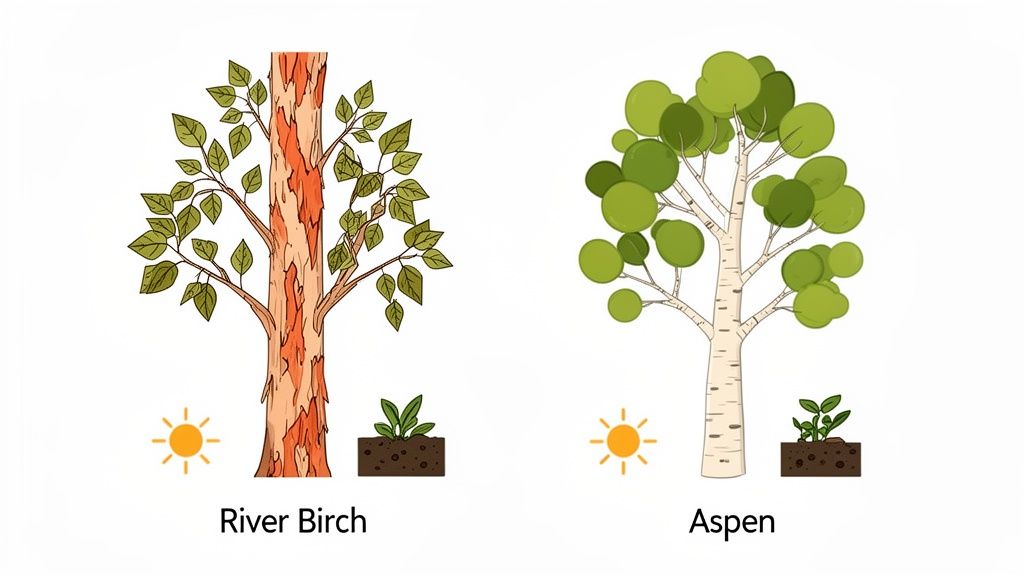
What You'll Notice First: Bark and Leaves
The easiest way to tell them apart is the bark. River Birch, which is the variety you'll want in Georgia, has that incredible peeling bark that exfoliates in papery strips of salmon, tan, and cinnamon. In stark contrast, Quaking Aspen bark is smooth and creamy white or pale gray—it never peels.
Their leaves are another dead giveaway. Birch leaves have a more distinct diamond or oval shape, coming to a sharp point with jagged edges. Aspen leaves are smaller and almost heart-shaped or circular, and it's their fluttering in the slightest breeze that gives the tree its "quaking" name.
Key Differences Birch vs Aspen for Atlanta Homeowners
Here’s a simple table to break down the most critical differences for anyone planting in North Georgia. It’s a handy reference that cuts right to the chase.
| Characteristic | Birch (e.g., River Birch) | Aspen (e.g., Quaking Aspen) |
|---|---|---|
| Bark Texture | Peeling, papery, often salmon to brown | Smooth, white to grayish, does not peel |
| Leaf Shape | Diamond-shaped, pointed tip | Rounded or heart-shaped, fine teeth |
| Growth Form | Often multi-stemmed, grows as an individual tree | Forms clonal colonies via root suckers |
| Growth Rate | Very Fast (2-3 feet per year in ideal conditions) | Moderate, but struggles in Atlanta's heat |
| GA Climate Suitability | Excellent; tolerates heat and humidity | Poor; prefers cooler, drier climates |
| Soil Preference | Prefers moist, acidic soil (common in GA) | Needs well-drained soil; dislikes heavy clay |
| Sunlight Needs | Full sun to partial shade | Full sun |
| Lifespan in GA | Typically 40-50 years | Very short; struggles to establish and thrive |
This table makes one thing crystal clear: while they might look distantly related, their performance in a Milton or Marietta landscape couldn't be more different. An aspen's habit of sending up suckers from its roots can quickly turn into a frustrating maintenance chore in a tight suburban yard. On the other hand, a River Birch's rapid growth is often exactly what homeowners are looking for to get shade fast.
Want to see how these two stack up against other popular choices? For a broader look at trees that thrive in our region, you can learn more about the common types of trees in Georgia in our comprehensive guide. It's a great resource for exploring all your options.
Identifying Key Tree Characteristics
For homeowners here in Atlanta, a successful landscape all starts with knowing what you’re looking at. Getting the identification right between a birch and an aspen is the first, most crucial step in choosing a tree that won’t just survive our Georgia climate, but will actually look great on your property for years to come. While they both have that beautiful, light-colored bark, the details tell two completely different stories.
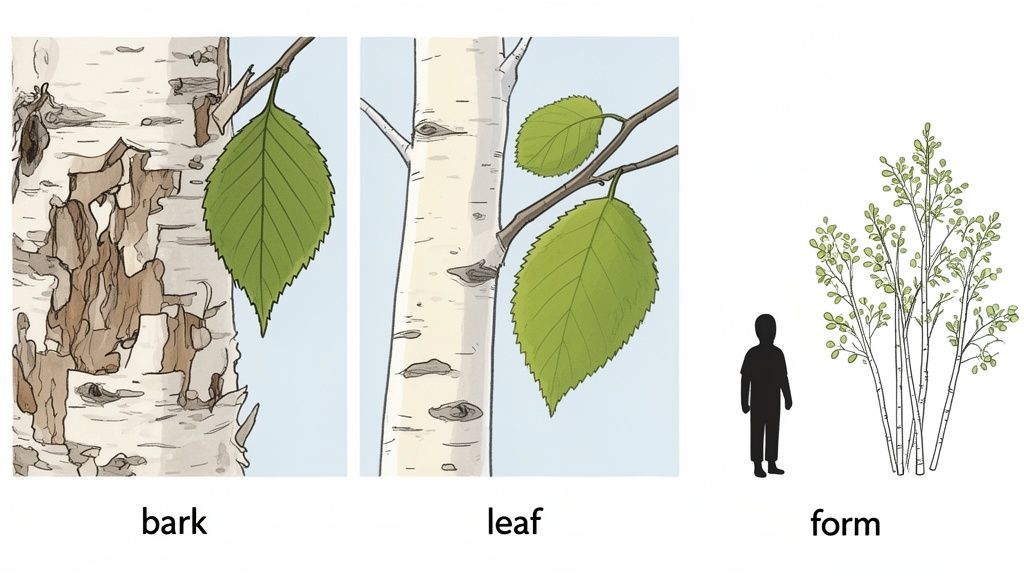
The most obvious giveaway for the River Birch (Betula nigra)—the variety we see most often because it handles our heat and humidity—is its incredible peeling bark. It exfoliates in these thin, papery sheets, showing off layers of color from creamy salmon and soft tan to a rich cinnamon-brown. This texture is a showstopper all year long, but it really stands out in a Roswell or Marietta winter landscape when everything else is bare.
Aspen, on the other hand, is the complete opposite. The bark on a Quaking Aspen (Populus tremuloides) is smooth to the touch, with a chalky white or pale gray trunk that absolutely does not peel. You'll often see dark, eye-like knots or horizontal scars, but it keeps that same uniform surface its whole life.
Distinguishing Leaves and Shape
Once you get past the bark, the leaves offer another dead giveaway. A birch leaf is distinctly diamond-shaped or ovate, and it tapers to a sharp point. Look closely at the edges—they're double-serrated, which just means it has a kind of "tooth-on-tooth" pattern that gives them a jagged, almost rough look.
Aspen leaves are much rounder, almost circular or heart-shaped, with edges that are just finely toothed. The real tell, though, is how they're attached. The leaf stalk, or petiole, is flattened, which causes the leaves to flutter and "quake" in the slightest breeze. It's a signature move for the species.
A simple trick I tell people is to think about the shape: Birch leaves are pointed, almost like a 'V', while aspen leaves are rounded like an 'O'. It's a small detail but a reliable clue when you're out in the yard.
Overall Tree Form and Structure
Finally, take a step back and look at how the tree grows. River Birch is very commonly sold as a multi-stemmed tree, giving it a graceful, vase-like shape that opens up as it gets older. If you find one with a single trunk, it’ll usually have a classic pyramid shape when it's young before broadening out over time.
Aspens have a completely different game plan. They are clonal, meaning they spread through a massive underground root system that sends up new shoots, called suckers. This growth habit creates dense groves or stands of genetically identical trees, not just a single specimen. For a homeowner in a planned Milton or Alpharetta neighborhood, this is a make-or-break detail. An aspen can quickly take over a manicured lawn, turning your single-tree vision into a whole colony before you know it.
Comparing Site Suitability and Growth in Georgia
Choosing between a birch and an aspen for your property isn't just about looks—it’s about understanding which tree is actually built to handle the challenges of our local environment. Honestly, the success or failure of your new tree comes down to its ability to manage Georgia's distinct soil and climate. For most Atlanta-area homeowners, this is the single most important factor.
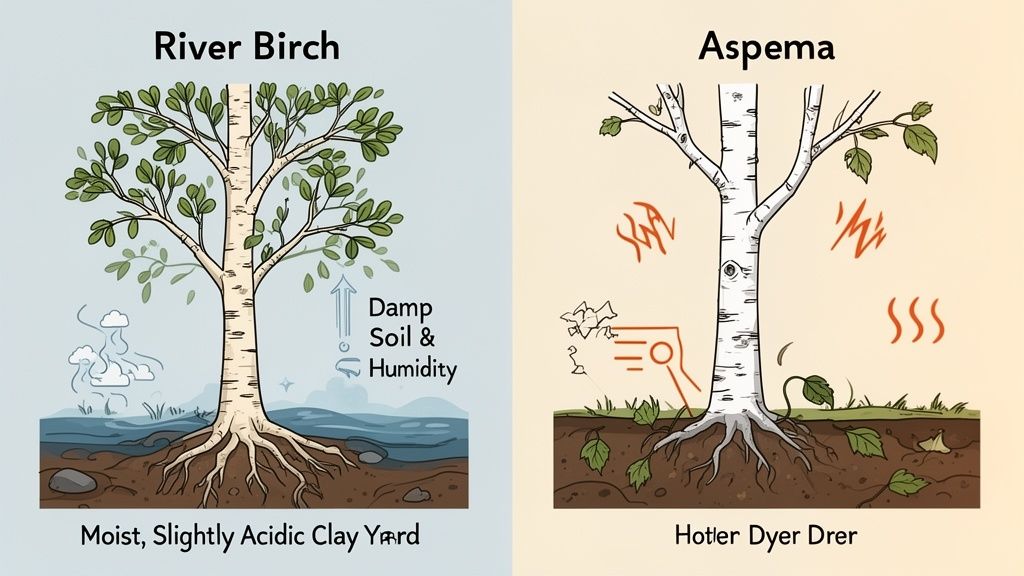
The River Birch is a true champion of the Southeast. It thrives in the heavy, acidic clay soil that’s so common across Gwinnett, Cherokee, and Cobb counties. More importantly, it can handle "wet feet," which makes it an excellent choice for yards with poor drainage or for properties near creeks.
On the other hand, aspen species are fundamentally unsuited for our region. They need the cooler temperatures, lower humidity, and well-drained, loamy soils you’d find in mountainous or northern climates. Our intense summer heat and prolonged humidity create immense stress for aspens, making them highly susceptible to a whole host of fatal diseases and pests.
Sunlight Needs and Growth Habits
Sunlight requirements also play a critical role in figuring out where to plant your tree. The River Birch is pretty adaptable, flourishing in full sun but also tolerating partial shade. This flexibility makes it a versatile option for various spots in a suburban landscape, whether it's an open lawn in Milton or a partially shaded corner in Alpharetta.
Aspens, however, are less forgiving and demand full sun to have any chance of thriving. But their most significant growth trait is their clonal nature. Aspens spread aggressively through underground root suckers, forming dense colonies.
A Critical Consideration: While a single aspen might look appealing, its natural tendency is to become a small forest. This spreading habit is extremely difficult to manage in a typical yard and can quickly invade lawns, garden beds, and even your neighbors' properties. The singular, clumping growth of a River Birch is far more predictable and contained.
Drought Tolerance and Moisture
Georgia's weather often swings between heavy spring rains and hot, dry summers. The River Birch has a distinct advantage here, showing moderate drought tolerance once it’s established but performing best with consistent moisture. Its natural habitat is along riverbanks, so it’s well-equipped for the damp conditions found across our region.
Aspens really struggle with our climate's extremes. They simply are not adapted to our combination of heat and drought, which weakens their defenses and often leads to rapid decline. While they may survive for a short period, they rarely achieve the health or longevity you'd see in their native environments.
It's interesting to note the resilience of some aspen species in other parts of the world. For instance, the European aspen (Populus tremula) is one of the most widely distributed trees globally, with a range stretching from the Arctic Circle down to North Africa. For property managers in places like Forsyth County, this just highlights how crucial it is to match the right species to the right location. Not all aspens share this hardiness, especially not in Georgia's unique climate. You can discover more insights about aspen facts and distribution on treesforlife.org.uk.
Long-Term Health: Pests and Disease
Once a tree is in the ground, its real test begins. Thinking about the long-term health challenges of a birch and aspen is absolutely vital for success here in the Atlanta area. The choice you make now will decide whether you get a beautiful, low-maintenance tree or a constant source of frustration battling pests and disease. A tree’s ability to fight back is directly linked to how well it handles our specific climate.
The River Birch is a real standout for its toughness in the Southeast. Its biggest win is a strong natural resistance to the bronze birch borer, a destructive insect that wreaks havoc on other birch species, especially the white-barked types. For homeowners in Cumming and Roswell, this is a huge plus—that particular pest is a non-issue for River Birch.
That said, the River Birch isn't completely bulletproof. Its main vulnerability in Georgia is chlorosis, a condition that turns the leaves yellow because the tree can't get enough chlorophyll. This is almost always a soil problem—specifically, high pH (alkaline) soil that locks up the iron the tree needs. A little proactive soil management is all it takes to keep this from becoming a problem.
Aspen Vulnerabilities in the Georgia Climate
Aspens, on the other hand, face a much harsher reality in our region. The constant stress from our heat and humidity just wears down their natural defenses, turning them into a magnet for all sorts of issues. They are incredibly susceptible to fungal cankers, which create dead, sunken spots on the bark that can eventually choke off and kill entire branches or even the whole tree.
Insect pests are another major battle. Here, aspens are a prime target for borers, aphids, and scale insects that just love our warm weather. For a property manager in Alpharetta or Johns Creek, this means you've signed up for a high-maintenance tree that needs constant watch and frequent intervention.
It's interesting to note that in a European context, both birch and aspen are ecological powerhouses. In the Baltic region, for example, they are dominant players, with birch covering 29% and aspen covering 7% of Latvia's total forest area. This just goes to show their value as fast-growing species in cooler, temperate climates. You can learn more about the ecological role of birch and aspen in forest systems and see how it contrasts with their performance in our backyards.
When you put them side-by-side, the health comparison in Georgia is stark. The issues you might face with a River Birch are typically manageable with smart planting and a bit of soil care. In contrast, the problems that plague aspens are systemic; they're rooted in a fundamental mismatch with our climate that creates a never-ending cycle of stress and disease. If you want to get ahead of potential issues, take a look at our guide on tree disease identification. Being proactive is always the best way to protect your landscape investment for the long haul.
Making the Final Decision for Your Property
After weighing all the details, the right choice for your Atlanta property really boils down to our local environment. The decision hinges on one critical factor: climate suitability. One of these trees is set up for success here, while the other is in for a constant, uphill battle.
For the overwhelming majority of properties in places like Cumming, Johns Creek, and Milton, the River Birch is the definitive winner. It’s really that simple. If you have that classic Georgia moist, slightly acidic clay soil and want a beautiful, fast-growing shade tree that naturally shrugs off our most destructive pests, the River Birch is your answer. Its ability to take our summer heat and soupy humidity in stride makes it a reliable, low-stress investment for your landscape.
When to Even Consider an Aspen
So, is there ever a time to plant an Aspen? It's a very niche scenario. You'd need a truly unusual microclimate—maybe at a higher elevation up in Forsyth or Cherokee County with fantastic air circulation and cooler temps. Even then, you have to be prepared for proactive, ongoing disease management and ready to constantly fight its aggressive root suckering.
Expert Takeaway: The fundamental mismatch between what an Aspen needs and what Georgia’s climate provides makes it a high-risk, high-maintenance choice. For a thriving, resilient landscape, you’ve got to align your tree selection with the proven performers of the region.
This flowchart gives you a good visual of the likely health journey for a River Birch versus an Aspen in our area, highlighting the major risk factors you'll face.
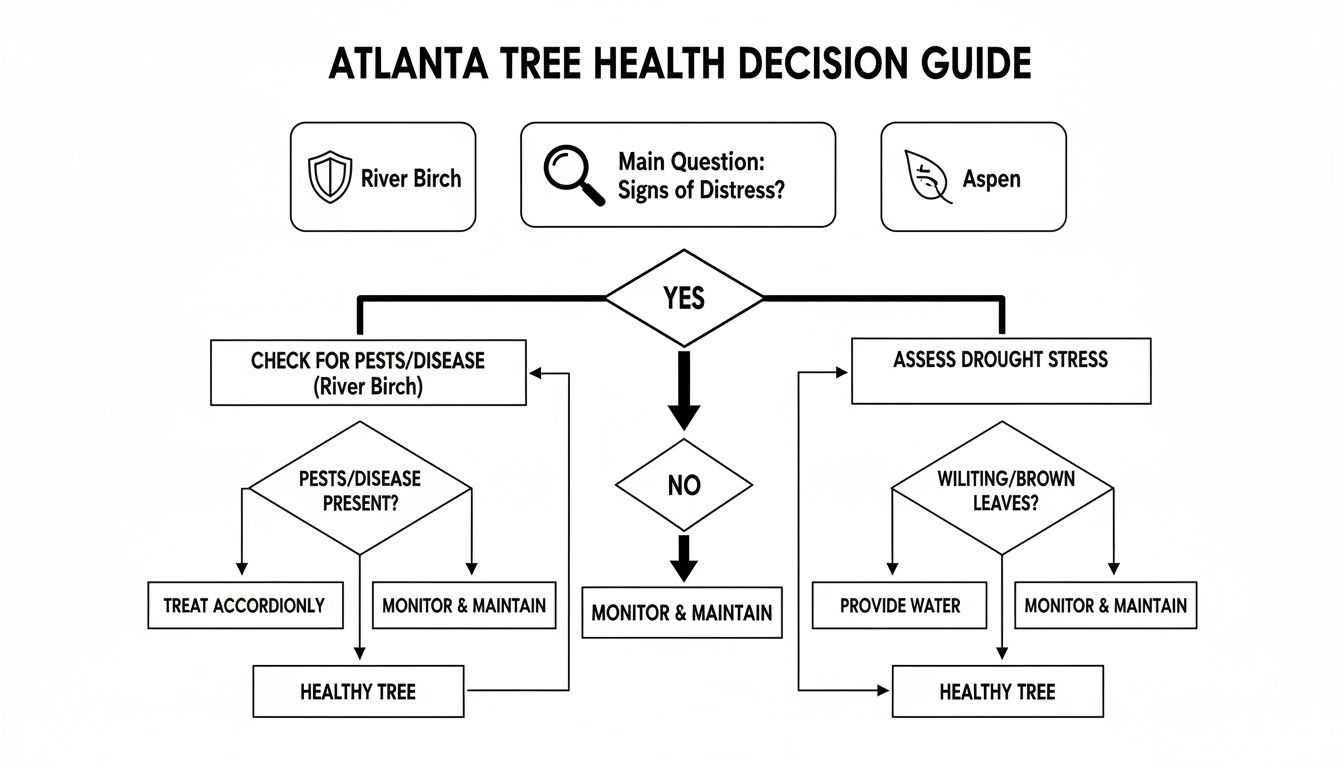
The chart makes it pretty clear: the River Birch follows a path toward resilience, while the Aspen is constantly vulnerable to stress and disease. Understanding these core differences is all about ecological context. For instance, Water birch (Betula occidentalis) is the most common birch out in the Rocky Mountains, perfectly adapted to that environment. Arborists working in Gwinnett and Cobb know that picking a species built for local conditions is the first and most important step to success.
Ultimately, making the right choice from the start ensures your new tree adds beauty and value, rather than becoming a costly problem. For professional advice that’s specific to your property's unique conditions, it always pays to consult with a certified arborist in Atlanta, GA.
Answering Your Top Questions
Even after a side-by-side look, you probably still have a few specific questions. That's normal. Here are the answers to some of the most common things we get asked by homeowners around the Atlanta metro.
Which Tree Grows Faster in Georgia: Birch or Aspen?
Hands down, the River Birch. It's a notoriously fast grower in our Georgia climate. If it has enough water and good soil, you can easily see it shoot up by more than two feet a year, which is great for establishing quick shade.
Aspens? If they even survive the initial planting, they'll struggle. The constant stress from our heat and humidity means their growth will be significantly slower, assuming they grow at all.
Are Birch Trees Messy for a Suburban Yard?
Okay, let's be honest: yes, the River Birch can be a little messy. It’s known for that signature peeling bark, dropping small twigs, and shedding its catkins (the little flower clusters) in the spring. It definitely creates some natural yard debris.
But for most people, that exfoliating bark is the main reason they plant it. It adds incredible visual interest all year long, especially in the winter when everything else is bare. A little raking is usually a small price to pay for that unique look.
For many, the unique, peeling texture of River Birch bark is a celebrated feature, not a flaw. It provides a dynamic, natural look that contrasts beautifully with a manicured lawn or garden bed, especially during the winter months.
Why Don’t You See Many Aspen Trees in Atlanta?
It's simple: Aspens just aren't built for our environment. They are native to cooler, drier climates where the soil is loamy and drains well.
Atlanta throws the exact opposite at them—brutal heat, oppressive humidity, and heavy clay soil. This combination creates a perfect storm of stress, making them a magnet for fatal pests and fungal diseases. They're a poor, short-lived choice for any landscape in our region.
Is the River Birch a Good Tree to Plant Near a Patio?
Yes, a River Birch can be a fantastic choice near a patio or deck. Its canopy tends to be more open and airy, which gives you pleasant, dappled shade instead of a solid, dark shadow.
Better yet, its root system is generally not as aggressive or invasive as many other large trees, so it's less likely to cause problems with your hardscaping. You'll just want to be prepared for some of that shedding bark and twigs to land on the patio surface.
Deciding between a birch and aspen is simple when you have local expertise. For professional planting, pruning, or health assessments tailored to your property, trust the certified arborists at Richmond Tree Experts GA. Contact us today for a consultation at https://richmondtree.com.

