

When you first plant a Bradford pear, you might be impressed. They grow incredibly fast and burst into a spectacular show of white blossoms every spring. But that rapid growth comes at a steep price, and most homeowners are shocked to learn the average Bradford pear lifespan is only 15 to 25 years.
The Promise and Peril of a Popular Tree
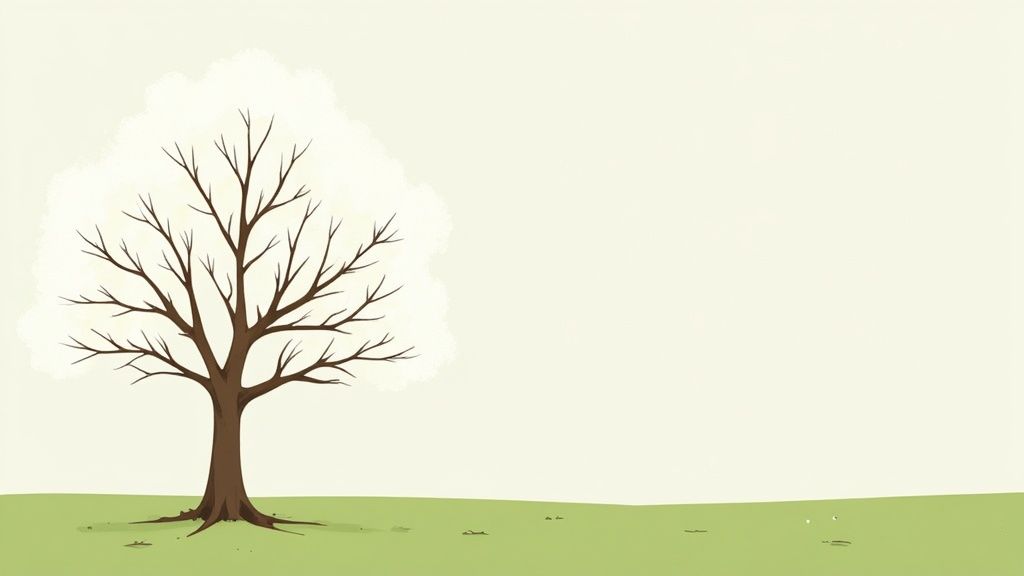
Back in 1964, the U.S. Department of Agriculture introduced the Bradford pear, touting it as the perfect ornamental tree for cities and suburbs. On the surface, it checked all the boxes: it had a pleasing, symmetrical shape, could handle poor urban soil, and its spring flower display was second to none.
But there was a hidden, fatal flaw. Think of it like a skyscraper built too quickly with shoddy materials—it looks impressive for a while, but it’s structurally unsound and destined to collapse. The tree's fast growth is its own worst enemy, creating weak, brittle wood and a dangerously unstable branch structure.
This built-in weakness means the tree almost always self-destructs, often in a dramatic fashion. The very traits that made it so popular are the same ones that lead to its short, problematic life. After decades of widespread planting, homeowners and arborists alike have found that most of these trees barely make it to the 20-year mark before a storm or even their own weight brings them crashing down. If you want to dive deeper, you can learn about the typical lifespan of pear tree varieties from Gardening Know How.
The Bradford pear's story is a classic case of good intentions gone wrong. What was meant to beautify our landscapes ultimately became a liability due to its poor structure and invasive nature.
To give you a quick snapshot of what you're dealing with, here's a rundown of the tree's key characteristics.
Bradford Pear Key Characteristics at a Glance
This table breaks down the essentials, from its short life to its infamous smell.
| Attribute | Details |
|---|---|
| Average Lifespan | 15–25 years, with many failing around the 20-year mark. |
| Growth Rate | Very fast, leading to weak, brittle wood. |
| Mature Height | 30–50 feet tall, but its weak structure makes this height a liability. |
| Flowers | Abundant white blossoms in early spring with a notoriously unpleasant smell. |
| Structural Integrity | Poor. Branches grow at a steep, narrow angle, making them prone to splitting. |
| Invasiveness | Highly invasive; it cross-pollinates and spreads aggressively, choking out native plants. |
As you can see, the initial appeal quickly gives way to a host of problems. In this guide, we'll dig into the specific reasons behind its short lifespan, from its genetic makeup to the environmental factors that seal its fate.
Why Bradford Pears Are Built to Fail
The notoriously short lifespan of a Bradford pear isn’t really about disease or pests. It’s much simpler than that: the tree has a catastrophic design flaw baked right into its DNA. The core of the problem lies in its infamous ‘V-shaped crotches,’ where a bunch of branches all shoot up from the trunk at a really tight, steep angle.
Think about it this way. If you try to glue two pencils together at a wide, open angle, the joint is pretty stable. But if you glue them at a sharp "V," that connection is incredibly fragile and snaps with the slightest pressure. That's exactly what's happening with every Bradford pear.
The Fast Track to Failure
This built-in weakness is only made worse by the tree's ridiculously fast growth. It's not uncommon for them to shoot up 12 to 15 feet in just 8 to 10 years. All that speed produces weak, brittle wood that just doesn't have the density or strength it needs. You can dig into the specifics of their growth patterns in this factsheet from Clemson University.
As those branches get longer and heavier—especially when weighed down by leaves, rain, or a bit of ice—the strain on those already-weak connection points becomes immense.
This image really drives home how quickly the tree moves from a young sapling to its inevitable breaking point.
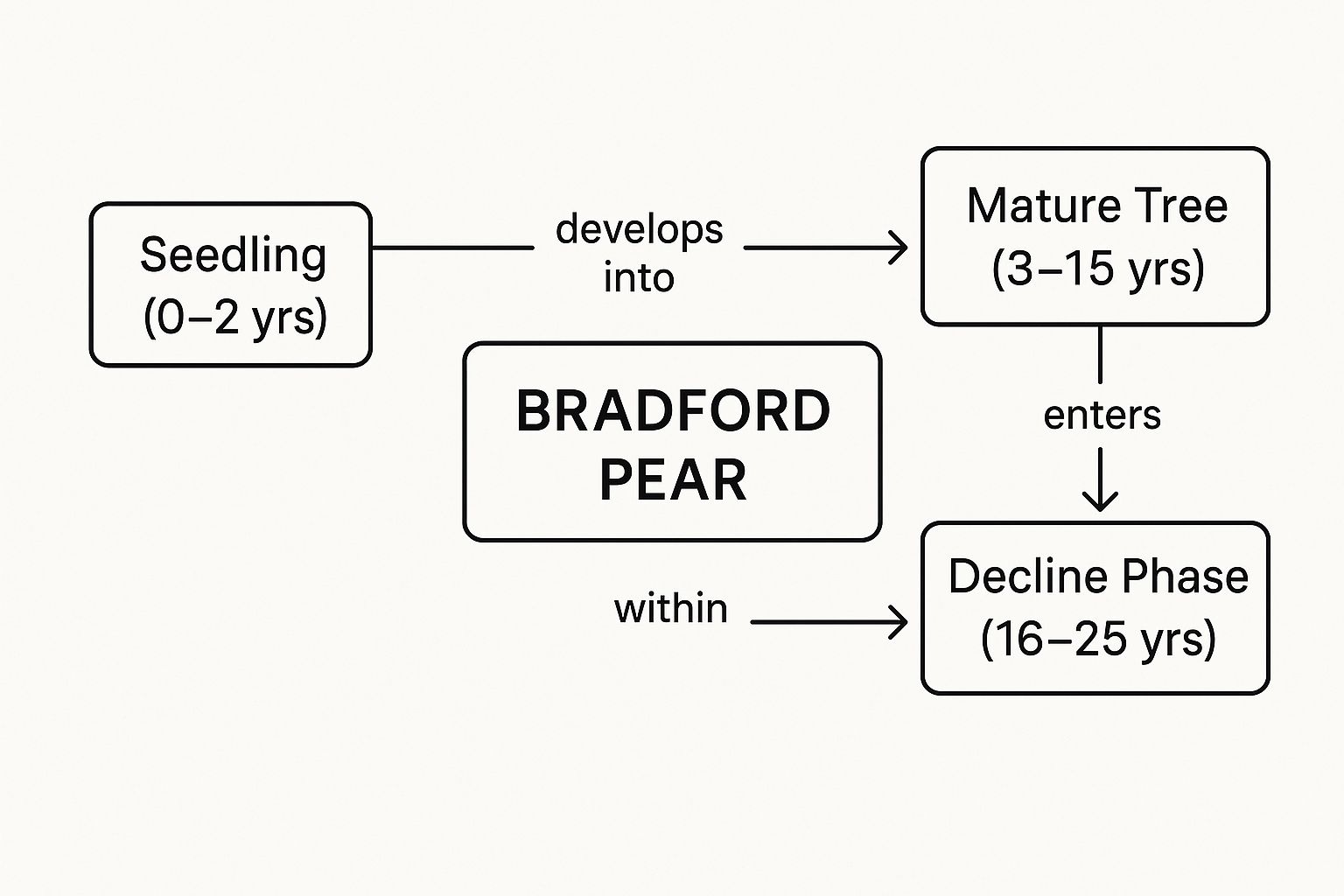
As you can see, the tree spends most of its short life in a state of rapid growth before hitting a swift decline, which is a clear sign of an unsustainable structure.
In essence, the Bradford pear grows too fast for its own good. Its speedy development creates a weak frame that cannot support its own weight over time, creating a perfect storm for structural failure.
When you combine those weak branch unions with heavy, fast-growing limbs, it’s not a question of if the tree will split apart, but when. For trees already showing signs of stress, sometimes professional support systems can buy you a little more time. You can learn more about these methods by looking into tree cabling and bracing services. But honestly, even these are just temporary patches for a tree that was fundamentally built to fail from the start.
Environmental Factors That Accelerate Their Decline
As if their built-in design flaws weren't enough, Bradford pears face a whole host of environmental pressures that can cut their already short lives even shorter. These trees are magnets for certain diseases that love to exploit their fragile state, but one bacterial infection, in particular, is a major culprit.
It's a disease called fire blight, and it’s just as nasty as it sounds. The infection spreads systemically, causing entire branches to turn black and shrivel up as if they were literally scorched by fire. For a tree that's already vulnerable, a fire blight infection can be a rapid death sentence, making it a prime candidate for collapse. Knowing the signs is half the battle, and a good tree disease identification guide can help you catch the symptoms before things get out of hand.
Weather: The Final Executioner
While disease can rot the tree from the inside, the most common reason for a Bradford pear's sudden end comes from the outside. Those weak, V-shaped branch unions are basically a ticking time bomb, just waiting for the right storm to come along.
Severe weather acts as the final executioner for the Bradford pear, exploiting its inherent structural weaknesses with brutal efficiency. A single storm can undo two decades of growth in an instant.
Heavy snow, ice storms, and high winds put an incredible amount of stress on those brittle connection points. The sheer weight and force are often far more than the wood can bear, leading to catastrophic failure. It’s not uncommon to see a Bradford pear literally torn in half after a bad storm, bringing its short life to an abrupt end.
Even the day-to-day struggles add up. Things like poor urban soil, long periods of drought, and constant exposure to pollution take a cumulative toll. A Bradford pear might tolerate these conditions for a while, but they slowly chip away at its health, pushing it ever closer to its inevitable—and often spectacular—collapse.
The Hidden Ecological Cost of Bradford Pears
The structural problems and short Bradford pear lifespan are bad enough, but they're nothing compared to the tree’s devastating ecological impact. The trouble isn't just about one broken tree in a suburban yard; the real damage starts when these trees reproduce, creating a massive environmental headache for all of us.
For years, the Bradford pear was sold to unsuspecting homeowners as a sterile tree, one that couldn't produce fruit or spread. Well, that turned out to be dangerously wrong. While a single Bradford pear can't pollinate itself, it has no problem cross-pollinating with any other Callery pear variety growing nearby—which happens all the time in modern landscapes.
The Rise of an Invasive Offspring
The result of all this cross-pollination is a small, hard fruit. It’s useless to humans, but birds love it. As they eat the fruit and fly off, they scatter the seeds far and wide into forests, fields, and along roadsides. This is how the invasion of aggressive, wild Callery pear trees begins.
These new trees are a far cry from the neat, thornless Bradford pears planted in subdivisions. They revert to their wild, ancestral form, armed with nasty, four-inch-long thorns sharp enough to puncture tractor tires. This makes them a genuine physical hazard to wildlife, livestock, and people.
The story of the Bradford pear serves as a stark warning. It is a cautionary tale of an ecological invader hiding in plain sight, sold as an ornamental beauty while quietly launching a thorny assault on native ecosystems.
This invasive spread has become a serious problem across the country. What was once thought to be a harmless ornamental has, through its ability to cross-pollinate, kicked off a rapid invasion. The resulting seedlings have now spread across 152 counties in 25 U.S. states, creating dense, impenetrable thickets. You can find more details on the Bradford pear's invasive spread on Trees by Jake.
These thorny thickets grow so densely that they form a solid canopy, blocking sunlight from reaching the ground. This effectively chokes out native grasses, wildflowers, and young trees trying to get a start. This process completely destroys the understory habitat that countless insects, birds, and other animals rely on for food and shelter, wrecking entire ecosystems from the ground up.
Smarter Tree Alternatives for Your Landscape
So, you've learned about the Bradford pear's short lifespan and the damage it causes. The good news? You have a ton of better options waiting for you. Picking a replacement isn't just about dodging a bullet; it’s your chance to plant something that will actually improve your yard and help the local ecosystem.
The trick is to go with native species that give you that same burst of spring beauty without the brittle branches and invasive habits. When you ditch the Bradford pear, you’re investing in a healthier, stronger landscape. These alternatives offer gorgeous flowers, solid growth, and become a food source for birds and pollinators, making your yard truly come alive.
Top Native Tree Replacements
Making a better choice is easy with these hardy and beautiful native trees. Each one brings something special to the table that a Bradford pear just can't match.
-
Serviceberry (Amelanchier): This is a fantastic all-season tree. It kicks things off with delicate white flowers in early spring, which turn into edible berries that both you and the local wildlife will love. To top it off, it has stunning orange and red leaves in the fall.
-
Eastern Redbud (Cercis canadensis): A true showstopper. The Redbud is famous for its breathtaking display of pinkish-purple blossoms that cover the branches before its heart-shaped leaves even appear. It grows in a graceful, multi-stemmed shape and lives a much longer, healthier life.
-
Flowering Dogwood (Cornus florida): A classic American beauty for a reason. The Dogwood offers those iconic white or pink bracts (that everyone thinks are petals) in the spring. It also produces berries for birds and wraps up the year with a deep reddish-purple fall color.
-
Hawthorn (Crataegus): If you need a tough, durable tree, this is it. The Hawthorn produces clusters of white flowers and provides dense cover that’s perfect for nesting birds. Its thorny branches can even double as a natural security barrier for your property line.
When considering a replacement, it helps to see how these alternatives stack up against each other. Each tree offers a different combination of lifespan, features, and benefits for your local environment.
Bradford Pear Alternatives Comparison
| Tree Name | Typical Lifespan | Key Features | Native Status |
|---|---|---|---|
| Serviceberry | 40-60+ years | Early spring flowers, edible berries, brilliant fall color, multi-season interest. | Native |
| Eastern Redbud | 50-75+ years | Unique purple-pink blooms on bare branches, heart-shaped leaves, graceful form. | Native |
| Flowering Dogwood | 80+ years | Iconic large "flowers" (bracts), berries for birds, excellent fall foliage. | Native |
| Hawthorn | 50-150+ years | Hardy and tough, dense clusters of white flowers, provides habitat for birds. | Native |
This table makes it clear that you aren't sacrificing beauty or longevity by choosing a native tree. In fact, you're gaining a stronger, more valuable addition to your landscape that will thrive for decades to come.
Choosing a native alternative is a long-term investment in your property's beauty and ecological health. These trees are adapted to the local climate, require less maintenance, and support the web of life in your own backyard.
What to Do If You Have a Bradford Pear
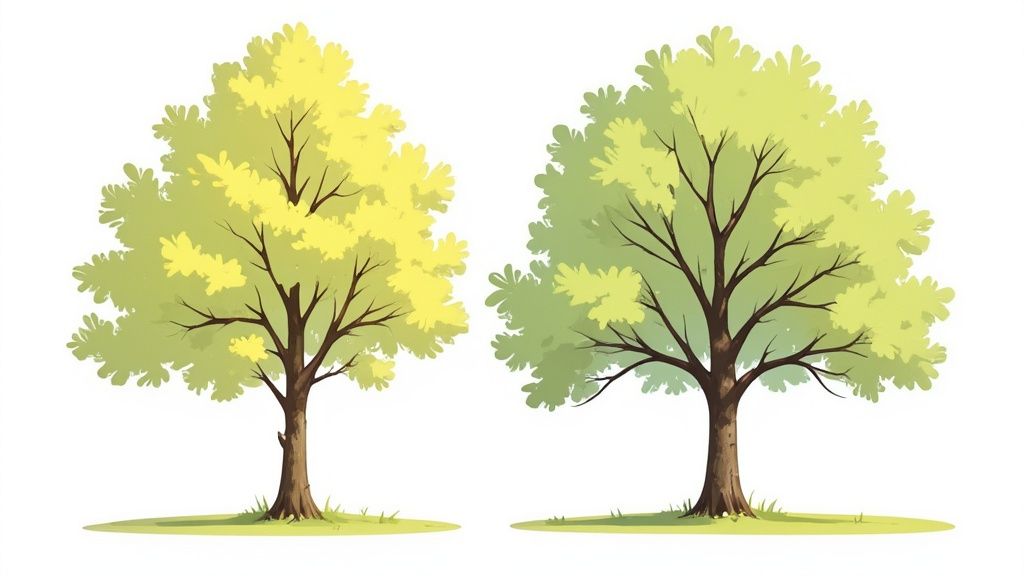
If you’ve got a Bradford pear in your yard, you're certainly not alone. For decades, these trees were planted just about everywhere. Now, you’re left with a decision to make about this ticking clock, with the safety of your property hanging in the balance.
The first and most important step is to figure out the risk. Bradford pears are infamous for their weak branch structure, which turns them into a serious hazard during storms. A sudden split can cause catastrophic damage to your home, cars, or fence lines.
Assessing Your Tree's Health and Risk
While it's tempting to try and prolong your tree's life, you have to be able to recognize the warning signs of failure. It's crucial to be on the lookout for specific red flags that tell you the tree's structural integrity is compromised.
Key warning signs include:
- Deep Cracks: Look for vertical cracks where large branches connect to the main trunk. This is a classic sign of stress.
- Sudden Leaning: If the entire tree starts to lean, especially right after a storm, its root system might be giving up.
- Included Bark: This happens when bark gets pinched in the tight "V" of a branch union. It creates an incredibly weak point just waiting to break.
- Large Fallen Limbs: A tree that has already dropped a major limb is significantly more likely to do it again.
Managing a mature Bradford pear is not a DIY project. Their unpredictable nature and high risk of collapse mean any major pruning or removal requires professional expertise to be done safely.
For a proper evaluation, your best bet is always to consult with a professional. A certified arborist in Atlanta GA can give you a detailed risk assessment and map out the safest course of action. While some structural pruning can sometimes reduce the immediate danger, it can't fix the tree's underlying genetic flaws.
Ultimately, professional removal is often the safest and most responsible long-term solution—both for your property and for the local ecosystem.
Bradford Pear FAQs
Got questions about the Bradford pear on your property? You're not alone. Here are some of the most common things homeowners ask us.
Can a Bradford Pear Actually Live Longer Than 25 Years?
It's possible, but it's a huge gamble and extremely unlikely. Think of the tree's weak structure as a ticking time bomb. With each passing year, the risk of it splitting apart under its own weight—or during the next big storm—skyrockets.
Even with a professional arborist doing everything right, most Bradford pears will suffer a catastrophic failure long before they hit what other tree species would consider middle age.
Is My Bradford Pear a Real Danger to My Property?
Absolutely. It can be a significant hazard. The real danger lies in its notoriously weak branches, which have a nasty habit of snapping without warning and coming down on roofs, cars, fences, or anything else underneath.
If you have a large Bradford pear looming over anything you value, getting a professional risk assessment from a certified arborist isn't just a good idea—it's a crucial step for peace of mind.
If They're So Bad, Why Were These Trees Planted Everywhere?
It's a classic case of good intentions gone wrong. When they were first introduced, they were hailed as the perfect street tree. They shot up incredibly fast, could handle city pollution, and put on a massive flower show in the spring.
Unfortunately, the severe structural flaws and their aggressive, invasive nature only became widely understood after millions had already been planted across the country.
Is a Bradford pear threatening your property? The team at Richmond Tree Experts GA offers professional risk assessment and removal services to keep your home and family safe. Contact us today for a free estimate.
Not sure what your tree needs? Richmond Tree Experts has worked on Marietta and Metro Atlanta trees since 1985, and every job is looked at by an ISA Certified Arborist before it is priced. Start with an ISA Certified Arborist evaluation, or see everything we do: tree removal, stump grinding and arborist services across Cobb, Fulton, Cherokee, Gwinnett and DeKalb counties (service areas).
Call (770) 974-3964, 7am to 11pm every day, or request an estimate online.

