

When a powerful storm rips through Marietta, the sickening crack of a tree limb—or the entire tree—is a sound that instantly triggers alarm. If you're facing a fallen tree on your property, your first priorities are ensuring everyone's safety, documenting the damage for insurance, and calling a professional 24/7 service for emergency tree removal in Marietta.
Acting quickly but safely is the key to preventing a bad situation from getting worse.
When a Tree Emergency Strikes Your Marietta Property
That heart-stopping sound of splintering wood, followed by a ground-shaking thud, is a chaotic moment for any homeowner. It's natural for panic to set in, but a clear, methodical approach is your best defense against making a dangerous situation worse.
The moments right after a tree fails are absolutely critical. Your immediate priority isn't the tree itself—it's the well-being of anyone on the property.
Your First Safety Checks
Before you do anything else, do a quick headcount. Make sure all family members, tenants, and pets are safe and accounted for. You need to instruct everyone to stay far away from the affected area.
Fallen trees can be deceptively unstable and might shift or roll without any warning. But the biggest hidden danger is often downed power lines, which can be easily concealed by tangled branches and debris.
Assume any fallen wire is live and extremely dangerous. If you see downed lines, stay back at least 25 feet and call 911 immediately to report the hazard. That's your first call, before anyone else.
Crucial Takeaway: Never, ever approach a downed tree that is tangled with utility lines. The risk of electrocution is severe. You must wait for emergency personnel and the power company to give the all-clear.
Document and Call for Professional Help
Once you're certain the immediate area is secure and you've reported any urgent hazards, your next job is to document the scene. Grab your smartphone and take extensive photos and videos of the damage from multiple safe angles.
Get wide shots of the entire scene and also close-ups of where the tree has hit your roof, fence, car, or any other structure. This visual evidence is absolutely invaluable when you file your insurance claim.
After you've documented everything, your next call should be to a professional service that specializes in storm-damaged tree removal. Don't even think about trying to cut, move, or dislodge any part of the tree yourself. The tension stored in a fallen tree's limbs can create unpredictable and powerful forces, making any DIY removal attempt incredibly risky.
The simple protocol below is your best guide in a high-stress moment.

This simple flow—Assess, Document, Call—is designed to streamline your response during what is always a stressful event, keeping you safe and moving things forward efficiently. For a quick reference, here's a simple breakdown of what to do.
Immediate Steps for a Fallen Tree Emergency
| Action | Why It's Critical | Who to Contact |
|---|---|---|
| Confirm Everyone's Safety | Your first priority is human and pet safety. The tree can wait. | Family members, tenants |
| Assess for Power Lines | Downed lines pose a lethal electrocution risk. Never approach them. | 911, then your power company |
| Photograph/Video Damage | This documentation is essential for a smooth insurance claim process. | Your insurance agent |
| Call a Professional Arborist | DIY removal is extremely dangerous due to hidden tension and instability. | An ISA-Certified Arborist |
Following these steps methodically will help you navigate the initial chaos safely and set you up for a smoother recovery process.
Why Professional Expertise is Non-Negotiable
Handling tree emergencies is one of the most hazardous jobs in the country. To put it in perspective, tree care workers face a staggering fatality rate of 110 per 100,000 full-time workers. That's about 30 times the national all-industry average. With severe weather events becoming more common here in Georgia, attempting this work without proper training and equipment is a gamble no homeowner should ever take.
Think about how other critical services manage urgent calls. Industries rely on a dedicated emergency restoration answering service to ensure rapid, organized response around the clock. This highlights the importance of 24/7 availability and quick dispatch—hallmarks of any reliable emergency tree service.
A qualified, ISA-certified arborist has the experience and specialized equipment to safely dismantle and remove the tree, all without causing additional harm to your property. It's simply not worth the risk to do it any other way.
Spotting a Dangerous Tree Before It Falls

While our team is always ready to respond, the best emergency is the one that never happens. Learning to spot the subtle warning signs of a high-risk tree lets you shift from a reactive mindset to a proactive one. This approach doesn't just protect your home—it can save you the major stress and expense of an emergency tree removal in Marietta.
Most tree failures aren’t random events. They're usually the final stage of a long-developing problem. Knowing what to look for means you can take control before the next big storm puts your property on the line.
How to Read the Warning Signs
A tree's posture and bark can tell you a lot about its stability. A sudden lean, or one that gets worse over time, is a huge red flag. Check the ground around the base—if the soil is heaving or mounding up on one side, it's a classic sign of root failure. The tree's entire support system is compromised.
The trunk is another critical indicator. Keep an eye out for deep, vertical cracks, cavities, or big patches where the bark is peeling away or missing entirely. These are open invitations for decay and disease, which can hollow a tree out from the inside. It might look healthy from a distance, but its structural integrity could be shot.
Expert Insight: Think of a tree's trunk like a home's foundation. A small crack might not seem like a big deal, but if it deepens or spreads, it points to a fundamental weakness that could lead to total collapse under stress.
Subtle Clues from Top to Bottom
Don't forget to check the very base of the tree. If you see mushrooms or any other fungal growth on the trunk or popping up from the roots, that’s a sure sign of internal decay. Some fungi are more aggressive than others, but their presence always means it's time for a professional look.
Next, look up. Do you see large, dead branches dangling in the canopy? Arborists have a grim nickname for these: "widow-makers," and for good reason. They can snap and fall at any moment, even on a calm day, posing a serious threat to anything underneath. Also, look at how the branches connect to the trunk. A tight, "V"-shaped junction is much weaker and more prone to splitting than a stronger, "U"-shaped one.
A quick checklist of common warning signs:
- Significant Lean: Any tree leaning more than 15 degrees from vertical needs a look.
- Root Problems: Heaving soil, visible decay on exposed roots, or fungal growth.
- Trunk Damage: Deep cracks, hollow spots, or large sections of missing bark.
- Deadwood: Big, dead branches high up in the canopy are a major hazard.
Why You Need a Professional Eye
Trying to diagnose a tree's health yourself can be a dangerous guess. The risks are real and severe. According to the Bureau of Labor Statistics, the tree care industry saw 243 fatalities from 2020-2023, many from falls caused by unexpected tree or branch failure. For a homeowner, that number is a sobering reminder of what can happen when a compromised tree is near your house. You can find more insights into tree care accidents and see why professional evaluation is non-negotiable.
An ISA-certified arborist is trained to perform a detailed tree risk assessment. We see the subtle signs most people miss—like early-stage pest problems or soil compaction that's silently stressing the root system. This proactive evaluation gives you a clear, honest picture of your property's potential hazards, letting you decide on pruning or removal on your own terms, not in the chaos after a storm.
What to Expect During the Removal Process

After you make that urgent call for emergency tree removal in Marietta, it's natural to feel a bit on edge. Knowing what happens next can make a world of difference. A professional crew doesn’t just show up and start cutting; they follow a precise, carefully orchestrated plan to make sure your property is safe from any more damage.
Think of it as a well-oiled operation where safety is the absolute top priority. From the moment the team arrives, their goal is to stabilize the situation and take apart the hazard with surgical precision. This is about more than just getting a tree off your house—it’s about restoring your peace of mind.
The Initial Site Assessment and Safety Plan
The very first thing a professional arborist does isn't firing up a chainsaw. It's conducting a meticulous site assessment. Honestly, this is probably the most critical part of the whole job. The crew chief will walk the property, evaluating the fallen tree, its position relative to your home and other structures, and any potential hidden dangers.
They're looking for things like tension points in the wood, instability in the remaining trunk, and confirming no live utilities are involved. This detailed assessment creates a specific removal strategy tailored to your situation. A massive oak draped over your roof, for example, is a completely different beast than a pine that’s just blocking the driveway.
Based on that plan, the team sets up a secure work zone.
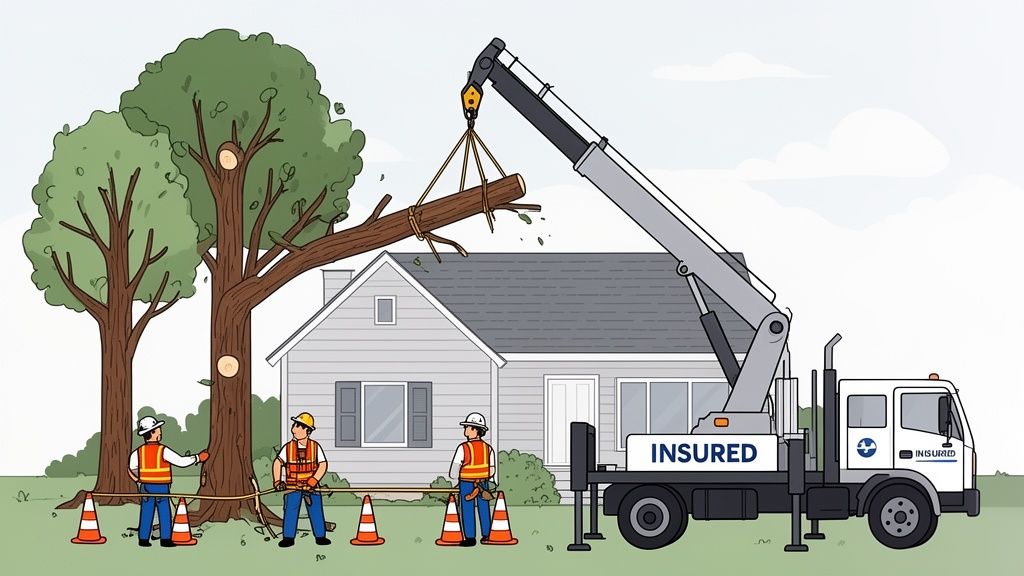
- Safety Perimeters: They'll use cones and caution tape to mark off the area. This keeps family, pets, and curious neighbors out of harm's way.
- Crew Briefing: The whole team huddles up to review the plan, assign roles, and confirm hand signals—especially crucial for complex jobs involving cranes.
- Protective Measures: If heavy equipment is needed, they might lay down protective mats on your lawn to prevent ruts and minimize impact.
Specialized Equipment for Complex Removals
Emergency tree work is no joke. It often means dealing with immense weight in tight spaces, which calls for tools that go way beyond a simple chainsaw. The gear a professional crew brings is what separates a safe, efficient job from a potential disaster.
For trees that have landed on a structure, a crane is often the hero of the day. Cranes allow arborists to lift huge sections of the trunk and limbs straight up. This prevents them from dragging across your roof or siding and causing even more damage on the way down. It's a delicate dance between the crane operator and the climber, working in perfect sync.
Real-World Scenario: Picture a 60-foot water oak that has crashed through your garage. Without a crane, the crew would have to slice it into small chunks while it's still on the roof, risking more structural damage with every cut. With a crane, they can rig large sections, lift them cleanly away, and lower them to a safe spot for processing.
You'll also see a ton of rigging equipment—a whole system of ropes, pulleys, and friction devices. This lets the team control the descent of heavy wood with incredible precision. A skilled crew can lower a 2,000-pound log to the ground as gently as a feather, keeping your lawn, garden beds, and driveway intact.
The Methodical Dismantling Process
With a solid safety plan and the right gear on site, the real work begins. This is a step-by-step dismantling, not a chaotic free-for-all. Climbers might need to ascend parts of the tree still standing to remove dangling "widow-makers," or the ground crew might start by clearing smaller branches to get better access to the main trunk.
Every single cut is deliberate. The arborist is always thinking several moves ahead, predicting how the wood will shift and fall once a piece is removed. This methodical approach ensures the tree's weight is managed constantly, preventing any sudden, uncontrolled movements.
Once all the wood is safely on the ground, the crew shifts to processing it. They’ll cut the trunk and larger limbs into manageable lengths for hauling away and feed smaller branches into a powerful wood chipper. This final step is all about efficiency and leaving your property as clean and clear as possible, paving the way for any repairs you need to make.
Navigating Costs, Insurance, and Cobb County Permits
Once the initial shock of a fallen tree wears off, the practical questions start flooding in. How much is this going to cost? Will my insurance cover it? Do I need some kind of permit? It's completely normal for these financial and logistical worries to take center stage, and getting straight answers can make a stressful situation much more manageable.
There’s no flat rate for emergency tree removal in Marietta; the cost is always a moving target based on the specific mess you're dealing with. Knowing what drives the price will help you understand the quotes you get and spot a fair deal.
Breaking Down the Cost Factors
The biggest variables are always the tree’s size and the sheer complexity of the job. A small Bradford pear that snapped and fell cleanly into the yard is a world away from a massive 80-foot oak that’s now tangled up with your roof and power lines.
Access is another huge cost driver. If our crew can pull the trucks and chipper right up to the tree, the job goes much faster. But if it's tucked away in a tight backyard with no direct access, it means more manual labor or even bringing in a crane, which will increase the price. And, of course, a call at 2 a.m. on a holiday weekend is going to be priced differently than one on a Tuesday afternoon.
Here’s a quick rundown of what shapes your final quote:
- Tree Size and Type: Bigger, heavier trees take more time and more powerful equipment to handle.
- Location and Accessibility: Is the tree leaning on your house, tangled in utility lines, or just lying in an open field?
- Equipment Needed: A job that requires a crane is a much bigger operation than one a ground crew can manage alone.
- Urgency: After-hours and holiday calls naturally come with a premium to get a crew mobilized immediately.
Working with Homeowner's Insurance
Your homeowner's insurance policy is your best friend when facing the unexpected cost of a tree emergency. In most situations, if a tree falls on a covered structure—your house, garage, shed, or even a fence—your policy should cover the cost of removing the tree off that structure, plus the repairs.
But every policy is different. For example, if a tree falls in your yard but doesn't damage anything, the removal probably won't be covered. The minute you and your family are safe, your next call should be to your insurance agent to clarify your coverage and get the claims process rolling. They'll tell you exactly what paperwork they need, which is why taking all those photos and videos is so critical.
Key Takeaway: Insurance typically pays to get the tree off a structure. Debris cleanup and hauling from the yard often have different coverage limits or may not be included at all. You have to ask your agent for the specifics.
For a deeper dive, check out our guide on tree removal insurance coverage. It’s a great resource for learning what questions to ask your agent.
Do You Need a Permit in Cobb County?
Navigating local rules is another headache you shouldn't have to deal with, and that's where a professional service comes in. Both Cobb County and the City of Marietta have tree ordinances designed to protect our local canopy.
The good news is that in a true emergency—when a tree is dead, dying, or hazardous and poses an immediate threat—a permit is almost never required for its removal.
That said, specific rules can sometimes depend on the tree's size and where it is on your property. Any reputable tree service will know the local regulations inside and out. We can tell you if any paperwork is needed and handle the whole process for you, making sure everything is done by the book. Understanding the complete Homeowner Insurance Claim Process can also help you smoothly navigate the aftermath, ensuring you've covered all your bases from cleanup to getting paid.
When a tree comes crashing down, your first instinct is to find someone—anyone—to make the problem disappear. Fast. But in that moment of chaos, the decision you make can be the difference between a smooth recovery and a costly nightmare.
Choosing the wrong company can lead to shoddy work that puts your home at further risk, property damage from careless crews, or even falling for a predatory scam. It’s not just about hiring someone with a chainsaw. It’s about trusting a team with the safety of your home, and a quick, five-minute check on their credentials can save you thousands of dollars and a world of frustration.
The Non-Negotiable Qualifications
Before you even think about agreeing to any work, a legitimate tree service must have proof of two non-negotiable types of insurance. The first is general liability insurance, which protects your property from any damage the crew might accidentally cause. The second, which is just as critical, is worker's compensation insurance.
Why is worker's comp so important? Without it, if a crew member gets injured on your property, you could be held liable for their medical bills. Never, ever just take a company’s word for it. Ask to see the actual insurance certificates and make sure they are current. Any hesitation to show you their paperwork is a massive red flag.
Another key qualifier is having an ISA Certified Arborist on the team. This certification isn't just a piece of paper; it’s the gold standard in the tree care industry. It proves an individual has a deep understanding of tree biology, advanced safety protocols, and the right techniques for complex removals. You can learn more about why hiring a certified arborist in the Atlanta area is so crucial, especially when an expert assessment can prevent even more damage.
Expert Insight: An ISA Certified Arborist doesn't just cut—they analyze. They can read the subtle stress fractures in a damaged tree, predict how it will behave under pressure, and develop the safest plan to bring it down without harming your home.
Red Flags That Scream Stay Away
After a big storm rolls through, shady operators known as "storm chasers" often flood neighborhoods like Marietta. They prey on anxious homeowners, using high-pressure tactics to exploit the urgency of the situation. Knowing how they operate is your best defense.
Be immediately skeptical of anyone who just shows up at your door unsolicited. Real, professional companies are usually slammed with calls from existing clients and don't have time to go door-to-door. These pop-up outfits often lack proper insurance, training, and equipment, putting your property at serious risk.
Keep an eye out for these common storm chaser tactics:
- Demanding huge upfront payments: A reputable company might ask for a reasonable deposit, but a demand for the full amount—especially in cash—before the work is done is a huge warning sign.
- Suspiciously low bids: If a quote seems too good to be true, it is. Lowball offers almost always mean the company is cutting corners on something important, like insurance or skilled labor.
- High-pressure sales tactics: Anyone trying to rush you into a decision with claims like "this special price is only good for today" does not have your best interest at heart.
- No local presence: Ask for a local office address and a local phone number. Many storm chasers are from out of state and will be long gone by the time you discover issues with their work.
Vetting a Company in Minutes
Even when you're in a hurry, you can vet a company surprisingly quickly. A simple online search for their company name plus "reviews" will tell you a lot. You want to see a consistent history of positive feedback from local customers. A company with a strong, long-standing reputation in communities like Marietta, Roswell, and East Cobb is a much safer bet than a complete unknown.
Take a look at their website. Do they have photos of their actual team and equipment? Do they look professional? Do they proudly list their credentials, like an ISA certification number? These little details show a real commitment to quality and transparency. Taking these few extra minutes ensures the team you hire for your emergency tree removal in Marietta is one you can actually trust.
Common Questions About Emergency Tree Removal
When you're staring at a tree that's just crashed onto your property, your mind is probably racing with a thousand questions. It's an overwhelming situation, and getting clear, straightforward answers is the first step to feeling in control again.
We've been doing this a long time, so we've heard just about every question in the book. Here are the answers to the most common ones we get from homeowners in Marietta.
How Much Does Emergency Tree Removal Cost in Marietta?
This is always the first question, and the honest answer is: it depends entirely on the situation. There's no flat rate for chaos.
A smaller tree that fell cleanly in an open yard might start around $1,500 for an urgent call-out. But if we're talking about a massive, mature oak that has smashed through your roof and needs a crane to be lifted out safely, the cost can easily climb past $5,000. The final price is a direct reflection of the risk, the number of crew members needed, and the heavy equipment required to do the job right.
Several key factors will shape your final quote:
- Tree Size and Weight: A monster of a tree simply requires more manpower, more time, and bigger machinery to dismantle and haul off.
- Location and Complexity: Is the tree tangled in power lines? Is it precariously balanced on your roof? Is it wedged in a tight backyard with no access? These complex scenarios are far more challenging than a simple takedown in an open field.
- Equipment Needs: If the job calls for a crane, aerial lifts, or other specialized machinery, those costs are factored into the project.
- Time of Call: Getting a full crew mobilized in the middle of the night or on a holiday weekend understandably comes at a premium.
Before any work starts, you should always have a detailed, written estimate in your hands. Be very skeptical of any quote that seems way too good to be true—it's often a red flag for a company that is cutting corners on insurance or doesn't have the right experience.
Will My Homeowner's Insurance Cover a Fallen Tree?
More often than not, yes. This is exactly the kind of disaster that homeowner's insurance is designed for. If a tree—whether it was yours or your neighbor's—lands on a covered structure on your property, your insurance should step in. This usually includes your house, a detached garage, a shed, or even a fence.
Most policies will cover the cost of removing the portion of the tree that is physically on the structure, plus the cost to repair the building itself. The key phrase to remember is "from the structure."
Important Insurance Detail: Here's where it can get a little tricky. While your policy will pay to get the tree off your roof, it might have a separate, much lower limit for hauling all the wood and debris away. And if a tree falls in your yard but doesn't hit anything, the removal cost is often not covered at all.
Your first move should be to document everything with photos and videos (from a safe distance!) and then call your insurance agent immediately. They'll walk you through your specific policy and get the claims process started for the emergency tree removal your Marietta home needs.
How Quickly Will an Emergency Tree Crew Arrive?
A true emergency tree service runs 24/7, because storms and falling trees don't care about business hours. Any reputable company will prioritize calls where a tree is an immediate safety hazard or has breached the security of a home—like punching a hole right through the roof.
In those truly urgent scenarios, a crew can often be on-site within just a few hours. That quick response is critical to prevent even more damage from rain and exposure.
Of course, after a major storm rolls through and causes widespread damage across Marietta and Cobb County, response times can get stretched due to the sheer volume of calls. A professional company, however, will always give you a realistic ETA and keep you in the loop. You should never be left guessing when help will finally arrive.
What Is an ISA Certified Arborist and Why Is It Important?
Think of an ISA Certified Arborist as a board-certified specialist in the tree world. They aren't just "tree guys"; they are professionals who have proven their deep knowledge of tree care by passing a rigorous exam and documenting extensive experience in the field.
In an emergency, that certification isn't just a fancy title—it's your best guarantee of safety and expertise.
An arborist's role is critical because they can:
- Accurately assess risk. They see things an untrained eye would miss, like hidden stress fractures in the wood or an unstable root ball that could shift unexpectedly.
- Develop the safest removal plan. They map out the precise sequence of cuts to dismantle the tree methodically, ensuring no further damage is done to your property.
- Understand tree physics. They know how a tree under immense tension will react when cut, which is essential for preventing catastrophic accidents.
Hiring a company that has ISA Certified Arborists on staff is the single best thing you can do to protect your property and ensure a highly dangerous job is managed by genuine professionals.
When you're facing a tree emergency in Marietta, Roswell, East Cobb, or the surrounding areas, you need a team you can trust to respond quickly and work safely. Contact Richmond Tree Experts GA for 24/7 emergency services from ISA Certified Arborists. https://richmondtree.com
Need a tree taken down safely? Richmond Tree Experts has worked on Marietta and Metro Atlanta trees since 1985, and every job is looked at by an ISA Certified Arborist before it is priced. Start with tree removal, or see everything we do: tree removal, stump grinding and arborist services across Cobb, Fulton, Cherokee, Gwinnett and DeKalb counties (service areas).
Call (770) 974-3964, 7am to 11pm every day, or request an estimate online.

