

Oak wilt is a silent, creeping threat to the iconic oak trees across the Atlanta area, from Cumming to Milton. If you only remember three things, let them be these: avoid pruning from spring to mid-summer, handle any firewood with extreme care, and know exactly when to call a certified arborist for help.
Think of this as your proactive game plan to protect what is likely one of your property's greatest and most beautiful assets.
Understanding the Oak Wilt Threat
In neighborhoods like Johns Creek and Roswell, oak trees aren't just part of the scenery; they're majestic, long-living landmarks that define a property's character. But a devastating fungal disease, first identified way back in 1942, is putting all of that at risk. It’s called oak wilt, and this pathogen is an efficient, often rapid killer, giving homeowners precious little time to react once the first signs appear.
The fungus, Bretziella fagacearum, works by essentially clogging up the tree's vascular system. It's like a blockage in the tree's arteries, cutting off the flow of water and nutrients from the roots all the way up to the canopy. This internal shutdown is what leads to the classic wilting symptoms that give the disease its name. Once an infection gets a foothold, the outcome can be both severe and incredibly fast.
A Rapidly Spreading Concern
This isn't just a local headache; it's a growing national crisis. As of 2023, the disease had spread to 24 U.S. states, causing widespread devastation. To give you some perspective, in Minnesota alone, over 266,000 oak trees were lost to infection between 2007 and 2016. That's a staggering number that really highlights its destructive power.
The urgency is even higher for certain types of oaks. You can learn more about the national effort to combat this disease and see how researchers are tracking its relentless spread.
- Red Oaks: Highly susceptible species like Shumard, Pin, and Northern Red Oaks are extremely vulnerable. Once infected, they can die in as little as a few weeks. For these trees, an infection is almost always a death sentence.
- White Oaks: On the other hand, species like White, Post, and Bur Oaks tend to be more resistant. They might be able to fight off the infection for several years, showing a much slower decline, but even for them, there's no guaranteed cure.
Because there is no cure for oak wilt, prevention is the only effective strategy. Understanding how this disease moves from tree to tree is the first real step in building a powerful defense for your property.
How Oak Wilt Spreads in Your Neighborhood
The fungus has two primary ways of traveling, which makes it a particularly tough adversary. The first route is through tiny sap-feeding beetles. These little insects are drawn to fresh wounds on oak trees—the kind left by pruning, storm damage, or construction nicks. If a beetle has recently fed on an infected tree, it can carry fungal spores on its body and deliver them right into the next healthy, wounded tree it visits.
The second, and arguably more insidious, method of transmission is completely hidden underground. Oak trees growing close to each other, a common sight in Forsyth and Gwinnett County yards, often fuse their root systems together. This process, known as root grafting, creates a subterranean superhighway for the fungus. It can travel directly from an infected tree to its healthy neighbors, completely bypassing any above-ground signs of trouble until it’s far too late.
Recognizing the Early Warning Signs
Knowing what to look for is more than half the battle—it's the critical first step in protecting your property. Spotting the subtle but urgent symptoms of oak wilt, especially in its early stages, can make all the difference. This is your field guide for identifying the key warning signs, with specific advice for homeowners in Alpharetta, Marietta, and surrounding Atlanta suburbs.

The disease hits different oak species in drastically different ways. Red oaks and white oaks react on completely separate timelines, which can be deceptive if you don't know what you're looking for. Getting a handle on these distinctions is crucial for an accurate assessment out in the yard.
Red Oak Symptoms: A Rapid Decline
For trees in the red oak family (like Shumard, Pin, and Northern Red Oaks), the signs are dramatic and frighteningly fast. An infection can cause a tree to go from seemingly healthy to near-death in just a few weeks. You have to keep a sharp eye out for these specific indicators.
- Rapid Leaf Discoloration: Look for a distinct bronzing or dull tan color that often starts at the very top of the leaf margin and works its way inward and downward. It’s not the gentle yellowing of autumn; it's a sick, scorched look.
- Widespread Wilting: The entire canopy can appear to wilt suddenly, almost as if it's suffering from extreme drought, even if you've been watering it.
- Sudden Leaf Drop: An infected red oak will shed its leaves prematurely and rapidly. Finding a carpet of dead or dying leaves under your tree in July is a massive red flag.
Imagine you're in Johns Creek and you notice your beautiful Shumard red oak is suddenly looking thirsty in mid-summer. Its upper leaves turn a sickly bronze, and within two weeks, most of them are on the ground. This is a classic real-world scenario pointing directly to oak wilt, not just simple summer stress.
White Oak Symptoms: A Slower, Deceptive Fade
White oaks (including White, Post, and Bur Oaks) are much more resistant, and their symptoms progress slowly and are far more localized. This slow decline can easily mislead homeowners into thinking the issue isn't as severe as it truly is.
The signs in white oaks often mimic general decline or stress from other factors, making them tough to diagnose without professional help.
A key takeaway for white oak owners is that symptoms often appear on just one or two branches at a time. This isolated "flagging"—where a single branch dies off while the rest of the tree looks relatively healthy—can persist for years as the disease slowly advances.
Instead of a rapid, full-canopy collapse like you see in red oaks, you might just see scattered branch dieback over several seasons. While this gives you more time to act, it also makes those initial signs much easier to dismiss as "no big deal."
For a more detailed look at various tree health issues, our comprehensive tree disease identification guide can help you distinguish between the different problems that could be affecting your landscape. Acting early, even on subtle clues, is absolutely essential to prevent oak wilt from spreading.
Smart Pruning to Avoid Oak Wilt Infection
If there's one mistake I see homeowners make that unintentionally invites oak wilt onto their property, it's pruning at the wrong time of year. It’s a simple misstep, but it can have devastating consequences. To keep your oaks safe, you have to understand the critical link between a fresh tree wound, the season, and the tiny insects that act as the disease's personal couriers.
Every single cut you make on an oak releases sap. That sap gives off a specific scent that sap-feeding beetles find absolutely irresistible. These little guys are the main culprits in spreading oak wilt spores from infected trees to healthy ones. When they land on a fresh pruning cut to feed, they can transfer the deadly fungus directly into the tree's vascular system.
This is why your pruning calendar isn't just about what looks good; it's a core part of your tree's defense strategy.
The Golden Rule of Oak Pruning in Georgia
For those of us in Atlanta and surrounding suburbs like Cumming, Johns Creek, and Roswell, there's one rule you need to commit to memory: avoid pruning oaks during the high-risk season. This period runs from early spring through mid-summer, which is exactly when beetle populations are at their most active and destructive.
To be specific, the golden rule is to dodge any pruning from April through July. This isn't just a suggestion; research has confirmed this window accounts for a staggering 80-90% of new infections that start from fresh wounds. This is prime time for sap beetles, as they swarm and carry spores from the fungal mats growing on dead or dying trees. You can discover more insights about these critical findings to see just why this timing is so crucial.
The safest time to get your pruning done is when your trees are dormant.
- Your Golden Window: The period from November to March is ideal. In these colder months, the sap-feeding beetles are inactive and the trees aren't actively growing, making it the perfect time for structural work or thinning out the canopy without putting your trees at risk.
For a broader look at seasonal tree care, you might find our guide on the best time to prune trees helpful, as it provides context for other species as well.
A simple calendar reminder can be one of the most effective tools in your oak wilt prevention toolkit. Mark April 1st as your "no-prune" start date and November 1st as your "safe-to-prune" date to stay on track.
This tiny bit of scheduling can save your magnificent oaks from completely unnecessary exposure to this terrible disease.
Responding to Unplanned Tree Wounds
Of course, life doesn't always stick to a neat schedule. A summer thunderstorm can snap a heavy branch, or a contractor might accidentally gash a trunk—all during the high-risk months. So, what do you do when your oak gets wounded in May or June?
The key is to act fast. Don't leave a fresh, weeping wound exposed to the open air for even a few hours.
If a branch breaks or the trunk is gashed during beetle season, you need to create a physical barrier right away. The most straightforward and effective method is to seal the wound. You can use a commercial tree wound paint or even just some basic latex-based paint you have in the garage. The color is irrelevant; the goal is simply to cover the exposed wood to stop the sap from leaking and mask its scent.
Example Scenario
Imagine a heavy thunderstorm rolls through your Marietta neighborhood in June and tears a large limb right off your prized red oak.
- Assess the Damage: As soon as it's safe to go outside, check the tree.
- Make a Clean Cut (If Necessary): If the break left a jagged, shredded mess, you'll want to make a clean, smooth cut. This helps the tree compartmentalize the wound and heal more effectively.
- Seal Immediately: Within the hour, apply a thin layer of tree wound dressing or paint over the entire surface of the cut. This simple, quick action is like putting up a "No Vacancy" sign for disease-carrying beetles.
This kind of emergency response is a critical skill for any oak owner. It can turn a potentially catastrophic event into a manageable one. By sealing that wound, you're protecting your tree until the dormant season arrives, giving it a fighting chance. It's a small step that provides a massive amount of protection when you need it most.
Stopping the Underground Spread Between Trees
While we often focus on threats we can see—like storm damage or pests chewing on leaves—one of oak wilt’s sneakiest attacks happens completely out of sight. The disease travels silently and quickly underground through a massive, interconnected network of roots. This is a huge problem in the beautiful oak groves common throughout Atlanta's suburbs, from East Cobb all the way to Cherokee County.
What most homeowners don't realize is that oaks of the same species growing close together often fuse their root systems. This process, called root grafting, essentially creates a shared circulatory system, turning a group of individual trees into one super-organism. So when one tree gets infected, the fungus has a direct, open highway to all its neighbors.
It's a devastating domino effect. A single sick tree can start a chain reaction that systematically wipes out an entire line of mature, healthy oaks before you even spot the first wilting leaf. This is exactly why professional intervention is crucial to stop the disease dead in its tracks.
Severing the Connection with Trenching
To halt this underground invasion, arborists use a powerful technique called trenching. It’s a purely defensive move that physically severs the root connections between infected and healthy trees, creating a protective barrier. We use a specialized machine, like a vibratory plow or a rock saw, to cut a deep, narrow trench in the soil—usually about four to five feet deep.
This cut creates an isolation zone, breaking the very network the fungus needs to travel. It's a surgical strike aimed at saving your valuable, healthy trees from an infection creeping its way toward them.
The visual guide below breaks down the simple but critical protocol for preventing those initial infections that often kickstart a much bigger problem.

This process shows just how straightforward safe pruning can be: make the right cut, immediately seal the wound, and stay away from the work during high-risk seasons. Sticking to this protocol is your best first line of defense against the beetle-borne infections that can trigger a widespread outbreak.
Why Trenching Is a Professional Job
Let me be clear: trenching is absolutely not a DIY project. The success of this entire strategy hinges on perfect placement and depth, which requires a real understanding of tree biology and some serious, specialized equipment. An ISA Certified Arborist will map out the trench line with precision to isolate the disease without causing unnecessary harm to the very trees you're trying to protect.
Here’s why you need to call a pro:
- Accurate Placement: The trench has to be in exactly the right spot. It needs to be far enough from the infected tree to be ahead of the fungal spread, but close enough to the healthy trees to shield them. Being off by just a few feet can make the whole effort worthless.
- Avoiding Utilities: Professionals know how to locate and work around underground utility lines—gas, water, electrical. Hitting one of those is not just expensive, it's incredibly dangerous.
- Proper Depth: The trench must be deep enough to cut through all potential root grafts. A shallow trench is like building a wall that the enemy can just tunnel under. Research confirms most grafts happen within the top 50 inches of soil, which dictates how deep we have to go.
Trenching is a significant investment, but you have to think of it as an investment in the long-term survival of your landscape. For historic or high-value oaks in neighborhoods like Milton or Alpharetta, it's often the only realistic way to contain an outbreak and prevent catastrophic losses.
By physically disrupting that root system, you are drawing a line in the sand that the oak wilt fungus simply cannot cross. It's a powerful tool that, when paired with smart pruning and fungicide treatments, creates a truly robust defense against one of the biggest threats to our local urban canopy.
Using Fungicide Injections for Proactive Defense
For your most prized trees—that towering oak that’s been a landmark on your property for decades or the healthy ones right next door to a confirmed outbreak—a purely defensive strategy might not feel like enough. This is where you bring in the heavy hitters: proactive measures like preventative fungicide injections. Think of it as a vaccine for your high-value, uninfected oaks.
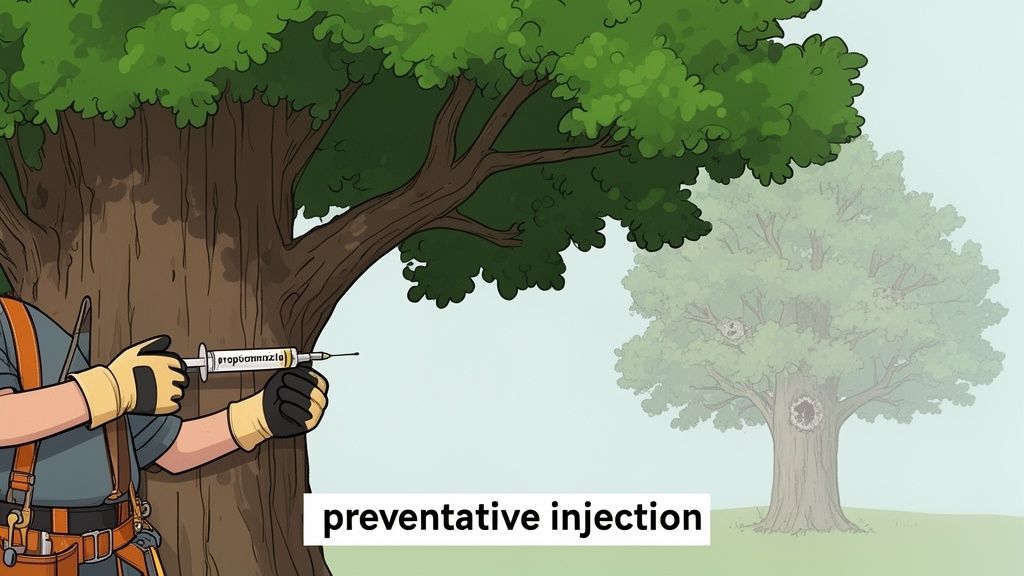
The approach is straightforward but highly technical. A systemic fungicide gets introduced directly into the tree's vascular system, giving it an internal shield that protects it from the inside out. As the fungicide is absorbed and distributed throughout the tree, it can stop the oak wilt fungus dead in its tracks if it’s ever introduced.
Let’s be crystal clear about one thing: this is not a cure for an already-infected tree. It’s a powerful shield for healthy oaks that are at a high risk of exposure.
How Propiconazole Injections Work
The go-to fungicide for this kind of preventative work contains the active ingredient propiconazole. An ISA Certified Arborist uses a specialized micro-injection system to deliver a precise dose right into the tree's flare roots or lower trunk. This method is key because it ensures the fungicide is quickly taken up into the tree's water-conducting tissues, the xylem.
Once inside, propiconazole gets to work. It won't necessarily stop spores from entering a fresh wound, but it effectively prevents the fungus from colonizing the tree's vascular system. It’s like having an internal bodyguard that intercepts the disease before it can do any real damage. These treatments typically provide solid protection for up to two years, after which a re-application might be needed to keep that defensive barrier strong.
Identifying the Best Candidates for Treatment
Fungicide injections aren't for every oak on your property. This is a specialized, professional-grade treatment we reserve for specific situations where the risk is high and the tree's value justifies the investment. An arborist will help you assess your property, but generally, the best candidates fall into a few categories:
- High-Value Trees: That irreplaceable, historic oak that’s the centerpiece of your landscape.
- Neighboring Healthy Oaks: Healthy trees standing within 50-100 feet of a confirmed oak wilt infection.
- Trees Inside a Trench Line: Oaks on the "safe" side of a recently installed root-graft barrier, giving them an extra layer of protection.
This treatment really shines when it’s part of a bigger plan. For instance, in a dense oak stand in Alpharetta, an arborist might recommend trenching to sever root connections and then applying fungicide injections to the most valuable healthy trees inside that protective line.
This two-pronged attack combines physical isolation with chemical protection, offering the strongest possible defense against the silent, underground spread of oak wilt. It’s a strategic investment in preserving the health and beauty of your most cherished trees for years to come. Because this job requires specialized equipment and a deep understanding of tree biology, it should always be handled by a qualified, ISA Certified Arborist.
Oak Wilt Prevention Methods Compared
Deciding on the best way to protect your oaks can feel overwhelming. Each strategy has its own place, depending on your property's specific situation, the value of your trees, and your budget. This table breaks down the primary prevention methods to help you make an informed decision.
| Method | Best For | Cost | Effectiveness | Professional Help Needed? |
|---|---|---|---|---|
| Proper Pruning | All oak trees as a baseline preventative measure. | Low (if DIY) to Moderate | High for preventing beetle spread | Recommended for large trees |
| Sanitation | Properties with infected trees that need removal. | Moderate to High | Crucial for stopping local spread | Yes, for safe removal/disposal |
| Root Graft Trenching | Dense oak stands where underground spread is likely. | High | Very high for stopping root spread | Yes, absolutely |
| Fungicide Injections | High-value, healthy oaks near a known infection. | Moderate to High | High for individual tree protection | Yes, must be an ISA Arborist |
Ultimately, the most effective oak wilt prevention plans often combine multiple strategies. For homeowners in areas like Cumming, Johns Creek, or Roswell, where mature oaks are a defining feature of the landscape, a consultation with a local arborist can help you build a customized defense plan that makes sense for your property and protects your trees for the long haul.
When to Call a Certified Arborist in Atlanta
Knowing the theory behind oak wilt prevention is one thing, but taking decisive action is what actually saves trees. You can do the pruning and sanitation yourself, and those are great first steps. But some situations just demand a higher level of expertise.
Recognizing those moments—and knowing when it’s time to pick up the phone—is a critical part of protecting your oaks. A professional consultation isn't just about fixing a problem after it starts; it's an investment in your property's long-term health and value. An ISA Certified Arborist brings a trained eye and specialized tools to the table, creating a strategic plan that goes far beyond basic weekend maintenance.
Key Triggers for a Professional Consultation
So, when do you switch from DIY prevention to calling in the pros? For homeowners in the Atlanta suburbs like Milton, Marietta, and throughout Forsyth County, a few key scenarios should be immediate red flags.
- You Spot Potential Symptoms: If you notice any of the warning signs we've talked about—like the rapid browning of leaves on a red oak or branch dieback on a white oak—don't wait and see. Oak wilt can easily be mistaken for less severe issues like simple drought stress, and getting an early, accurate diagnosis is everything.
- A Neighbor Has a Confirmed Case: The moment oak wilt is confirmed nearby, your trees are at high risk. The danger comes from both the beetles that spread the fungus and the interconnected root systems underground. An arborist can assess the immediate threat and recommend proactive measures, like preventative fungicide injections.
- Construction Is Planned Near Your Oaks: I've seen it happen too many times. Heavy equipment damages trunks, compacts the soil around the roots, and creates the kind of wounds and stress that make trees vulnerable. A pre-construction chat with an arborist can help establish clear tree protection zones and prevent accidental damage during the high-risk season.
- A Storm Causes Damage During High-Risk Months: When a summer storm snaps a limb between April and July, it’s an open invitation for fungus-carrying beetles. A professional can properly prune the damaged area and make sure the wound is treated correctly to prevent an infestation.
Partnering with a trusted local expert is your best defense against this devastating disease. An arborist offers peace of mind, ensuring your prevention strategy is based on proven science and built for your specific property.
What to Expect from a Certified Arborist
When you bring in a professional, they won't just look at a single tree in isolation. They evaluate your entire property, taking into account the species, age, and proximity of your oaks to one another.
From there, they’ll build a complete health management plan. This might include soil testing to check for nutrient deficiencies, setting up a schedule for preventative treatments, or even planning a trench to create a root graft barrier between your trees and a known infection source.
For those of us in the Atlanta area, finding a qualified professional is the most important step you can take. You can learn more about the benefits of working with a certified arborist in Atlanta, GA and see how their expertise can protect your landscape's most valuable assets. Think of them as your on-call tree doctor, ready with the diagnosis and treatment needed to keep your oaks thriving for generations.
Your Top Questions About Oak Wilt Answered
Homeowners across the Atlanta area often call us with pressing questions about their oak trees. It's a stressful situation, and you need clear, straightforward answers. Here are some of the most common questions we get, with practical advice to help you protect your property.
Can I Save an Oak Tree That Already Has Oak Wilt?
This is the toughest question we have to answer, and unfortunately, the news usually isn't good. For a red oak, an oak wilt infection is almost always a death sentence, sometimes in as little as a few weeks. Once the fungus takes hold in these highly susceptible trees, there's currently no cure.
White oaks, on the other hand, are a different story. They have more natural resistance and can sometimes battle the disease for years. Even so, they will still face a slow, gradual decline. The best approach, bar none, is prevention—stopping the fungus before it ever gets a foothold.
Is It Safe to Use Mulch From an Infected Tree?
Using wood chips or mulch from a tree that died from oak wilt is a huge gamble. The fungus can stay alive in the wood for up to a year, and the sap-feeding beetles that spread it can easily emerge from an infected log or woodpile, ready to find their next victim.
To be completely safe, wood from an infected tree must be handled with extreme care. The only sure ways to eliminate the threat are to burn it on-site (where local ordinances permit), bury it deep underground, or have it professionally chipped and composted at high temperatures to kill the fungus for good.
How Far Can Oak Wilt Spread Through the Roots?
This is oak wilt’s most dangerous trick. The fungus travels silently underground through interconnected root systems, called root grafts, which are incredibly common when oaks of the same species grow near each other.
This underground highway for the disease typically connects trees within 50 to 100 feet of one another. This is exactly why trenching to sever those root connections is a critical containment strategy in the dense oak stands we see all over Forsyth, Gwinnett, and Cobb counties. Creating that physical barrier is the only way to stop the invisible spread from one tree to the next.
At Richmond Tree Experts GA, our ISA Certified Arborists have the local knowledge and hands-on experience to diagnose and manage oak wilt threats across the Atlanta area. If you're concerned about the oaks on your property in Cumming, Johns Creek, or anywhere nearby, contact us for a professional consultation. Let's protect your property's most valuable living assets together.
Not sure what your tree needs? Richmond Tree Experts has worked on Marietta and Metro Atlanta trees since 1985, and every job is looked at by an ISA Certified Arborist before it is priced. Start with an ISA Certified Arborist evaluation, or see everything we do: tree removal, stump grinding and arborist services across Cobb, Fulton, Cherokee, Gwinnett and DeKalb counties (service areas).
Call (770) 974-3964, 7am to 11pm every day, or request an estimate online.

